Private Lives
38 pages • 1-hour read
Noël CowardPrivate Lives
A modern alternative to SparkNotes and CliffsNotes, SuperSummary offers high-quality Study Guides with detailed chapter summaries and analysis of major themes, characters, and more.
Important Quotes
“SIBYL. Oh, darling, I’m so sorry. (She holds her face up to his.) Kiss me.
ELYOT (doing so). There.
SIBYL. Ummm, not so very enthusiastic.
ELYOT (kissing her again). That better?
SIBYL. Three times, please, I’m superstitious.”
(Act 1, Page 6)
Initially presented as a stereotype of youthful naivety, Sibyl is more perceptive than she initially appears, as her uneasiness points to the reality that all is not right in their marriage. Elyot’s obliging but uninitiated kisses signify his disinterest in his new wife, and Sibyl’s claim to be “superstitious” is an instance of wordplay evoking the aurally similar “suspicious.”
“We made each other miserable.”
(Act 1, Page 7)
Elyot acknowledges the mutual destruction that he and Amanda caused in their relationship, a contrast to the scapegoating that Sibyl engages in. The subtext to Elyot’s statement is that he and Amanda were also mutually and passionately in love. He follows Sibyl’s comment that Amanda lost him with, “We lost each other” (7), suggesting that she was both the love and hate of his life.
“Love is no use unless it’s wise, and kind, and undramatic. Something steady and sweet, to smooth out your nerves when you’re tired. Something tremendously cosy; and unflurried by scenes and jealousies.”
(Act 1, Pages 8-9)
Elyot attempts to moderate his passions by marrying Sibyl and choosing to avoid the drama and confrontation of his first marriage. His description uses imagery of buffering oneself against a storm (“unflurried”) and settling into tranquility (“steady,” “smooth,” “cosy”) after an exhausting day (“when you’re tired”). The imagery connotes quiet domesticity with a soporific quality, the opposite of the fiery but more fulfilling connection he had with Amanda.
“ELYOT. I said Kitten, not Cat.
SIBYL. Kittens grow into cats.
ELYOT. Let that be a warning to you.”
(Act 1, Page 10)
Sibyl resents Elyot’s description of her as a “sharp-eyed, blonde kitten” (10) who will try to control him now that they’re married. His comment is made partly in jest but also as a warning that he will not cooperate. Sibyl’s response adheres to the dichotomy of women being either innocent or conniving. She resents the implication that she will become a “cat,” a pun on “catty” and the stereotype of an aggressive or manipulative woman as a tigress ready to sink her claws into her next victim. She places Amanda in the latter category.
“Oh, dear. I did so hope our honeymoon was going to be progressive.”
(Act 1, Page 14)
After Victor expresses his distaste for “sunburnt women” (14), Amanda insists that she will lather herself in oil and sunbathe regardless. Her disappointment in Victor’s conservatism highlights their incompatibility as a couple. Amanda shows that she is comfortable in her body and follows her own standards for beauty, not those intended to please a man.
“I suffered a great deal, and had my heart broken. But it wasn’t an innocent girlish heart. It was jagged with sophistication.”
(Act 1, Page 15)
Amanda resents Victor’s characterization of her as an innocent and vulnerable victim in her marriage to Elyot. She considers herself as Elyot’s equal who is capable of both instigating fights and defending herself, as symbolized by her “jagged” and “sophisticated” heart.
“How can you say it’s nonsense. It was chance meeting you. It was chancing falling in love; it’s chance that we’re here, particularly after your driving. Everything that happens is chance.”
(Act 1, Page 17)
Amanda considers herself an “[i]nveterate” (17) gambler, and she credits chance for the major milestones in her life. In an earlier scene, Elyot likewise describes himself as a gambler “[e]very now and then” (11). Both characters credit chance, rather than free will, as the driving force behind their lives—a philosophy that absolves them of accountability for their actions.
“What an odd thing to be glad about. Why?”
(Act 1, Page 18)
Elyot and Amanda prefer the duality of love and hate over the middle ground, having found their stable second marriages “dull” (9) and “less wild” (17). When Victor proclaims his normalcy, Amanda is perplexed as to why social conformity would be appealing. Victor doesn’t have an answer to her question, suggesting that someone who values normalcy would not be critical enough to question why.
“I don’t believe you’re nearly as complex as you think you are.”
(Act 1, Page 19)
Victor does not engage with Amanda on an intellectual level and patronizes her when she describes her conflicting values and the theory that no one is normal in their private lives. Instead of offering his own take, as Elyot does, Victor remains perplexed and is “frighten[ed]” by her ideas (18). He ends their conversation with a demand for a kiss, emphasizing that what he wants from a wife is affection, not philosophy.
“Don’t ask why. Just give in to me”
(Act 1, Page 24)
Elyot assumes that his younger, more naïve wife will comply with his wishes, but Sibyl refuses to leave the hotel and rejects Elyot’s pleas to “give in,” challenging the depiction of her merely as a passive partner. She speaks “with complete decision” (24) when she decides to stay, considering her welfare and needs rather than Elyot’s whims. Doing so earns Elyot’s wrath, highlighting his superficial and misguided attempt to marry a woman he can control.
“ELYOT. If you start bickering with me, Amanda, I swear I’ll throw you over the edge.
AMANDA. Try it, that’s all, just try it.”
(Act 1, Pages 29-30)
Elyot’s violent threats to Sibyl reveal his cruel nature and tendency for hyperbole. Amanda’s reaction indicates that she is a partner who can hold her own. Rather than cower to his threat, she threatens him in return, establishing herself as his formidable equal.
“You have an immoral memory, Amanda. Here’s to you.”
(Act 1, Page 30)
Elyot toasts to Amanda’s comment that they once got drunk and had a lovely time at the beginning. Elyot remembers the time as a “dismal failure” (30), but he celebrates Amanda’s selective memory, suggesting that the couple are likely to forget their flaws and romanticize their past to rationalize getting back together.
“You don’t hold any mystery for me, darling, do you mind? There isn’t a particle of you that I don’t know, remember, and want.”
(Act 1, Page 37)
Elyot’s love for Amanda is based on transparency, and his declaration that he wants every part of her suggests that he accepts her for who she is and has no desire to change her. His reference to her holding no mystery aligns with Amanda’s own criticism about traditional gender roles that expect women to be mysterious to hold a man’s attention.
“They both laugh rather mirthlessly and then sit down on the balustrade, pensively sipping their cocktails and looking at the view […] The curtain slowly falls.”
(Act 1, Page 41)
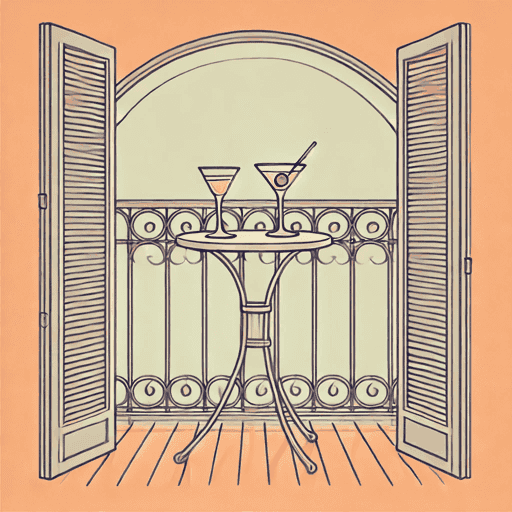
Act 1 ends with Victor and Sibyl numbly drinking their cocktails as the realization that they’ve been jilted sinks in. All three acts in the play end with the curtain falling on Victor and Sibyl alone together, suggesting that they may end up as a couple and perpetuate Elyot and Amanda’s cycle of love and hate.
“Strangely peaceful. It’s an awfully bad reflection on our characters. We ought to be absolutely tortured with conscience.”
(Act 2, Page 43)
In the beginning of Act 2, Elyot and Amanda leisurely enjoy a nightcap in their elegant apartment, dressed in comfortable pajamas and dressing gown. They only half-heartedly feel guilty about enjoying themselves so luxuriously knowing the pain they have caused Victor and Sibyl. As wealthy individuals, the connotation is that they face no consequences for their actions, and their cruel nonchalance is another way for them to spend their leisure time.
“I don’t believe in crying over my bridge before I’ve eaten it.”
(Act 2, Page 44)
Amanda uses a deliberate malaphor, a mixture of metaphors and idioms, in a comic expression that reveals both her wit and nonchalance about the consequences of their actions. A blend of “not crying over spilled milk,” “crossing the bridge when you get to it,” and “having one’s cake and eating it, too,” Amanda’s statement means she regrets nothing, enjoys the moment, and doesn’t feel the need to address the consequences until they arise.
“I believe it was just the fact of our being married, and clamped together publicly, that wrecked us before.”
(Act 2, Page 45)
Amanda’s attitude about marriage is that it is an institution meant to garner social acceptance rather than honor a loving bond. She believes the concept of marriage is flawed and perhaps unnecessary. She hesitates remarrying Elyot not because she doesn’t love him, but because the institution puts public pressure on them and does nothing to improve their personal relations.
“ELYOT. It doesn’t suit women to be promiscuous.
AMANDA. It doesn’t suit men for women to be promiscuous.”
(Act 2, Page 47)
Amanda does not repress her sexual desires and feels no shame in having sexual relationships as a single, divorced woman. Elyot sarcastically calls her “[v]ery modern” (47) and resents that she did not remain celibate in their five years of divorce. Amanda sees through his irritation and calls him out on his sexism, implying that men would rather protect their ego and control women than conceptualize female sexual freedom.
“I believe in being kind to everyone, and giving money to old beggar women, and being as gay as possible.”
(Act 2, Page 52)
When Elyot asks Amanda if she believes in anything, she gives a pat response about universal kindness and happiness which she has yet to demonstrate. Amanda’s words do not match up with her actions, as her escapade with Elyot is neither charitable nor empathetic.
“ELYOT. How convenient. (He lights a cigarette.)
AMANDA (holding out her hand). I want one please.
ELYOT (throwing her one). Here.”
(Act 2, Page 54)
The play’s humor is also expressed through physical comedy, as Elyot and Amanda’s demeanor change sharply from gallantry to insolence. In previous scenes, Elyot made much ceremony in graciously lighting Amanda’s cigarettes for her. In this scene, shortly after Amanda has turned down his sexual advances, Elyot dismissively tosses her a cigarette and makes her wait before throwing the matches at her. This scene foreshadows the much more physical climax, as the tension between whether they will make love or fight is answered when Amanda smashes the records on his head and their brawl ensues.
“Let’s be superficial and pity the poor Philosophers. Let’s blow trumpets and squeakers, and enjoy the party as much as we can, like very small, quite idiotic school-children.”
(Act 2, Page 59)
Elyot advises that he and Amanda should be flippant about love and indulgently behave like children. The advice is meant to be liberating and to assuage Amanda’s doubts about whether they will last. However, his approach is also cynical and assumes that true love is unrealistic or requires seriousness, maturity, and selflessness to maintain, characteristics that they neither have nor care to develop. His figurative advice becomes literal, as Elyot and Amanda partake in childish behavior like name-calling and tantrums.
“On the contrary. I find it exceedingly difficult. I seldom regret anything. This is a very rare and notable exception, a sort of red-letter day. We must all make the most of it.”
(Act 3, Pages 72-73)
When Elyot is finally forced to confront Sibyl and Victor, he does so in his flippant manner, much to Victor’s annoyance and Sibyl’s dismay. Though he finally relents and apologizes, his sorry is disingenuous as he qualifies that his apology is meaningful because he seldom has regrets, not because he is remorseful. The distinction lies in regret meaning he wishes the outcome for himself was different, whereas remorse implies guilt and acknowledging that he hurt others. Elyot believes that Victor and Sibyl should be grateful and celebrate rather than complain about his apology, another flippant joke about his lack of sincerity and demeanor of impeccability.
“I’m a bad lot […] I’m thoroughly unprincipled; Sibyl was right!”
(Act 3, Pages 81-82)
Amanda appears to show more genuine remorse than Elyot’s flippant apology, even internalizing the blame for all the couple’s wrongdoing. Yet, she quickly changes her woeful tone when Victor complains about Sibyl, and she promptly agrees with him that “Sibyl’s an ass” (82). The scene shows Amanda’s wily side, as she speaks out of self-pity to prompt Victor to feel sorry for her rather than to express remorse. Neither Elyot nor Amanda feel contrition, as the conclusion ends the same way as Act 1, with the two sneaking away together right under their spouses’ noses.
“You needn’t worry about leaving me, as though I were a sort of parcel. I can look after myself.”
(Act 3, Page 84)
Amanda criticizes Victor’s patronizing treatment of her that undermines her independence and authority and makes her feel as if she is a discarded or misplaced object. Even after she explains her active participation in abandoning him, he still frames her as a vulnerable creature who needs a man by her side, whether that is him or Elyot.
“I expect I love you still; one doesn’t change all in a minute.”
(Act 3, Page 84)
Victor’s statement is ironic, as he doesn’t recognize Elyot and Amanda’s stormy relationship as a demonstration of how quickly and impulsively emotions can change. The irony extends in the play’s final scene, as Victor himself shifts from Sibyl’s supportive companion to her mortal enemy.

Unlock every key quote and its meaning
Get 25 quotes with page numbers and clear analysis to help you reference, write, and discuss with confidence.
- Cite quotes accurately with exact page numbers
- Understand what each quote really means
- Strengthen your analysis in essays or discussions