60 pages • 2-hour read
Promises and Pomegranates
A modern alternative to SparkNotes and CliffsNotes, SuperSummary offers high-quality Study Guides with detailed chapter summaries and analysis of major themes, characters, and more.
Symbols & Motifs
Content Warning: This section of the guide includes discussion of sexual content, death, and graphic violence.
The Asphodel
The Asphodel—once a hotel where Kal and his mother stayed, and now his home on Aplana Island—is a symbol of the death and darkness with which Kal is associated. When he introduces Elena to the place, she says, “The Asphodel. How strangely fitting. I can’t help wondering if he senses the irony of his home being named after part of the Greek underworld” (68). In Greek mythology, the Asphodel Meadows (also known as the Asphodel Fields) are the most populated area within Hades’s realm. This area is where most human souls go, the final stop for all those who aren’t particularly evil or exceptionally good. Kal has killed many people during his time working for Rafe, and the name of his home goes along with the fact that he reaps souls, adding to Elena’s sense that his home is a place that is “plagued by death and darkness” (231), just like he is.
On an island and in a life so beset by criminal activity, Kal finds peace here. In some ways, his home feels like a memorial to his mother, who’s been gone for 20 years, and this is appropriate given the asphodel flower’s association with remembrance. Elena says that the home’s “absolute emptiness echo[es] around [her] like a vast cavern, neglected by man. It sometimes feels like the temperature drops at night, as if [Kal’s] ghosts come out to play when [they’re] supposed to be sleeping” (86). The Asphodel is Kal’s home, a fitting one for a man who likens himself to Hades, who has cheated death more than 100 times, and who routinely takes others’ lives.
Blood and Marking
Blood operates throughout the novel as a symbol of both violence and intimacy, underscoring the blurred line between obsession and love. Kal’s arousal at the sight and taste of blood dramatizes his association with brutality, while Elena’s eventual willingness to embrace this imagery marks her transformation from object to participant. Early in the marriage, Kal repeatedly describes her body as “flesh broken and bleeding” (152), or notes her “raised, broken flesh” as evidence of his dominance (351). For Kal, blood initially functions as proof of possession—physical traces that certify his control.
As the relationship evolves, however, blood becomes a medium through which Elena reclaims agency. During sex, she licks her own blood from Kal’s lips, interpreting the act not as degradation but as empowerment, a sign that she can take ownership of what once symbolized injury. Later, the act of marking itself shifts from unilateral domination to mutual participation. Kal frequently calls her his “canvas,” a metaphor that objectifies her as something to be altered, while Elena complicates this metaphor by inviting him to “mark” her, reframing inscription as an active choice. By the end, she reciprocates, carving an “E” into his chest at his invitation, which transforms the motif of marking into one of shared authorship.
The motif thus evolves alongside their intimacy: blood and marks once used to signal subjugation become emblems of reciprocity, showing how violence is transmuted into chosen vulnerability. At the same time, the permanence of these bodily traces highlights the novel’s interest in scars, memory, and permanence. Blood and marking symbolize the paradox of their bond, born out of force but sustained by consent, making them central to the novel’s exploration of how intimacy can both wound and heal.
Elena’s Garden
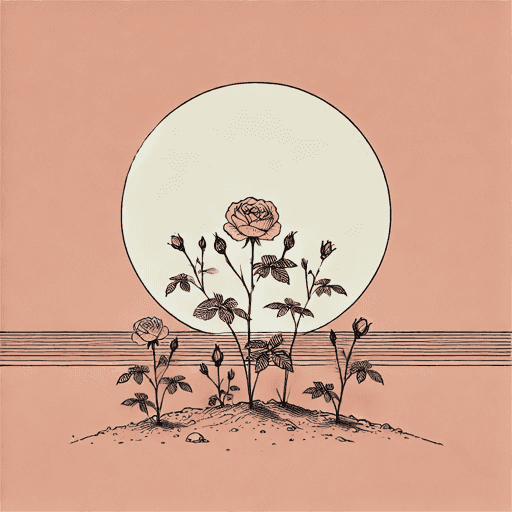
Elena’s garden at the Asphodel is a motif that highlights the possibility of Reclaiming Agency Within Forced Marriage. Associated as she is with Persephone, the goddess of springtime, it is apt that she longs for flowers and for a place in Kal’s home that feels like her own. As she tells him, “I wanted something at the Asphodel that felt like mine. My balcony back home was covered in all sorts of plants, and I’d go out and read, surrounded by fresh flowers, and just feel at peace. I thought…maybe if I tried to recreate that feeling, I wouldn’t be so lonely here” (210). Like Persephone, Elena was stolen from her home, against her will, and in creating a space that feels like the best part of her home, Elena can keep that part of herself alive too. When Kal first finds her, covered in dirt and planning her garden, he says, “There’s a look of elation cast over her delicate features, a softness erasing deep-set rigidity” (174). The prospect of bringing her garden to life allows Elena to feel like herself again, to feel at least a little happy and active, in a place that feels strange and overwhelming to her.
However, the garden doesn’t grow as expected, perhaps because Elena’s associated with spring has been tempered with a new association with darkness. She says, “I see no significant growth in the garden I planted last month […]. Part of me is starting to wonder if maybe the air of death that surrounds the house is keeping the flowers underground, where they’re safe” (179). Just as Persephone accesses a figurative “darkness” within herself after spending time in the Underworld, so do Kal and the Asphodel unlock the darkness within Elena. Kal shows her an area where flowers native to Aplana grow, acknowledging both Elena’s wish for the comfort they bring her as well as the way she has undergone certain personal changes since arriving.
Pomegranates
Pomegranates are another motif that emphasizes the possibility of Reclaiming Agency Within Forced Marriage. In the original Hades and Persephone myth, Persephone eats pomegranate seeds while in the Underworld, and it is for this reason that she must spend part of every year in the Underworld with Hades. In the myth, then, the pomegranate can be interpreted as a symbol of Hades’s power over Persephone, at least in the beginning of their relationship. However, in Kal and Elena’s story, the pomegranate becomes a symbol of their mutual desire and love for one another.
Elena got the pomegranate tattoo under her breast “because [she] wanted nothing more than to be [Kal’s] Persephone” (51). In this way, she expresses her hope that she will be bound to him and will always return to him, forever. Thus, she willingly submits to his sexual power. At the same time, other references to pomegranates suggest that the reverse is true, and she has just as much power over him. During one sexual encounter, Kal says that the taste of Elena “mixes with the scent of her pomegranate shampoo, and suddenly I don’t want to ever eat another fruit as long as I live” (93). She is so tempting, attractive, and arousing to him that he seems just as beholden to her as she to him. This is so obvious that even she sees it, despite her insecurity. When Kal licks her blood during sex, she says it is “as if it was the juice of a pomegranate and he was starved in the Underworld” (160). Here, it is he who is in thrall to her, he who seems to submit. This allows her to share in the power within the relationship and to feel some agency and authority of her own.

Unlock the meaning behind every key symbol & motif
See how recurring imagery, objects, and ideas shape the narrative.
- Explore how the author builds meaning through symbolism
- Understand what symbols & motifs represent in the text
- Connect recurring ideas to themes, characters, and events