Remain: A Supernatural Love Story
58 pages • 1-hour read
Nicholas Sparks, M. Night ShyamalanRemain: A Supernatural Love Story
A modern alternative to SparkNotes and CliffsNotes, SuperSummary offers high-quality Study Guides with detailed chapter summaries and analysis of major themes, characters, and more.
Chapters 1-8Chapter Summaries & Analyses
Content Warning: This section of the guide includes discussion of death, grief, and mental illness.
Chapter 1 Summary
Tate Donovan drives to Heatherington, a quaint Cape Cod town that has a 1950s aesthetic. He’s there to help his best friend, Oscar, and Oscar’s wife, Lorena, design their vacation home. The town is preparing for the Memorial Day weekend Mask and Music Festival, so Tate had difficulty finding lodging until Oscar helped secure accommodations.
At the building site, a grassy bluff overlooking the ocean, Tate finds Oscar, Lorena, and their five children playing on a newly installed playset. Oscar, who sold his vintage sports apparel company for nearly a billion dollars, explains that the playset will keep the children occupied during construction. Lorena greets Tate warmly, asking about his recent hospital stay and mentioning the care package she sent, which included a plush penguin. Tate thanks her for looking after his cat, Paulie, during his hospitalization. Lorena will stay until Friday for the children’s recitals and exams, and then return home for the summer.
After Lorena takes the children to town for lunch, Oscar asks about Tate’s psychiatric hospital stay. Tate explains that the program focused on dialectical behavior therapy. Oscar makes Tate promise to call if his depression returns and asks whether doctors helped decode what Tate’s sister, Sylvia, said before dying. Tate says doctors attributed it to neurological anomalies, but admits that Sylvia believed what she said. He deflects the conversation to house design.
Chapter 2 Summary
Nearly a year has passed since Tate’s sister, Sylvia, died of heart failure. After her death, he experienced paralyzing depression, eventually entering a psychiatric hospital, where Dr. Rollins treated him. Lorena watched Paulie during Tate’s four-month stay.
Tate, 38, is an architect. He sold his partnership after Sylvia’s death. His father was the CEO of a sprawling conglomerate, and his mother was a Romanian model. They lived in a Fifth Avenue penthouse, but Tate’s parents were largely absent, pursuing affairs and social obligations while nannies raised him and Sylvia. Sylvia, five years older, had heart damage from a childhood virus and spent years confined to home with tutors. At 12, Tate was sent to Exeter, where he made friends, joined sports teams, and became close with Oscar, a scholarship student from an immigrant family. After attending Yale, Tate became an architect, defying his father’s wish that he study business.
Sylvia attended the New School, worked for a nonprofit, and married Mike, a music teacher. When their parents died in a plane crash, Sylvia grieved deeply, while Tate felt little loss. Sylvia believed in God, ghosts, and the afterlife, and these beliefs later proved significant.
Chapter 3 Summary
At the picnic table, Tate and Oscar discuss the house design. Oscar guesses that they’ll need 12 bedrooms to accommodate their children, extended family, and guests. They walk to the bluff’s edge, where the property extends halfway down to the beach below.
As they stand overlooking the ocean, Tate experiences peripheral oscillopsia, flickering movements at the edge of his vision that began after Sylvia died. Neurologists found no physical cause, attributing it to stress. Tate tries to ignore the sensation but eventually turns to investigate; however, he sees nothing that could have caused the flickering. Oscar notices that Tate is pale and asks if he’s experiencing the phenomenon he previously mentioned. Tate deflects, claiming that he’s simply tired from the drive and needs rest.
Chapter 4 Summary
Sylvia collected friends effortlessly and drew people to her, including doctors and nurses, during her final hospitalization. She worried about Tate’s isolation and urged him to travel and experience wonder. Though Tate had relationships, he never achieved the vulnerability necessary for something serious.
Sylvia, who was 42, had been on the transplant list for a decade but had a rare blood type. During their final visit, she asked to speak with Tate alone. She revealed that their parents had visited her as ghosts and that she had seen spirits since childhood: some of whom were visitors, others who had unresolved trauma. She said their mother had the same gift. Following her mother’s ghostly instruction, Sylvia blew into Tate’s mouth. Her breath had a licorice-like scent. She predicted that Tate would fall in love and that it would change his life forever.
After Mike returned, Tate left them alone and sobbed in the corridor. On his last day at the hospital, Dr. Rollins asked if Tate still experienced the visual disturbances. Tate lied, saying no.
Chapter 5 Summary
An unnamed woman sits in her kitchen, drinking tea and watching cardinals outside. She reflects on recent hardships: her grandmother’s death three years ago, the pandemic’s devastating impact on local businesses, ongoing legal troubles, and a falling-out with close friends. She fantasizes about traveling to Rome, Paris, or Barcelona to escape her troubles.
Her grandmother Joyce, who raised her alone after losing her husband and daughter, was a tough, practical woman who ran a hospitality business. The woman recalls her childhood in Heatherington, where everyone knows everyone else’s secrets and past mistakes. As a teen, she once toilet-papered a neighbor’s house and was caught, a prank that people still reference.
On a recent trip to town for groceries (visiting the Rolling Scones bakery, the Let’s Meat butcher shop, and the farmers market), she deliberately avoided her other business downtown. At the market, she spotted Dax and his wife, Tessa, and hid to avoid them. Despite her efforts, Tessa saw her and scowled. Back home, the woman realizes that a guest will soon arrive at the house.
Chapter 6 Summary
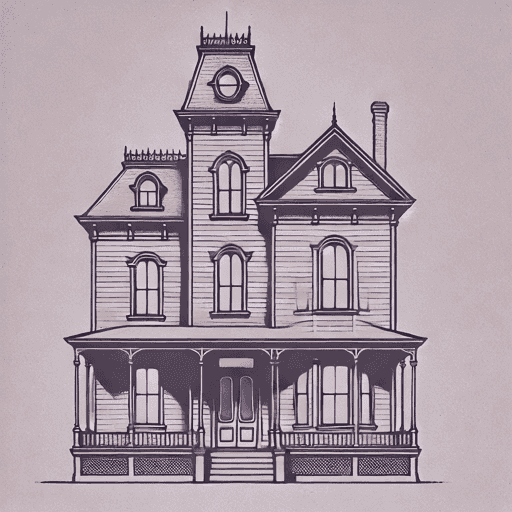
Tate arrives at his lodging, a massive Victorian bed-and-breakfast with four turrets and a wraparound porch. Louise Gaston, the caretaker, and her husband, Reece, the groundskeeper, greet him. Louise initially objects to Paulie, saying pets aren’t allowed, but Tate promises to cover any damages if she keeps it from Mr. Aldrich, the trustee of the estate that owns the property.
Louise gives Tate a tour of the house’s six bedrooms, each of which has a bathroom. The door to the shared bathroom halfway down the hall has squeaky hinges and swings outward; the bathroom features Italian marble, a claw-foot tub, and modern fixtures. Tate’s suite at the hall’s end is the largest and has an ocean view. In the kitchen, Louise points out a temperamental gas stove, and in the cellar, Reece shows Tate the circuit breakers, furnace, and laundry facilities. The house has no back door, but rope ladders lie under every bed. Outside, Reece mentions that the formal garden needs funding for fountain repairs and replanting across the 20-acre property.
After they leave, Tate releases Paulie, who explores the house, racing through the rooms. Upstairs, Tate unpacks and sets up his laptop. Downstairs, he places Sylvia’s photograph on the mantel and discovers poetry books with handwritten notes. After napping with Paulie, he wakes to humming from the kitchen but finds no one there. He shops at Star Market, eats a simple dinner, and works on his laptop before bed. That night, he has a disturbing dream: Paulie approaches the bathroom door, which opens by itself, emanating darkness. Paulie is drawn toward it, growling, before the door closes on its own.
Chapter 7 Summary
Tate wakes with a headache, disturbed by the vivid dream. After showering, he checks his phone and finds a text from Mike, his brother-in-law, with a video that Sylvia recorded. Mike explains that he waited to send it until Tate was out of the hospital and that two more videos will follow.
In the video, Sylvia warns that Oscar won’t always be available and that loneliness corrodes over time. She asks Tate to strike up a conversation with a stranger (perhaps at a coffee shop, gym, or grocery store) and remain open to the possibility that the encounter happened for a reason. She emphasizes that being needed is rewarding.
Downstairs, Tate finds a woman in her late twenties doing yoga in the parlor. She greets him warmly, apologizing for not meeting him when he arrived. As she moves through poses, Paulie approaches and lies on her hoodie. The woman notices that Tate is upset and encourages him to confide in her, using nearly the same words as Sylvia used in her video (mentioning coffee shops, gyms, and grocery stores). Shocked by the coincidence, Tate shares everything: his childhood, Sylvia’s illness, his breakdown, his hospitalization, and the video. The woman listens intently and is remarkably empathetic.
When Louise knocks at the door, Tate asks the woman to answer it. He goes to the kitchen to prepare coffee, but when he returns to the parlor, the woman has vanished, along with her yoga mat, water bottle, and hoodie. Louise delivers a gift basket from Oscar and insists that no other guest is staying at the house. Tate searches upstairs but finds all the bedroom doors locked. He assumes that the woman is in the bathroom and goes downstairs to work, thinking about her mesmerizing, color-changing eyes. She never reappears, and he leaves to meet Oscar.
Chapter 8 Summary
The mysterious woman sits reading an illustrated copy of A Christmas Carol, reflecting on how she loses track of time when reading books, just as she did as a child with Grandma Joyce. She chose this particular book because of a line about strangers knowing secrets, which reminds her of Tate.
She reflects on their morning conversation, moved by Tate’s vulnerability and courage in sharing his painful past. She almost took his hands when he showed her Sylvia’s video and felt as though Sylvia brought them together, creating a spark between them. She reads her teen poetry, scribbled in the book’s margins, blushing at her youthful attempt to mimic e. e. cummings.
Despite the connection she feels, she reminds herself not to develop feelings for Tate. Her life is too chaotic for romance, and he’ll soon return to New York City. She needs to focus on resolving her own problems. She resolutely closes the book and returns it to its place on the shelf.
Chapters 1-8 Analysis
The narrative structure of these opening chapters mirrors the psychological state of the protagonist, Tate Donovan, establishing The Haunting Nature of Unresolved Trauma as a theme. The first-person narration is fragmented, weaving a present-day architectural project with flashbacks to Tate’s emotionally barren childhood, his bond with his sister, Sylvia, and his recent psychiatric hospitalization. This fractured timeline externalizes Tate’s internal struggle with grief, which prevents him from fully inhabiting the present. The peripheral oscillopsia, or flickering visions, that he experiences physically manifests this trauma. The revelation that Sylvia also saw spirits reframes Tate’s condition as a potential inherited sensitivity, blurring the line between grief-induced stress and paranormal ability. This ambiguity is central to the novel’s gothic elements, suggesting that the ghosts of the past are both literal and metaphorical.
The setting of Heatherington juxtaposes idyllic Americana with concealed darkness, introducing the theme of The Deception Beneath Small-Town Charm. The novel presents the town as a picturesque and mythic place, featuring quaint shops and gossipy locals who know everyone’s secrets. This curated perfection is a facade, hiding anxieties simmering beneath the surface. The Mask and Music Festival is a motif that reinforces this idea of communal disguise. The perspective shift in Chapter 5 to the unnamed woman pierces the veneer, revealing a resident tormented by legal troubles and social ostracization. Her fantasy of escaping to a place of carefree existence starkly contrasts with the town’s charming exterior, suggesting that the community’s insularity is suffocating rather than comforting. This duality creates suspense, implying that the town’s welcoming appearance is a deception.
Another theme, The Redemptive Power of Love and Vulnerability, emerges as the text characterizes Sylvia, through flashbacks and posthumous video messages, as a spiritual and emotional foil to Tate. While isolation and emotional restraint define him, Sylvia represents empathy, connection, and embracing the unknown. Her belief in the supernatural is central to the worldview that she attempts to pass on to her brother. Her act of blowing into his mouth is an act of transference, an effort to open him to a world of “infinite mystery and wonder” (14) that exists beyond the rational. Sylvia’s video messages catalyze her guidance, her voice leading Tate toward the vulnerability he has avoided. His discovery of a poetry book with the handwritten note, “Our life’s journey IS our own, but wouldn’t it be better with someone by your side?” (46), echoes Sylvia’s message, suggesting that a convergence of fate and spiritual guidance will force Tate to confront his emotional defenses.
The house on the bluff symbolizes the novel’s gothic suspense and psychological drama. A massive Victorian, its state of genteel decay (flaking paint, a broken fountain, an overgrown garden) mirrors the unresolved trauma affecting the characters. Its architectural quirks foreshadow later plot developments. For example, the absence of a back door creates a sense of entrapment, while the shared upstairs bathroom, with its squeaky, outward-swinging door, becomes a focal point of dread. Tate’s nightmare, in which his cat Paulie is lured toward the bathroom’s oppressive darkness, is a premonition, establishing the room as a nexus of supernatural energy. The house is thus more than a setting; it’s an active participant in the narrative, its physical properties embodying the psychological and spiritual conflicts at play.
The introduction of the mysterious woman marks a turning point at which the novel’s psychological and supernatural threads converge. Her sudden appearance and disappearance challenge the perception of reality, raising the question of whether she’s a ghost, a hallucination, or a guest whom Louise is concealing. The novel withholds a clear answer, forcing readers to share Tate’s disorientation. The woman’s empathy and the way her words about meeting strangers in a “coffee shop, […] gym, or […] the aisle of a grocery store” (53) echo Sylvia’s video message, positioning her as an agent of his sister’s posthumous wish for him to connect with others. In her own chapter, she reflects on this connection through poetry scribbled in a copy of A Christmas Carol, noting that Tate is “just a stranger, / who knows, / all my secrets” (62-63). This captures the immediate intimacy between them, propelling Tate’s journey from isolation toward emotional and spiritual awakening. Her ephemeral presence aligns with Tate’s flickering peripheral visions, linking her to the supernatural world that is revealing itself to Tate.

Unlock all 58 pages of this Study Guide
Get in-depth, chapter-by-chapter summaries and analysis from our literary experts.
- Grasp challenging concepts with clear, comprehensive explanations
- Revisit key plot points and ideas without rereading the book
- Share impressive insights in classes and book clubs