Rendezvous with Rama
64 pages • 2-hour read
Arthur C. ClarkeRendezvous with Rama
A modern alternative to SparkNotes and CliffsNotes, SuperSummary offers high-quality Study Guides with detailed chapter summaries and analysis of major themes, characters, and more.
Chapters 1-9Chapter Summaries & Analyses
Chapter 1 Summary: “SPACEGUARD”
Content Warning: This section of the guide includes discussion of death.
In September 2077, a meteorite hit northern Italy, leaving thousands dead. The tragedy compelled humanity to prevent similar tragedies from ever occurring again. Using their joint defense weapons capabilities, humans launched Project SPACEGUARD, which proves its value 50 years later.
Chapter 2 Summary: “Intruder”
By 2130, Project SPACEGUARD is tracking half a million asteroids to assess their threat to the solar system. The SPACEGUARD computers detect an object designated 31/439 near Jupiter. The object’s unusual size and orbit attract the attention of the SPACEGUARD astronomers, who name the object “Rama.”
Unlike normal asteroids, Rama lacks a light curve, suggesting either that it doesn’t spin or that its shape is perfectly symmetrical. An astronomer named Dr. William Stenton takes telescopic images of Rama and later observes that it spins at an extreme rate. Stenton initially theorizes that Rama is a dead sun but then recalls the short story “The Star” by H. G. Wells and is terrified by the destructive potential that a dead sun’s gravity might have on the solar system. He reassures himself that this theory is unlikely, considering how deeply the object went into the solar system without detection.
Chapter 3 Summary: “Rama and Sita”
The Space Advisory Council (SAC) convenes to discuss Rama. SAC Chairman Professor (Emeritus) Olaf Davidson generally opposes any research on objects smaller than galaxies. When council members propose sending a space probe to take closer images of Rama, Davidson argues against it, prioritizing a mission that will revalidate the big bang theory. This doesn’t sit well with the older astronomers, who support the modified steady state theory and thus vote in favor of probing Rama.
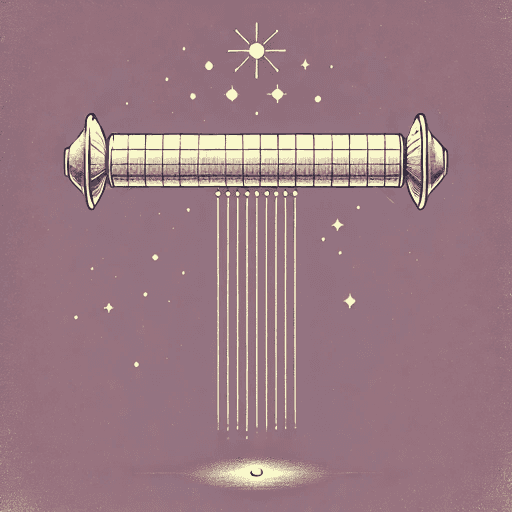
Three months later, a space probe named Sita conducts a reconnaissance mission on Rama. The photographs that it sends back prove that Rama isn’t a natural object but a constructed cylinder. Other images suggest that Rama is a hollow mass. The astronomers conclude that Rama is humankind’s “first visitor from the stars” (12).
Chapter 4 Summary: “Rendezvous”
The SAC sends the spaceship Endeavour, led by Commander William Norton, to board Rama. They choose the Endeavour because it’s closest to Rama, so it’s the only ship capable of intercepting the vessel before it orbits the sun. It reaches Rama inside the orbit of Venus.
Commander Norton faces the daunting challenge of landing on something larger than any of the moons or planets he has visited. He’s likewise overwhelmed by all the advice from the astronomers monitoring the mission. He receives their communications at a delay, so much of their advice is irrelevant by the time it reaches him. Most of all, he doesn’t know what to expect from Rama.
The Endeavour lands on Rama’s north pole so that it remains visible in sunlight. The ship’s pilot, Lieutenant Joe Calvert, reminds Norton of the theory that Rama could consist of antimatter, which would cause a massive explosion as soon as their ships make contact. This doesn’t happen. Norton orders Calvert to land among the pillboxes built around Rama’s polar axis to prevent the Endeavour from sliding off its surface.
The crew has at least 40 days to complete their mission before Rama moves into perihelion, an unsafe proximity to the sun. Once the Endeavour has disembarked from Rama, Mission Control will send fuel tankers to bring it home. Norton knows that Rama may be capable of rendering the Endeavour expendable at a moment’s notice.
Chapter 5 Summary: “First EVA”
Norton finds Rama’s total silence disturbing. After their first day on Rama’s outer surface, Norton and his life-support officer, Karl Mercer, embark on their first extravehicular activity (EVA), setting guide ropes between the ship and one of the pillboxes.
While traveling between the ship and the pillbox, Norton finds a wheel embedded in Rama’s dome. He moves a spoke, causing the wheel to slide outward. He suspects that it’s a manual air lock. When the ship crew informs Norton that his actions haven’t raised any alarms inside Rama, Norton and Mercer turn the wheel clockwise. It doesn’t budge. Norton realizes that he was acting on human assumptions and tries moving the wheel counterclockwise. The air lock opens.
Chapter 6 Summary: “Committee”
On Earth’s moon, the United Planets (UP), a confederation representing human colony settlements throughout the solar system, convenes to discuss Rama. The UP Rama Committee has seven members representing colonies on Mars, Mercury, Earth, Luna, Ganymede, Titan, and Triton. Accompanying them are technical specialists: Professor Davidson from the SAC, archaeologist Dr. Thelma Price, exobiologist Carlisle Perera, science historian Dennis Solomons, anthropologist Conrad Taylor, and historian Sir Lewis Sands. Sands isn’t present in person since he refuses to leave Earth.
Martian Ambassador Dr. Bose declares the committee’s objective: to evaluate the Endeavour’s operations in real time. Earth Ambassador Sir Robert Mackay asks about Norton’s qualifications. Davidson reads out Norton’s bio-note, indicating his extensive service as an astronaut from Earth. This elicits Davidson’s confidence that Norton is the right man for the job. The Hermian (Mercurian) ambassador raises the point that Rama is unlike any known object in the solar system. Sands argues that this isn’t true and compares Norton to an archaeologist.
Dr. Price, addressing the theory that Rama may be an ancient tomb, raises another point: A social movement called Pandora believes that unsealing Rama may doom humankind. Taylor sneers at this idea. Mackay interjects with the other possibility: that Rama may be inhabited by living beings. Citing precedents between civilizations on Earth, that could mean disaster for both humankind and the Ramans. This kicks off an argument within the committee, which eventually concludes that Norton should proceed with entering Rama.
Chapter 7 Summary: “Two Wives”
Norton records a video message for his two wives, duplicating a message that could apply to both families before splicing together specific messages that make the overall video message feel tailor-made. One of his wives, Caroline, lives on Earth, while the other, Myrna, lives on Mars. They’re on good terms with each other, though neither is willing to leave their respective planet to meet the other.
Norton apologizes for contacting them late but assures them that everything’s all right. He explains the locking mechanisms for each of the doors they’ve encountered, as well as the design for the initial corridor. The tunnel stretches for half a kilometer, running through Rama’s thick shell. Norton shares his observation that the Ramans appear to build everything in threes—locks, doors, and chambers.
Norton refers to British archaeologist Howard Carter’s excavation of King Tutankhamen’s tomb in 1922. During the dig, Carter uncovered a room that contained various treasures. Norton suspects that Rama has a similar function. He prepares to record personalized messages for each of his families and then realizes that if something goes wrong, the recordings may be the last time he ever communicates to them.
Chapter 8 Summary: “Through the Hub”
Norton continues to think of Carter and Tutankhamen when he passes through the last corridor leading to Rama’s interior. He drifts out into its central axis but can’t see the end with his flashlight. Around him, he can make out artificial terraces and ramps. Norton concludes that he’s inside an abandoned mine, which disappoints him.
He lights a flare to illuminate the space, and what he sees surprises him. From his estimation of the flare, Rama is around 10 kilometers wide and of an indeterminate length. The walls curving around him are covered in detailed landscapes. Norton can make out areas that he believes are bodies of water, pathways, and even organized settlements. In the very center of Rama, a dark band circles the cylinder’s interior. He suspects that this may be a frozen sea.
Reorienting himself, Norton realizes that he’s at Rama’s highest point and that everything he sees above him extends to a symmetrical crater in Rama’s south pole. Gravity increases as Norton drifts up to one of the curving walls due to centrifugal force. As the flare dies, Norton realizes that he’s the first human to ever witness proof of intelligent alien life.
Chapter 9 Summary: “Reconnaissance”
From the north pole, which they rename the Northern Hemisphere, or “the Hub,” the Endeavour’s crew fires additional flares and begins mapping out Rama’s interior geography. Norton records a reconnaissance report, describing the vessel’s key features. They establish a base along the axis of the Northern Hemisphere, where three ladders lead to a terrace. Although the Southern Hemisphere bowl is symmetrical to the Northern one, it features a series of spikes instead of stairs and a central hub.
They name the area between the two bowls the “Central Plain.” Its defining feature is the “Cylindrical Sea,” the dark ring at the halfway point of Rama. In the middle of the sea is a large island covered with structures. They dub this area “New York,” though Norton theorizes that it may be an industrial complex. The crew counts six distinct towns, which they similarly name Rome, Peking, Paris, Moscow, London, and Tokyo. The settlements link via an apparent railway system.
The Rama Committee listens to the recording. The initial images and descriptions of Rama leave them awestruck. Professor Davidson is especially moved by the notion that an alien civilization had the confidence to attempt interstellar travel. Dr. Perera is the only member of the group who is excited by the outcome since it aligns with the personal theories he has preached for years. He proposes that Rama is a “Space Ark,” citing British physicist J. D. Bernal’s 1929 theory of interstellar travel and colonization.
Perera further explains that given its size, Rama likely journeyed over a long period of time, possibly even millions of years. He cites evidence showing that at least 200,000 years have elapsed since Rama’s last visit to another star. Dr. Price suggests that the Ramans built the Space Ark to escape that star after it became unstable. Perera says that this theory is unlikely since the star was too hostile to foster life to begin with. He adds that even if the Ramans built the vessel to escape disaster, the system’s ecology would only have sustained them for up to 10,000 years. This leads him to conclude that Rama is indeed a tomb, though he notes that Rama’s trajectory is precise enough to be premeditated.
Despite Rama’s apparent absence of life, Perera theorizes that an automatic guidance system could be driving the ship forward. He confidently dismisses Pandora’s theory about Rama but regrets that they won’t have the opportunity to meet an alien species during Rama’s visit to their solar system.
Chapters 1-9 Analysis
Clarke begins the novel by establishing the stakes that surround all of humankind. Rather than starting with the discovery of Rama as an inciting incident, the story flashes back to a much earlier time than the main action to depict a catastrophic meteorite impact on Earth. This event becomes the seed of several world-building elements that develop throughout the novel. The most direct outcome of the disaster was the formation of Project SPACEGUARD, the system by which humanity detects Rama’s arrival. Importantly, however, SPACEGUARD is a defense system, implying that humanity views all passing bodies as a threat. This introduces one of the novel’s major themes, The Human Instincts of Wonder and Aggression, and underlies the humans’ initial approach to the object. Their inability to anticipate what it brings to the solar system means that it could doom humanity at any time and on an unknown scale.
Despite their distrust, the humans name the object after the major Hindu deity Rama (whom worshippers revere as the Supreme Being or Ideal Man and who overcame many challenges). The name Rama represents another of Clarke’s pieces of world building that highlights humanity’s link to religion, while ironically foreshadowing the science community’s reverence (once it ascertains that Rama isn’t a natural object like an asteroid) for the challenges inherent in building such a large structure and creating a guidance system capable of navigating it through interstellar space. To capture initial images of Rama, the humans send a probe called Sita, which further alludes to Hinduism since it’s the name of the deity Rama’s wife (whom he rescued after a demon-king kidnapped her).
The possibility that Rama represents a threat is central in the chapters that follow the UP Rama Committee’s discussions, during which various representatives try to anticipate the outcome of the Endeavour’s mission. Interestingly, they draw their expectations from historical encounters, which indicates less about the Ramans than about the human reaction to an exclusive community or entity: “Pizzaro and the Incas. Peary and the Japanese. Europe and Africa. Almost invariably, the consequences have been disastrous—for one or both parties” (29). Additionally, discussion of the Pandora movement shows that this concern extends beyond a select few. In fact, much of humanity worries about Rama’s sudden appearance in their solar neighborhood.
The existence of the UP is another feature that distinguishes the novel’s world from that of readers. Clarke’s vision of the future depicts humanity systematically colonizing Earth’s neighboring planets and moons, giving the human race a chance to continue in the event of Earth’s destruction. To define the dynamics among the planets, Clarke mimics the real world by depicting the UP as analogous to the United Nations. This drives some of the novel’s tension, especially as it becomes clear that some human settlements are culturally driven to adopt the characteristics associated with their planetary bodies. For instance, as the novel continues, the Hermians reveal their mercurial nature by urging their neighbors to take a militaristic stance toward Rama.
Regardless of the committee’s attitudes, the Endeavour’s crew undertakes an exploration of Rama. Clarke introduces the novel’s protagonist, Commander William Norton, revealing his character. Once Rama is discovered, Norton is called to action, though he accepts reluctantly due to the mission’s uncertain nature. He’s willing to respond to the call of duty, but he takes everything he sees with caution until he sees the interior of Rama. This moment exposes the defining element of Norton’s character arc: “Norton knew that as long as he lived these images would be burned on his mind. Whatever discoveries the future might bring, they could never erase this first impression” (36-37). Throughout his exploration of Rama, Norton rediscovers the sense of wonder that he lost in an increasingly familiar solar system.
Reflecting Norton’s character arc is his attitude toward his two wives. Because he has spent so much time traveling in space, he has become accustomed to life on different planets, which may strike readers as remarkable. Rather than appreciating the differences in the lives that he and his wives lead, Norton records duplicate messages for them, seeing his marital responsibility as just another routine duty he must fulfill. Rama, conversely, represents a challenge to Norton. He must learn to respond to something that he has no precedent for predicting except through comparisons to things and events of the past. The historical allusion to Howard Carter’s excavation of King Tutankhamen’s tomb gives Norton a psychological foothold to prepare him for the unnerving quality of the situation he’s in. As Norton beholds Rama’s interior for the first time, Carter is the only person whose thoughts and feelings he can relate to—more than his wives or the crew members who serve under him. This introduces another of the novel’s major themes, The Mysteries of the Universe.
The Endeavour and the Rama Committee choose to perceive Rama by comparing it to human civilization. Because human civilization is the only form of intelligent life they understand, they naturally resort to referring to Rama’s features as though other humans built them. Underscoring this is their decision to name the Raman settlements after prominent cities on Earth. In addition, these chapters introduce the recurring motif of the number three, which is central to Raman culture and society. Why the Ramans build and do everything in threes is beyond the realm of human understanding, underscoring the Ramans’ identity as alien beings. At the same time, this suggests a recognition of order, which bolsters the sense of wonder that the universe, especially beyond the human solar system, inspires. This sense of order hints at yet another theme, The Beauty of the Other, which develops as Norton leads his crew deeper into Rama.

Unlock all 64 pages of this Study Guide
Get in-depth, chapter-by-chapter summaries and analysis from our literary experts.
- Grasp challenging concepts with clear, comprehensive explanations
- Revisit key plot points and ideas without rereading the book
- Share impressive insights in classes and book clubs