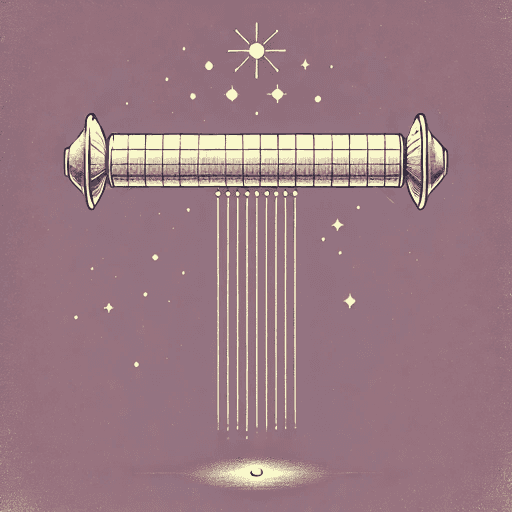
Rendezvous with Rama
64 pages • 2-hour read
Arthur C. ClarkeRendezvous with Rama
A modern alternative to SparkNotes and CliffsNotes, SuperSummary offers high-quality Study Guides with detailed chapter summaries and analysis of major themes, characters, and more.
Themes
The Mysteries of the Universe
Rendezvous With Rama explores what could happen if humankind ever comes across evidence of extraterrestrial civilizations without meeting the aliens who created it. The novel’s characters reckon with the implications of this premise, especially since it suggests that the Ramans’ purposes are beyond human comprehension. The Ramans’ apparent indifference to the existence of humanity underscores the vastness of the universe. The novel reveals that Rama’s passage through the solar system is simply a serendipitous event that affords humanity the chance to glimpse the Ramans’ lives but not the chance to know them.
Exemplifying this theme is the character arc of protagonist William Norton, who begins the novel having lost his sense of wonder about the universe. The novel drives this dilemma by emphasizing that he’s a frequent flyer through a solar system in which humans have extended their grasp. The solar system no longer feels like a mystery to explore because humanity has conquered and settled it. When Norton records messages for his wives, the fact that they live on different worlds is a simple matter. Clarke knows that to readers, this seems incredible, far different from the world that he and his readers live in. Norton finds nothing to marvel over in his society. His character arc moves toward restoring that wonder, beginning from the moment he recognizes the pattern of threes in Rama’s air lock system. It escalates when he beholds Rama’s interior for the first time, recognizing himself as the “first of all mankind to gaze upon the works of an alien civilization” (37).
When the Endeavour’s other crew members follow Norton into the vessel, they must reckon with the limits of their knowledge. They base their understanding of Rama on what they can see, which even then relies heavily on comparisons to human experience. They refer to the Straight Valley as a canal before realizing that it’s one of six linear suns. They give the settlements the names of prominent cities on Earth, based on their physical resemblance. When they reach those cities, they’re restricted from learning what purposes they serve, guessing at them only through their shape and size. Even then, Norton and his crewmates frequently remind themselves that “Rama [i]s hundreds of times older than any structure that ha[s] survived on Earth” (65). This precludes any attempt to draw parallels between humanity and Raman civilization and underscores the inability of the Endeavour’s crew to understand the mysteries of the universe.
Although the novel frames these mysteries within the context of first contact, Clarke hints that humanity need not wait for alien life to appear to sense the universe’s inexplicability. Boris Rodrigo’s character drives the idea that religion is humanity’s most accessible form of cosmic mystery at that moment. Even though Norton and the other crew members look down on Rodrigo’s religion for having the vague undertones of a cult, his theory that Rama is a cosmic ark, alluding to the Bible, resonates with the secularist assessments of Dr. Perera on the Rama Committee. The references to God and religion—including the fact that Rama derives its name from a major Hindu deity—signal Clarke’s position that some facets of human experience simply elude understanding. This doesn’t make them less valid as truths; it merely reflects the limits of human understanding.
When Norton leaves Rama for the last time, he’s haunted by his inability to make sense of where the Ramans are going and why. Equally haunting is the notion that the Ramans could reemerge and never even know that the humans were there. This marks the completion of Norton’s character arc, fully restoring his sense of cosmic wonder and mystery.
The Beauty of the Other
Apart from developing the inexplicable designs of the Ramans, the novel is about humanity’s relationship with itself and with the other. Clarke suggests that human communities can recognize the beauty and dignity of communities that differ from them. This influences humans to act in various ways, though Clarke emphasizes that any attempt to recognize beauty in others is also a reflexive attempt to express one’s own dignity and beauty.
Through sensory details, Clarke presents a society that lives according to an ordered reality. The Ramans don’t reflect the randomness of the natural world. Instead, everything about Rama gives the sense of being carefully designed to support the Raman mission, whatever it is. This is evident as early as the Endeavour team’s initial entry into Rama when Norton observes the pattern of threes recurring in the ship’s air lock system. That scene establishes the number three as a prominent motif that resonates with the symmetrical designs of Rama’s interior. Likewise, Rama’s symmetry resonates with the common interpretation of the number three in human psychology, mythology, and science: The number evokes balance, offsetting the differences between the numbers one and two. On Rama, the number three has no apparent functional purpose. Rather, it leans toward aesthetics and becomes the most prominent symbol of the Ramans’ worldview.
Jimmy Pak’s experiences on the southern continent further drive this recognition of order and symmetry. After trawling past several fields of unknown material and function, he sees a lone flower, which he resolves to pick. Rather than framing Jimmy’s actions as the work of a covetous man trying to claim Rama as his property, however, the novel suggests that the flower is an exchange of one of humanity’s beautiful things in return for one of Rama’s beautiful things: “I’ve murdered something beautiful […] [b]ut then Rama had killed him. He was only collecting his rightful due” (182). Convinced that he’ll die on the southern continent, Jimmy refuses to let the indifference of Raman nature take his dignity. Instead, he challenges it by placing his dignity on the same level as that of the flower.
Norton is likewise drawn to Rama’s sense of order, a sentiment that his medical officer, Laura Ernst, amplifies. Ernst becomes so obsessed with the biots that she actively hopes for one of them to experience an accident so that she can study its biology. Norton, conversely, views the biots with a mix of awe and terror. After seeing the deconstruction of the giant starfish in Chapter 32, he resolves that no human will ever cross the Cylindrical Sea again. He recognizes the biots’ terrifying power and scale and remains uncertain whether a closer encounter would put humans at risk. His recognition of the Ramans’ intelligence later influences his decision to save Rama from the Hermian missile strike: “The human race has to live with its conscience. Whatever the Hermians argue, survival is not everything” (234). Unlike Ernst and the Hermians, Norton doesn’t prioritize his dignity as a human over the dignity of the Ramans.
The Human Instincts of Wonder and Aggression
The novel’s human characters respond to Rama with one of two emotions: awe or fear. Both emotions reflect the innermost impulses of humankind. This aligns with Clarke’s objective for the book, which is not to reveal the truth about Raman civilization but to use their presence to reveal something fundamental about human behavior.
Awe leads the Endeavour’s crew to regard Rama with wonder. On the ground of Rama’s vast terrain, they’re continuously struck by the realization that no one else will ever see what they’ve seen: “He was going not only where no one had ever been before—but where no one would ever go again […] Whenever he felt fear brushing against his mind, he could remember that” (150). This revelation leads them to regard the Ramans with respect and dignity.
In contrast, the members of the Rama Committee function as a negative image of the Endeavour’s crew. Although the Committee members never set foot on Rama, they make rash judgments about it based on their assumptions of human behavior and sociology. Exemplifying this fearful perspective is the Hermian ambassador, who harbors the most paranoid and xenophobic views about the Ramans. In this sense, the Rama Committee represents the second impulse of humankind: fear and consequent instinctive aggression.
While the Endeavour’s crew wonders at what they can’t understand, the Rama Committee members use their lack of understanding as a sign that Rama is hiding its true intentions from them and is thus a threat to the human race. By launching a missile under the pretense that Mercury wants to defend the solar system from Rama’s supposed threat, the Hermians project their intentions onto Rama, showing that they’re more inclined to fight what they don’t know than to try to understand it.
Importantly, Clarke frames the dichotomy between awe and fear through the dynamics of bureaucracy. By letting the Hermian ambassador argue his way into recognizing the Ramans as a threat, the bureaucrats give the Hermians room to launch an aggressive attack without any consequence for acting on humanity’s worst impulses. Norton is bound by his station to follow the chain of command, but he recognizes that his duty is to humanity’s noble principles rather than to the Rama Committee’s authority. If not for Norton’s loyalty to those principles, which represent the best values of humankind, he would have been complicit in an unprompted act of aggression, signaling cowardice.

Unlock every key theme and why it matters
Get in-depth breakdowns of the book’s main ideas and how they connect and evolve.
- Explore how themes develop throughout the text
- Connect themes to characters, events, and symbols
- Support essays and discussions with thematic evidence