Rivers of London
53 pages • 1-hour read
Ben AaronovitchRivers of London
A modern alternative to SparkNotes and CliffsNotes, SuperSummary offers high-quality Study Guides with detailed chapter summaries and analysis of major themes, characters, and more.
Symbols & Motifs
Content Warning: This section of the guide includes discussion of graphic violence, child death, and death.
The Folly
The Folly is a symbol representing the hidden, archaic tradition of English magic and its isolation from the modern world. The historic building’s physical state embodies the decline of institutional magic. Its dusty, underutilized grandeur contrasts sharply with the bureaucratic efficiency and procedural rigidity of the contemporary Metropolitan Police. This directly illuminates the theme of The Tension Between Magical Reality and Bureaucratic Procedure.
When Nightingale introduces Peter to his new home, he defines the headquarters as the “Official home of English magic since 1775” (61). This declaration frames the Folly as a repository of a secret history that operates on principles antithetical to the modern age. Despite its decay, the Folly also symbolizes resilience. It is a sanctuary of forgotten knowledge and arcane power where an ancient craft survives, protected from a world that has largely forgotten it. For Peter, entering the Folly signifies his departure from the mundane world of ordinary policing. His new home and workplace mark his initiation into an older, more secretive order that values esoteric knowledge over paperwork and quantifiable evidence.
Punch and Judy
Punch and Judy operates as a central motif in Rivers of London. The traditional puppet show recurs across the novel as a structural framework for the murders and a lens through which The Fragile Boundary Between Social Order and Anarchic Violence is explored. Peter’s realization that “something is using real people to act out this stupid puppet show” (157) reframes the murders as scenes in a centuries-old script of domestic abuse, impulsive killing, and gleeful disorder.
The motif’s significance deepens as Peter uncovers the revenant Henry Pyke’s connection to it. What initially appears to be a quaint cultural artifact, celebrated at the Covent Garden May Fayre, becomes a blueprint for genuine horror. When Coopertown throws his baby from a window and beats his wife, he mirrors Punch’s infanticide and spousal murder with sickening fidelity. Leslie identifies the broader implications when she suggests Punch may be “[t]he spirit of riot and rebellion in the London mob” (192). This interpretation presents the motif as a commentary on the violence latent within ordinary urban frustration. Each “scene” in the revenant’s performance exploits mundane grievances, from a dog bite to a traffic accident, amplifying them into lethal rage.
The Punch and Judy motif, therefore, exposes how thin the membrane is between civilized routine and catastrophic violence. Aaronovitch suggests that London’s social order persists only through the collective, fragile decision to restrain impulses that the spirit of Punch gleefully unleashes.
Batons
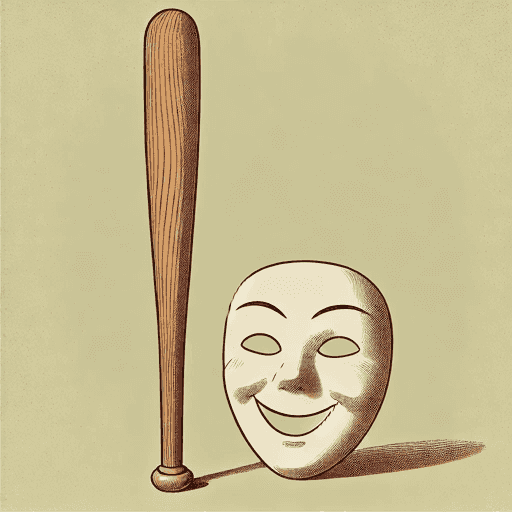
Batons symbolize irrational, overwhelming violence throughout Rivers of London, underscoring The Fragile Boundary Between Social Order and Anarchic Violence. This symbol first emerges when Peter discovers that a wooden baton decapitated William Skirmish. When Peter sees the weapon through CCTV footage, he notes that it is “much too big to be a baseball bat,” at least “two-thirds as long as the man who carried it” (18), The baton’s disproportionate size signals that the violence it delivers belongs to a different order of reality than conventional crime committed by humans.
The baton’s recurring presence across multiple attacks ties the weapon to the Punch and Judy script, where Punch wields a cudgel with manic energy, transforming slapstick comedy into disturbing carnage. Coopertown’s attack on his wife with the instrument while screaming, “Have you got a headache now!” (46), collapses the divide between puppet theater and domestic murder.
Conversely, batons also appear as standard police equipment in the novel. In preparation for potentially dangerous duties, Peter automatically arms himself with “stab vest, utility belt, baton, handcuffs” (3). The Met’s issue of these items to its officers is both a method of defense against violent perpetrators and a symbol of the enforcement of law and order. However, Leslie subverts the batons’ intended purpose when she uses hers to kill the courier with a fatal blow to the head. The excessive and unnatural force she uses reflects her possession by a supernatural entity. This reversal demonstrates the breakdown of social order.
As the narrative progresses, Peter comes to understand that the baton represents the point where bureaucratic policing fails. No forensic procedure or HOLMES database entry can account for a weapon that materializes from nowhere and decapitates with a single blow. The baton thus embodies the tension between the Metropolitan Police’s systematic, evidence-driven methodology and a magical reality that defies procedural containment.
The Silver-Topped Cane
The silver-topped cane symbolizes institutional magical authority in Rivers of London. This accessory serves as a physical marker of Nightingale’s role as the last official wizard of the Metropolitan Police. Peter first notices the cane during his initial encounter with Nightingale in Covent Garden and later observes that he carries it during significant operations, noting its dual nature as both a gentleman’s accessory and “a handy blunt instrument in times of trouble” (41). The cane’s elegance reflects the Folly’s faded grandeur, a relic of an era when English magic had enough practitioners to fill a building. Meanwhile, its practical sturdiness speaks to the dangers inherent in Nightingale’s work. Nicholas Wallpenny’s ghostly description of Nightingale as “him with the nice suit and the silver cad walloper” (41) further emphasizes how the cane projects authority even to the dead, marking its bearer as someone to fear.
The cane’s symbolic significance shifts dramatically when Henry Pyke, through the sequestrated Leslie, seizes it and declares it “the source of your master’s power” (237). In Pyke’s hands, the cane represents not order but its inversion: London’s magical establishment turned against itself by the very spirit of rebellion it was meant to suppress. That Pyke drains the cane of all its magic, leaving it inert when Peter recovers it, suggests that authority residing in objects alone is inherently vulnerable. The cane’s emptiness at the novel’s end underscores that the real power of the Folly must be regenerated through Peter’s apprenticeship rather than through symbols of an ancient tradition.

Unlock the meaning behind every key symbol & motif
See how recurring imagery, objects, and ideas shape the narrative.
- Explore how the author builds meaning through symbolism
- Understand what symbols & motifs represent in the text
- Connect recurring ideas to themes, characters, and events