Summaries & Analyses
Quizzes
NEWReading Tools
Games
Part 3, Chapters 1-2Chapter Summaries & Analyses
Part 3, Chapter 1 Summary
Content Warning: These chapters include scenes with an anti-gay slur and anti-Asian stereotypes.
Rosemary wakes up slowly, gradually aware of the pain between her legs. Guy is sitting by the bed. She remembers giving birth and asks if the baby is okay. Guy says yes and tells her that it is a boy.
When she wakes again, Laura-Louise is sitting by the bed. Rosemary asks where the baby is, startling Laura-Louise, who leaves without answering. Guy and Dr. Saperstein come in, looking serious, and when Rosemary asks again for the baby, Guy takes her hand and Dr. Saperstein tells her there were complications. She asks if the baby is dead, and Guy nods. Guy says they will conceive again, and Dr. Saperstein agrees, saying they can try in just a few months and this was “a one-in-ten-thousand mishap” that should not affect Rosemary’s ability to get pregnant (221). Rosemary calls them both witches and accuses them of lying until Dr. Saperstein gives her an injection.
While Rosemary eats a light meal in bed, Guy comments on her behavior over the past two weeks, which Dr. Saperstein thinks is prepartum hysteria. He doesn’t understand why she thought he was involved in the imagined conspiracy. Rosemary says Guy could have used Donald’s tie to cast a blinding spell. Guy accuses her of having “the prepartum crazies” and promises that everything will be better for them in the future (223). He says they will move to Beverly Hills and have more children. Rosemary demands to see his shoulder. He takes his shirt off, and Rosemary sees only a faint pimple scar.
Dr. Saperstein gets Rosemary a breast pump and sends a woman in every day to remove the milk, which is faintly green and smells like tannis root. Rosemary’s friends come to visit, and she talks to her brother on the phone. She takes the pills given to her without complaint. Several weeks later, she hears a baby crying faintly, but the woman sent in to fetch the milk denies hearing it. That evening, Guy mentions that a family with a baby has moved to the eighth floor. Rosemary hears the baby several more times over the next few days and is sure the baby is on the seventh floor. She asks Laura-Louise what they do with the milk, and Laura-Louise says they throw it away. Rosemary tries to put a used coffee spoon in the milk, but Laura-Louise jerks the milk away, saying it will make a mess.
Part 3, Chapter 2 Summary
Rosemary determines that her baby is alive and being kept in the Castavets’ apartment. Hutch’s book mentioned a major ritual on August 1, and she assumes the baby will be sacrificed then. She stops taking the pills given to her, hiding them under the mattress, and she soon feels stronger and more clear-headed. She knows she cannot trust anyone and will have to rescue the baby alone.
No one else knows that Rosemary knows about the secret entrance through the linen closet, which gives her an advantage. She remembers being carried through the closet during her dream but now believes that experience was not a dream. She prays that God will forgive her and help her save her baby.
She retrieves the pills and hides them at the bottom of a tissue box. Leah Fountain comes to sit with her that evening, and Rosemary puts the pills in Leah’s coffee. Leah falls asleep. Rosemary gets a carving knife from the kitchen and goes to the closet. She pushes on a panel at the back, which swings open to reveal another closet with a keyhole. Rosemary enters and looks through the keyhole into the Castavets’ hallway.
Rosemary enters the apartment. The hallway is empty, but she hears voices coming from the living room. She sees a painting of a church on fire, which she remembers from her dream, and another painting of naked men and women dancing in a circle. She remembers the Castavets’ coven dancing naked in her dream. She hears Minnie’s voice.
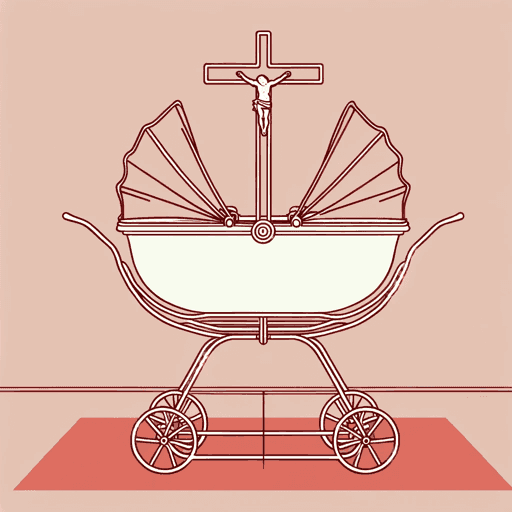
From the living room doorway, Rosemary sees the coven gathered at the other end of the room, drinking and laughing. By the bay window is a large black bassinet draped with black organza and a silver crucifix hanging upside down on the hood. Rosemary says a Hail Mary and steps into the room. She sees the Castavets, Guy, Mr. Fountain, Laura-Louise, and a young Japanese man she does not recognize; they are all standing beneath a portrait of Adrian Marcato, which hangs over the mantle. They notice Rosemary, and the room goes silent. One woman tells her to go back to bed, and the Japanese man asks if she is the mother. Rosemary raises the knife, saying she stabbed Leah and will stab anyone else who comes near her.
Looking inside the bassinet, Rosemary sees a small, rosy-faced baby with orange-red hair and tiny mittens. She reaches for him, and his eyes open—they are yellow with vertical black pupils. Rosemary screams at the group, asking what they did to the baby’s eyes. Roman says the baby has “[h]is Father’s eyes” (236). He reveals that the baby’s father is Satan, the baby’s name is Adrian, and Adrian will someday overthrow established Christianity. Satan brought the Woodhouses to the Bramford after changing his mind about Terry and chose Rosemary to give birth to his son. When Rosemary starts calling for God, Roman tells her that God is dead and they are now in Year One. Rosemary drops the knife and sits down.
Laura-Louise rocks the baby in the bassinet. Now Rosemary knows her dream was real. Roman tells Rosemary it is fine that she killed Leah, but Rosemary says she only drugged her. Roman encourages Rosemary to be a mother to her baby. The Japanese man smiles at her and holds up his camera. Rosemary begins to cry.
Roman walks in with a handsome, dark-skinned man wearing a white suit and carrying a wrapped gift. Everyone gathers around him to greet him, and Laura-Louise holds the gift up in front of the bassinet. Roman points out the baby was born just after midnight on June 25, which was exactly halfway from Christmas, and the newcomer, whose name is Argyron Stavropoulos, points out that writer Edmond Lautréamont had predicted the birth several centuries earlier. Stavropoulos drops to his knees in front of the bassinet. Meanwhile, Guy approaches Rosemary, saying he was promised she wouldn’t be hurt and she hasn’t been. Rosemary spits at him.
Rosemary knows the only thing to do is to kill the baby, but she realizes she cannot kill him because he is her child, no matter what, and killing is always immoral. She hears the baby whimpering and walks over to the bassinet, telling Laura-Louise she is rocking him too quickly. Laura-Louise tells her to go away, but Roman intervenes, urging Rosemary to rock him. She hesitates but finally rocks the bassinet, and the baby stops fussing. His eyes suddenly do not look so grotesque; she even finds them pretty. Roman says he has tiny claws and is only wearing mittens so he doesn’t scratch himself, but his hands are otherwise normal. Rosemary adjusts the baby’s gown, which is too tight around his neck.
She decides the baby can’t be all bad; even if Satan is his father, she is his mother, and she is a decent, ordinary person. She talks to the baby, telling him she is his mother. The room is silent, and everyone is watching her. The guests start to say “Hail Rosemary.” When Roman refers to the baby as Adrian, Rosemary tells him the baby’s name is Andrew John Woodhouse. Roman tries to argue, but Rosemary says that because the baby is hers, she gets to choose his name. Minnie finally says “Hail Andrew.” Rosemary murmurs to the baby, telling him not to look so worried, finally tapping the crucifix to make it swing. The Japanese man steps forward and takes several pictures.
Part 3, Chapters 1-2 Analysis
These final short chapters complicate a number of questions the novel has raised about religious faith, individual choice, The Performance of Social Identities, and The Deconstruction of Motherhood. While the coven has taken away Rosemary’s agency and continues to weaponize medicine to keep her docile, she aggressively reclaims her own power once she realizes her baby is alive. She goes from being a victim to the building’s labyrinthine malevolence to being able to navigate it successfully, using the hidden passage that the coven has used to control her. She drugs Leah, threatens to stab anyone who else who gets in her way, and silences both Guy and Dr. Sapirstein when they try to speak to her, refusing to let them control knowledge or rhetoric anymore. When she realizes her baby is demonic, she makes what would traditionally be seen as a heroic choice, and what she initially sees as the most moral choice, deciding to kill the baby and herself.
Exactly what changes Rosemary’s mind and returns her to a more obedient state is unclear, but it seems to be a genuine love for her baby and a desire to believe he can still become a good person. However, the novel suggests that maternal love might be its own kind of prison, in which unconditional devotion to a child circumscribes behavior and decision-making. It is also unclear to what extent Roman Castavet influences her decision. While she refuses to listen to any other coven members, Roman seems to have a strange sway over her, and the two come to a silent agreement at the end of the novel: Rosemary will be a mother to her baby, and his name will be Andrew.
This ambiguous ending leaves the moral center of Rosemary’s Baby up for debate. It seems that Rosemary has agreed to join a Satanic cult in exchange for being able to raise her child, and it even seems that she will have a place of honor within the coven, as they praise her along with her son. It is possible that Rosemary might enjoy this position of power after being powerless for so long. It is also possible that she is making a sacrifice for her child’s sake. The final scene, in which the Japanese photographer takes pictures of Rosemary and the baby, leaves these questions unanswered but suggests that Rosemary and Andrew will be both a conventional and an unconventional family, emphasizing the theme of The Unnatural Within the Natural.

Get in-depth, chapter-by-chapter summaries and analysis from our literary experts.
- Grasp challenging concepts with clear, comprehensive explanations
- Revisit key plot points and ideas without rereading the book
- Share impressive insights in classes and book clubs