Satantango
Satantango
A modern alternative to SparkNotes and CliffsNotes, SuperSummary offers high-quality Study Guides with detailed chapter summaries and analysis of major themes, characters, and more.
Summaries & Analyses
Quizzes
NEWReading Tools
Summary and Study Guide
Overview
First published in Hungary in 1985, Satantango is a Postmodern novel by László Krasznahorkai. An allegorical critique of the final, decaying years of state communism in the Eastern Bloc, the story is set in a desolate, rain-soaked Hungarian village whose few remaining inhabitants are mired in poverty and inertia. Their grim existence is disrupted by the rumored return of a charismatic figure named Irimiás, believed to be dead, whose arrival ignites a dangerous mix of hope and fear. As the villagers await their supposed savior, the novel explores how Desperation as Fertile Ground for False Prophets leaves a community vulnerable to manipulation. Krasznahorkai portrays Decay as an Unstoppable Force, where the relentless mud and rain mirror the moral and ideological collapse of a society. The narrative’s structure, mimicking the steps of a tango, reinforces The Cyclical Nature of History and Suffering by trapping its characters in a seemingly endless loop of hope and betrayal.
Satantango is considered a masterwork of contemporary European literature and a cornerstone of Krasznahorkai’s acclaimed body of work, for which he received the 2025 Nobel Prize in Literature. The 2012 English translation by George Szirtes won the Best Translated Book Award. In 1994, Satantango was adapted into a celebrated film of the same name, running over seven hours long. The film, which Krasznahorkai co-wrote, was directed by his longtime collaborator Béla Tarr and is a landmark of “slow cinema.”
This guide refers to the 2012 New Directions paperback edition, translated by George Szirtes.
Content Warning: The source material and guide feature depictions of illness, death, child death, death by suicide, animal cruelty and death, sexual harassment, physical abuse, emotional abuse, racism, religious discrimination, gender discrimination, addiction, substance use, and cursing.
Plot Summary
On a decaying, isolated Hungarian estate, the last few inhabitants lead passive, miserable lives, trapped by incessant autumn rain and their own inertia. One morning, a man named Futaki is woken in the bed of his lover, Mrs. Schmidt, by the sound of bells ringing from an unknown source. Her husband, Schmidt, is away with another resident, Kráner, ostensibly to collect the community’s collective earnings from a cattle sale. In reality, the men plan to abscond with the entire sum. Their plan, and the estate’s stagnant equilibrium, is shattered when Mrs. Halics arrives with news: Irimiás and his associate Petrina, two charismatic figures believed to have been dead for 18 months, have been seen in a nearby town and are on their way back. The news ignites a confusing mixture of hope and fear, causing Schmidt and Kráner to abandon their planned escape. Futaki, having overheard their plot, confronts Schmidt, forcing an uneasy truce and a plan to split the money three ways. As the villagers gather in the local bar, anxiously awaiting the return of their supposed saviors, their anticipation curdles into a drunken, desperate tango.
The narrative reveals that Irimiás and Petrina are not resurrected prophets; they’re informants in the employ of the state police. They have been summoned by a stern captain, who is displeased with their long absence and tasks them with a new mission: to infiltrate and control the troublesome community on the estate. Resentful but trapped, they set out in the driving rain. On the road, they’re met by Sanyi, the delinquent Horgos boy, who confirms that he spread the rumor of their deaths on Irimiás’s own instructions. Meanwhile, the estate is being obsessively chronicled by the doctor, who records every event from his window in a futile attempt to preserve his memory against the pervasive decay of the community. After venturing out into the storm for more alcohol, he has a series of unsettling encounters, first with Sanyi’s older sisters, sex workers based out of the abandoned mill, and then with Sanyi’s deeply troubled younger sister, Esti Horgos. The doctor eventually collapses in the mud and is taken to a hospital by Kelemen, a bus driver.
The source of Esti’s distress is her cruel brother, Sanyi, who tricked her into believing that she could grow a “money tree” by planting her meager savings. After Sanyi digs up the money and reveals his deception, a feverish and heartbroken Esti poisons the family cat, Micur, with rat poison. While clutching the dead cat and the remaining poison, she wanders to the ruins of the nearby Weinkheim Manor, where she eats the poison and dies. The next morning, the villagers wait for the arrival of Irimiás, who they thought to be dead. Irimiás and Petrina appear. Soon after, Esti’s mother, Mrs. Horgos, raises the alarm that her daughter is missing. Irimiás seizes control, organizing a search party that eventually discovers the girl’s body.
Back at the bar, with Esti’s corpse laid out on the billiards table, Irimiás delivers an impressive, manipulative speech. He declares that they are all collectively guilty for the child’s death, framing her suicide as a sacrifice that demands that they change their corrupt and hopeless lives. He offers them absolution and a new purpose: the creation of a model community at the nearby, abandoned Almássy Manor. He paints a vivid picture of a self-sufficient utopia, a small island of prosperity and security. To fund this venture, he convinces the villagers to pool all their money—such as the cattle earnings they were fighting over—and entrust it to his management. Swept up in messianic fervor, they enthusiastically hand over their life savings, believing that Irimiás is their salvation.
In a frenzy of liberation, the villagers destroy their dilapidated homes and set out in the rain toward Almássy Manor. Their initial euphoria quickly dissolves into misery as the journey proves arduous and old tensions resurface, culminating in Schmidt attacking Futaki. When they finally arrive, they find the manor a complete ruin. Irimiás meets them there, coolly explaining that unforeseen obstacles from higher authorities have forced a change of plans. The utopian community, he tells them, is indefinitely postponed. Instead, he disperses them to separate, distant towns with promises of menial jobs—Schmidt to a butcher, the Kráners to a laundry, and the Halicses to a rectory. He instructs them to act as his network of informants, observe their new surroundings, and await his next command. He returns only a fraction of their money for their immediate needs. The villagers are pleased to go along with the plan.
The full extent of Irimiás’s betrayal is revealed as he and Petrina report back to the captain. After being deeply unsettled by a strange, possibly supernatural vision of white veils and a levitating corpse near where they found Esti, Irimiás reveals his bleak philosophy to Petrina: The world is a meaningless trap, and their work is merely to readjust the locks. At the police station, Irimiás hands over the villagers’ money and delivers a folder containing his crudely written but psychologically astute reports on each person, detailing their weaknesses for future exploitation. His notes, full of vulgarities, are meticulously transcribed by clerks into the sterile, impersonal language of official bureaucracy, sealing the villagers’ fates as pawns in a state surveillance network.
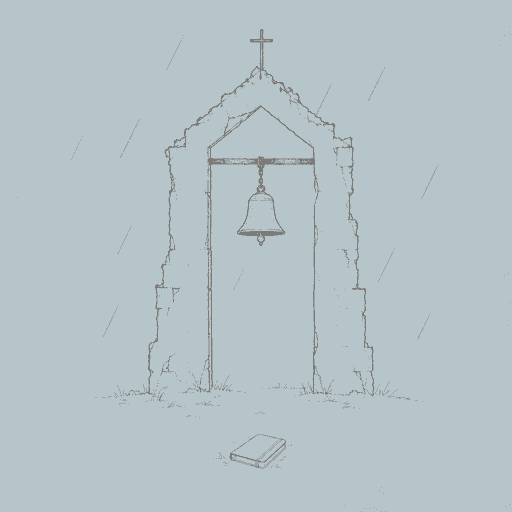
The story’s cyclical structure is completed in the final chapter, which returns to the now-deserted estate. The doctor has come back from the hospital to his sealed-off home. He again hears the mysterious bells and, after investigating, finds that they’re being rung by a strange old man living in the ruins of the Hochmeiss chapel. His hope for a transcendent sign shattered, he returns to his room and nails the door shut, permanently isolating himself from the world. To fight back against the chaos and decay, he decides that he must continue to write everything down to create his own order. He takes out a fresh notebook and begins to realize that he can influence events by describing what the villagers will do, rather than what he can see them doing. The novel ends as the doctor writes the novel’s opening sentence. The narrative folds back on itself, trapping the characters in a recursive loop, an endless dance of hope and betrayal from which there is no escape.

Get in-depth, chapter-by-chapter summaries and analysis from our literary experts.
- Grasp challenging concepts with clear, comprehensive explanations
- Revisit key plot points and ideas without rereading the book
- Share impressive insights in classes and book clubs