Seascraper
43 pages • 1-hour read
Benjamin WoodSeascraper
A modern alternative to SparkNotes and CliffsNotes, SuperSummary offers high-quality Study Guides with detailed chapter summaries and analysis of major themes, characters, and more.
Symbols & Motifs
Content Warning: This section of the guide includes discussion of death and animal death.
The Sinkpits on Longferry Beach
In Seascraper, the extremely dangerous sinkpits on Longferry beach function as a symbol related to the theme of The Constraints of Inherited Labor. The sinkpits are scattered around the beach, threatening shrimp fishers and their horses with injury or even death, as the author explains: “There are sinkpits all across the beach, […] They can drag your horse down by the fetlocks till it cannot move, and if no one is there with you to pull it free, you’ll have to cut the straps and leave it there to drown” (11). The use of second person in this passage creates a sense of immediacy that underscores the sinkpits’ danger.
However, it is difficult to see the sinkpits’ danger from a distance, so Thomas must memorize his Pop’s guidance to avoid disaster; thus, the sinkpits require the accumulated knowledge of generations to navigate. Moreover, their hidden danger evokes the hidden dangers of Thomas’s occupation. As a child, he found the idea of shrimp shanking appealing—just like vast Longferry beach seems from a distance—yet as an adult, he realizes his job’s many hazards and limitations. He thus feels trapped in his work, much like being stuck in a pit of wet sand.
This symbolism is literalized in Mr. Acheson’s rescue of Thomas when he falls unconscious in the sinkpit. Thomas was “sinking” or “drowning” in his work before Mr. Acheson came along and prompted him to think differently about his life choices. His experience with Mr. Acheson prevents Thomas from sinking deeper into the pit and dying—a physical representation of Mr. Acheson saving him from resigning himself to life as an unhappy shanker. Thomas touches on this in his conversation with Mildred, telling her, “I’ve only known him for a day, that’s true, but I feel better for it. I’m not sure I was awake before he came along” (144). His comment reiterates that Mr. Acheson helped to “wake” him not only from his stupor in the sinkpit but also from his resigned attitude to his work.
The Fogbell Pub
Thomas has a vivid dream or hallucination while stuck in the sinkpit. In it, he is taken to The Fogbell Pub—a figment of his imagination—where he meets his father, Patrick Weir. The Fogbell pub represents a beacon of Thomas’s own suppressed hopes, guiding him toward “safety” by helping him achieve self-understanding and work out his life choices and identity. By visiting The Fogbell, Thomas “meets” his father, Patrick Weir, who helps Thomas understand that he must pursue music, even if he cannot earn an income from his passion. Weir tells him, “No money in it. Never could give up the day job. But it’s given me more joy than otherwise life’s served me up. You know exactly what I mean, though, don’t you? I can see you do” (110). Weir thus encourages Thomas regarding Creative Longing in the Face of Economic Hardship, reassuring him that it is possible to reconcile the two. As Thomas’s mother later reveals, however, Weir was not particularly musical. Thus, what Thomas actually finds in the Fogbell is not a family legacy but insight into his own dreams. This is important in a novel that explores The Relationship Between Family, Identity, and Aspiration, suggesting that Thomas needs to define his own identity rather than search for his roots.
The novel develops this symbol by explaining the significance of Longferry’s old fogbell. Thomas tells Mr. Acheson that the town’s intense fog threatened the local fisherfolk, so the fogbell was built to guide them back to the safety of the shore: “Lots of them’d wind up stranded when the fog got thick. The coastguard had to build a fogbell house to stop it happening” (42). Thomas is both literally and figuratively the lost fisherman, neglecting his music and self-development as he toils away on the beach, which is physically and psychologically dangerous. His dreamed visit to The Fogbell saves Thomas from being “lost” in life by helping him to understand that music is an ingrained part of him that he must value and pursue.
The Guitar
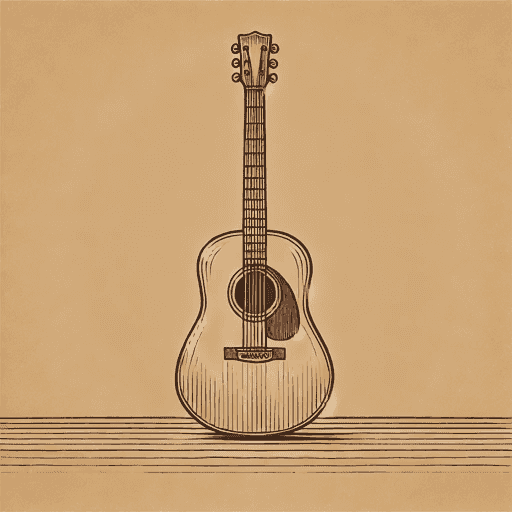
Thomas’s guitar is a symbol of his passion for music. Thomas keeps his guitar hidden away, just as he keeps his talent for singing and songwriting a secret from his mother. For instance, the author describes how Thomas stashes his guitar in the horse stable where his mother will not find it. Only when his mother is away will Thomas “go and fetch his instrument from where he’s got it hidden in the stable, wrapped up in the ratty saddlecloth he never uses” (7). Likewise, Thomas never mentions his music to his mother, keeping the existence of his guitar and his music practice a well-kept secret. When he tells Mr. Acheson about his songwriting, Thomas even asks him, “Just don’t tell Ma” (52), revealing how deep his commitment to secrecy goes.
In keeping with the broader role he plays in Thomas’s character arc, Mr. Acheson urges Thomas to be more open about his musical talent, saying, “You should make more time to practise that guitar. Stop keeping it a secret. You don’t have to be embarrassed that you play” (90). At the end of the novel, Thomas turns over a new leaf by leaving his guitar out in the open, which leads to an honest conversation with Ma about his music. By showing how Thomas conceals both his guitar and his reasons for owning it, the author makes the instrument a symbol for his hidden gift.

Unlock the meaning behind every key symbol & motif
See how recurring imagery, objects, and ideas shape the narrative.
- Explore how the author builds meaning through symbolism
- Understand what symbols & motifs represent in the text
- Connect recurring ideas to themes, characters, and events