Poem Analysis
Analysis: “See How the Roses Burn”
The English translation of “See How the Roses Burn!” is a quatrain, or four-line poem, that has a single rhyme. These features reflect its Persian poetical form, the rubāʿī. Hafez is known for writing poems that have many levels of meaning; any given work can be “at once carnal, sociopolitical, and mystical” (Princeton Encyclopedia of Poetry and Poetics. Edited by Stephen Cushman, Clare Cavanagh, Jahan Ramazani, and Paul Rouzer. Princeton, Princeton University Press, 2021, page 571). This rubāʿī explores love, death, and connection with God from a Sufi perspective.
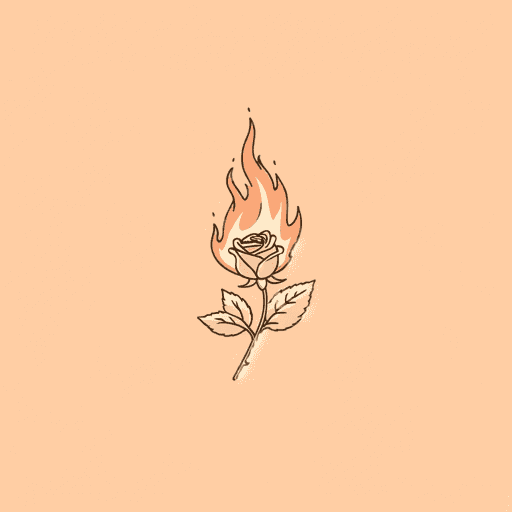
Hafez begins with an exclamation. The grammatical structure of the sentence propels the implied “you” of the reader to act: Look at the burning roses. Roses and fire are deeply symbolic in Sufi writings. The image of flowers burning can represent both the all-consuming ardor of romantic love and the difficult (but ultimately, transformative) path to spiritual enlightenment.
The speaker’s next command urges the reader to fetch wine to put out the fire. The word “quench” (Line 2) can refer to a supportive, sustentive act (as in quenching thirst) and a destructive act (as in putting out a fire). Again, Hafez returns to duality: That which should extinguish the fire also feeds it. This line reflects the sometimes self-destructive, irrational tendencies of lovers: Alcohol causes fire to grow. But wine, like roses and fire, is also a spiritual symbol that appears in many Sufi texts. Adding wine to fire could represent the burst of bright, intoxicating ecstasy accompanying religious enlightenment or the ability of excess to enable divine illumination.
In the next line, the interjection of “Alas!” (Line 3) indicates that the attempt to put out the fire has failed. Instead, the blaze is growing; it “come[s] up with us” (Line 3). “Up” indicates not only direction, but also an increase in intensity; the fire’s growth mirrors the growing intoxication (and helplessness) of the speaker and reader. Emerson’s use of the word “come” hints, too, at the sex act; it may refer to orgasm. The flames’ consumption of everything in its path—roses, wine, and people alike—symbolically reenacts the all-consuming nature of romantic love or divine love.
Love, or “desire” (Line 4), is ultimately what causes the duo to “perish” at the end of the poem. The Princeton Encyclopedia of Poetry and Poetics discusses Hafez’s “polysemous object of desire” (ibid., 1023); in Hafez’s poetry, there can be multiple, simultaneous recipients of desire. In the same breath, the poet can desire both an earthly, erotic lover and a divine, transcendent lover. In many Sufi poems, in fact, God is the Beloved (He also, simultaneously, lives in human lovers). The mention of death at the end of the poem is not, necessarily, macabre; a symbolic death from desire is not only agreeable, but also necessary to achieve illumination and to connect with God.

Get in-depth, chapter-by-chapter summaries and analysis from our literary experts.
- Grasp challenging concepts with clear, comprehensive explanations
- Revisit key plot points and ideas without rereading the book
- Share impressive insights in classes and book clubs