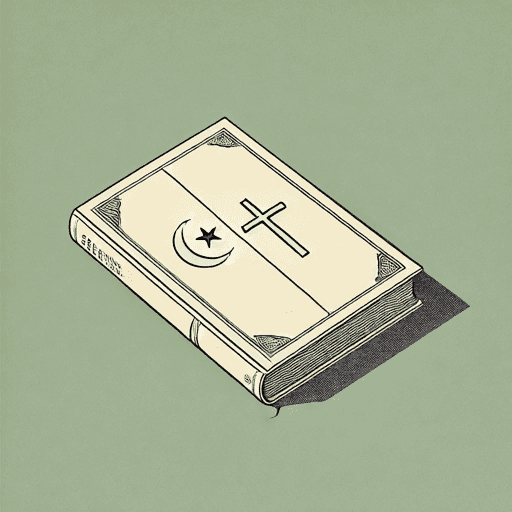
Seeking Allah, Finding Jesus: A Devout Muslim Encounters Christianity
62 pages • 2-hour read
Nabeel QureshiSeeking Allah, Finding Jesus: A Devout Muslim Encounters Christianity
A modern alternative to SparkNotes and CliffsNotes, SuperSummary offers high-quality Study Guides with detailed chapter summaries and analysis of major themes, characters, and more.
Parts 7-8Chapter Summaries & Analyses
Content warning: The source material and this section of the guide feature references to a historical event implying mass rape in a wartime context.
Part 7: “The Truth About Muhammad” - Part 8: “The Holiness of the Quran”
Part 7, Chapter 36 Summary: “Muhammad Revisited”
At Mike’s house, Qureshi presents his argument for Muhammad. In Islamic cultures, Muhammad is viewed as a man who has essentially achieved perfection and who is worthy of every honor. This idealized view of Muhammad makes him a paragon of virtue. Qureshi takes pains to present Islam as a religion of peace, and Muhammad as an exemplar of mercy. In him, the justice of Moses’s law and the compassion of Jesus’s teachings find their synthesis and completion.
The other guests ask some clarifying questions, and the most incisive come from Mike, who has debated Muslims before. He points out that Qureshi’s use of Quranic texts is selective, ignoring the many Quranic texts which pointed in a more violent direction. When Qureshi points out that the interpretation of those verses is guided by their historical contexts in the hadith, Mike answers that the hadith are not necessarily reliable in strictly historical terms, coming two centuries or more after the events they describe. Even if the chain of transmission includes the most intelligent and honorable people, the historical episodes related would still be suspect because of the imperfect way that human memory works over long time spans. Qureshi leaves the debate feeling puzzled, convinced that he has to do more research into the life of Muhammad.
Part 7, Chapter 37 Summary: “The Picture-Perfect Prophet”
Qureshi begins his exploration of the historicity of Muhammad’s life, only to find himself shocked at the incompleteness of the picture he had grown up with. Even the earliest biographies of Muhammad are late in historical terms, based on long chains of oral transmission, and those biographies themselves admit that they have been selective in choosing what to depict and what to omit. Qureshi notes that this selection bias has continued in many Muslim cultures, such that the picture of Muhammad passed down is an airbrushed one: “Through selective quotation, Muhammad becomes the picture-perfect prophet” (216).
Qureshi decides to leave the biographies behind and go to the earliest sources available, the hadith. Even in the most highly-regarded collections, he is startled by a very different picture of Muhammad that emerges: One who is terrified by the revelations he is receiving, to the point of contemplating death by suicide—a far cry from the composed courage Qureshi expected to find.
Part 7, Chapter 38 Summary: “Veiling the Violence”
Qureshi’s reading of the hadith continues to bring up unpleasant surprises. Far from Muhammad only prosecuting defensive wars, they show him going on the offensive at the earliest occasion, drawing first blood against the rival Meccans. When he consults with Abba about this, Abba simply directs him to study the scholars, as they have likely wrestled with the same questions and come up with the answers.
As Qureshi reads those scholars, he finds that they either admit the embarrassing details in the hadith or ignore them, explaining away inconvenient truths as unreliable points in the hadith tradition. Qureshi finds such dodges uncompelling, especially against the repeated, explicit evidence of brutal violence in the hadith’s traditions about Muhammad’s life.
Part 7, Chapter 39 Summary: “Muhammad Rasul Allah?”
While Qureshi has been researching Muhammad, David has been doing the same, and he hands over a binder of his findings to Qureshi. Some of his arguments seem trivial to Qureshi, but others are difficult to refute. As Qureshi tries to find responses, the only one that is available is not a rationally convincing one: “Muhammad must be a prophet, and therefore these stories must be false” (225). This tactic is not a sustainable one, though, for a very simple reason: If he kept denying the reliability of the historical traditions about Muhammad, he would have no sources to draw on to make a historically compelling case for Muhammad’s life and ministry.
Part 8, Chapter 40 Summary: “The Case for the Quran”
Qureshi turns his attention to the defense of the Quran, which for Muslims is the absolute bedrock of faith. The nearest Christian analogy for the Quran’s place in Islam is not the Bible, but Jesus himself—the Word of God, transmitted in physical form to God’s people.
Muslims defend the Quran on several grounds, including its inimitability and its fulfilled prophecies. On the first mark, Muslims hail the Quran as so beautiful and elegant that no other literature can compare to it—indeed, so much so that it must come from divine inspiration. Nevertheless, Qureshi is surprised to come across a challenge to the inimitability argument, Al-Furqan al-Haqq—a book written to express the truths of the Christian Bible in the literary style of the Quran. Its beauty and compelling power has been so widely hailed that many Islamic nations have banned it.
Regarding the argument for fulfilled prophecy, Qureshi realizes that it is not a robust case, as not only did the Quran seldom make future predictions, but most of the cited passages were too vague, and too often taken out of context, to make a compelling argument.
Qureshi turns to the final two defenses of the Quran: Its purported scientific accuracy, and the reliability of its textual tradition.
Part 8, Chapter 41 Summary: “The Quran, Science, and Bucailleism”
The scientific defense of the Quran has become widely discussed in Muslim circles for the past half-century, largely associated with the work of the Frenchman Maurice Bucaille. Bucaille argued that while the Bible is riddled with scientific errors, the Quran is entirely accurate. As Qureshi studies Bucaille’s arguments, he finds them dubious at best. Bucaille, and other like-minded apologists, tend to reinterpret the terms of the Quranic quotations they are using, and ignore any inconvenient evidence opposing their interpretation.
With his knowledge of medicine, Qureshi realizes at a glance that Bucaille’s attempt to interpret a Quranic verse as relating to human embryology gets the science wrong. One has to approach the question with an already-established presumption that the Quran must be right, and only then could one hammer the contrary evidence into place.
Part 8, Chapter 42 Summary: “Hadith and the History of the Quran”
According to Qureshi, much of Muslims’ confidence in the Quran is based on the idea of its perfect textual preservation. Qureshi’s research into the hadith does not buttress that confidence, instead undermining it considerably. “Once again,” Qureshi writes of the hadith, “it was the most trustworthy Islamic traditions that subverted my faith” (237).
Even in the most reliable hadith, the preservation of the Quranic text is portrayed as a scattered affair, reliant on human memories in a way that produced several alternate versions, and it wasn’t until a later caliph standardized the text and destroyed the other variants that the classic Quranic text took its final form. Even the men whom Muhammad had purportedly hand-selected as the best Quranic teachers had preferred other variants over the one that became dominant. When Qureshi goes to look at what Islamic scholars say of this scattered early tradition, he does not find any compelling denials, but only an argument that the process of standardization, as messy as it looks, was exactly how Allah had intended it. This is nearly the last straw for Qureshi’s faith.
Part 8, Chapter 43 Summary: “Those Whom Their Right Hands Possess”
There is one point of David’s binder, full of critiques of the Quran, that sticks in Qureshi’s mind. In several places, the Quran allows male Muslims to have sexual intercourse with “those whom their right hands possess” (242). David views this as referring to women captured in battle, but Qureshi cannot believe that to be the case.
He searches for alternative explanations, but the deeper he digs, the worse the picture gets. The context clearly favors David’s interpretation, but the earliest hadith which speaks of the matter makes the picture even worse. Not only was it an allowance for Muslims to take sexual advantage of captured women other than their own wives, but the stories told a yet darker tale of Muhammad making this allowance when the captives’ own husbands were still alive and present, and even after his own men had hesitated to take this liberty. To Qureshi, this is a clear picture of Muhammad commending brutality and rape. This was the point of no return: “I was done fighting. I was finally broken” (245).
Parts 7-8 Analysis
In Parts 7 and 8—wherein Qureshi turns the attention of his critical intellectual questions from Christianity to Islam—the narrative enters one of its most intense phases, as the intellectual questions that have been simmering across earlier sections begin to intersect more directly with the emotional fabric of his life. These chapters mark a crucial shift in his journey: Whereas his initial engagement with Christianity had been relatively detached—an exploration undertaken with curiosity rather than personal upheaval—his growing willingness to scrutinize Islam draws him into a far more painful and personal conflict.
The Emotional and Relational Costs of Religious Conversion come into particular focus in these chapters. Having spent much of the earlier narrative building a portrait of familial devotion, Qureshi now forces himself to confront what it would mean to step outside of the faith they so lovingly nurtured in him. When he examines Christianity’s claims, his posture is that of an inquisitive and critical observer, willing to examine another tradition without jeopardizing his identity. The moment he turns that same critical energy inward, the tone of the narrative darkens. Questions about Islam’s origins and the reliability of its sacred traditions become inseparable from his love for his parents and the fear of wounding them. Qureshi’s autobiographical method makes the stakes explicitly apparent: Each textual difficulty and each challenge to the traditional narrative surrounding Muhammad’s life reverberates with both intellectual and emotional force, drawing him closer to a point of no return.
This transition also amplifies The Balance of Intellectual Arguments and Spiritual Experience. Parts 7 and 8 present a series of moments in which Qureshi’s careful research is intertwined with periods of prayer, emotional turmoil, and earnest seeking. He does not frame his crisis as a collision between rationality and devotion; instead, he portrays it as a moment in which both faculties press upon him from different angles. His intellectual conclusions carry weight precisely because they challenge a spiritual world he has cherished since childhood. Similarly, his spiritual sensitivity deepens the significance of the arguments he wrestles with, because they threaten not only his beliefs but his sense of self. Qureshi’s narrative technique—juxtaposing scenes of scholarly investigation with more intimate reflections—underscores this interdependence, illustrating how the journey toward religious transformation engages his whole person, mind and heart alike.
The Role of Historical and Textual Criticism in Religious Belief, which also loomed large in Qureshi’s earlier exploration of Christianity, is now focused on Islamic tradition. His descriptions of these studies are framed within personal scenes—conversations with mentors, solitary moments of reading, periods of intense reflection—allowing the apologetic material to function as an integral part of his lived experience rather than a detached excursus. By anchoring the historical material in autobiographical anecdotes, Qureshi tries to depict how such intellectual discoveries became emotionally resonant for him, with his researches inviting him to question his own religious beliefs and assumptions.
Friendship as a Catalyst for Spiritual Transformation also continues to play a significant role. David remains a steady companion, now transitioning from functioning as a debate partner to providing an emotional anchor amid Qureshi’s growing distress. Qureshi’s pacing accelerates as the emotional and intellectual threads of his journey converge. The literary balance between memoir and apologetics, which had been carefully maintained, now begins to lean toward memoir by the end of Part 8, not because the arguments diminish in importance but because their emotional consequences have become more significant. Qureshi allows the intellectual and emotional dimensions of his crisis to illuminate each other, demonstrating that questioning one’s deepest loyalties requires both rigorous inquiry and courage.

Unlock all 62 pages of this Study Guide
Get in-depth, chapter-by-chapter summaries and analysis from our literary experts.
- Grasp challenging concepts with clear, comprehensive explanations
- Revisit key plot points and ideas without rereading the book
- Share impressive insights in classes and book clubs