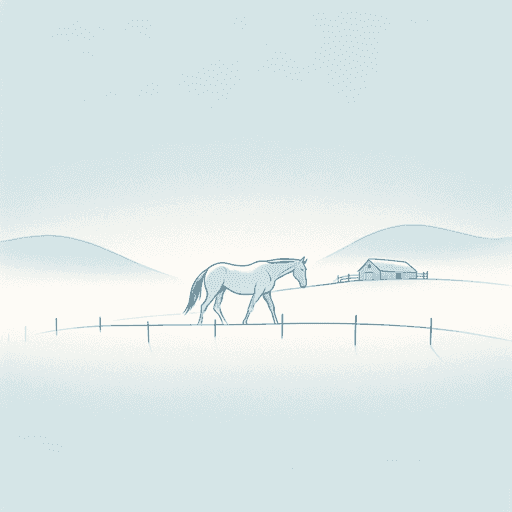
Sheep In Fog
19 pages • 38-minute read
Sylvia PlathSheep In Fog
A modern alternative to SparkNotes and CliffsNotes, SuperSummary offers high-quality Study Guides with detailed chapter summaries and analysis of major themes, characters, and more.
Further Reading & Resources
Related Poems
“Child” by Sylvia Plath (1963)
According to her notes, “Child” was written on the same day in January 1963 that Plath revised “Sheep in Fog.” This poem describes Plath’s son, whom she hopes to keep as a “stalk without wrinkle” (Line 7). She hopes the child’s “clear eye” (Line 1) will see “images [. . .] grand and classical (Lines 8-9) rather than the “wringing of hands, this dark / Ceiling without a star” (Lines 11-12). Plath uses similar techniques here as in “Sleep in Fog”: employing tercets, contrasting lighter images with darker ones, and a closing finale which concentrates on a night-time sky without illumination.
“Words” by Sylvia Plath (1963)
Written 10 days before her suicide, this poem deals an argument in which “words” (Line 16) were used like “[a]xes” (Line 1). Written at the same time as when “Sheep in Fog” was revised, this poem employs several images that correlate. In “Words,” the “[e]choes” (Line 4) of the painful exchange “trave[l] / Off from the center like horses” (Line 5), much as the “horse” (Line 6) quietly moves through Plath’s other foggy landscape. The “white skull eaten by weedy greens” (Lines 12-13) reflects the “bones [that] hold a stillness” (Line 11) in “Sheep in Fog.” The “words, dry and riderless” (Line 16) here are described as “hoof-taps” (Line 17) that are “indefatigable” in “Words”—which is similar to “hooves, dolorous bells” (Line 7) in “Sheep in Fog.” In “Words,” Plath remembers this painful encounter, and notes that at the “bottom of the pool, fixed stars / Govern a life” (Lines 19-20), proclaiming that this cruelty was destiny. This is similar to the “heaven” (Lines 14) that is really “dark water” (Line 15) in “Sheep in Fog.” Although the “water” (Line 15) in “Sheep in Fog” has no “stars,” the Fates in both poems seem to have “fixed” (Line 19) the fact that there is no reprieve from betrayal and abandonment.
“Lady Lazarus” by Sylvia Plath (1962)
In this long poem, collected in Ariel (1965), Plath discusses her failed suicide attempts, which she escaped as “[a] sort of walking miracle” (Line 4). The poem, written in late October 1962, is noted for its powerful exploration of suicidal thought and its nearly singsong cadence. Throughout the poem, power is re-gained by Plath, even though she honestly talks about how she makes “[dying] feel like hell. / I do it so it feels real” (Lines 46-47). By the end, however, she is resurrected like a phoenix, “out of the ash / I rise with my red hair / And I eat men like air” (Lines 82-84). The fierce anger present here is absent from December’s fatalistic “Sheep in Fog,” revised just three months later.
Further Literary Resources
“Poetry and Co-Dependency: The Poetry of Sylvia Plath” by Belinda Jack (2015)
Professor Belinda Jack of Gresham College in the United Kingdom offers her reading of Plath’s relationship with Ted Hughes and particularly addresses his interpretation of “Sheep in Fog.” Professor Jack argues against Hughes’s mythic interpretation and notes the poem’s “very large-scale canvas, further emphasizing the vulnerability of the speaker.” She stresses that the speaker/Plath is in a “liminal state, a moment on the threshold, everything on the brink.” She speaks of how Hughes’s interpretation, while valid, is not the only reading to be encouraged.
“Evolution of ‘Sheep in Fog’” by Ted Hughes (1994)
When collecting this essay in Winter Pollen (1994), Hughes notes that the essay was written for Roy Davids, of Sotheby’s Manuscripts Department, to be given as an illustrated lecture in 1988. This essay has facsimiles of several versions of “Sheep in Fog,” and shows Plath’s notations for removing portions and adding others. Hughes, a controversial figure due to the estranged relationship he had with his wife at the time of her death, analyzes the poem, noting its influence and its meaning, sometimes focusing more on images Plath excised than what she saved, a process that has met with critical resistance.
Interview with Sylvia Plath by Peter Orr (1962)
In this radio interview for the British Council, in October of 1962, Plath talks about her artistic life with Peter Orr. She discusses her early poems, particularly her early use of nature, and how her study with Robert Lowell opened her up to taboo subjects. She commends Anne Sexton for her deeply emotional but craftsman-like poems. She is outspoken on her identification as an American, and scoffs at English poets being “straight-jacketed.” She mentions that she is political and interested in history, and that her poems come out immediately of her own emotional and sensuous experiences. She does mention how these experiences should be crafted for the reader and not produced willy-nilly. This recording shows the persona Plath presented to the public three months before her suicide and captures her speaking voice.
Listen to the Poem
“Sheep in Fog” by Sylvia Plath read by Belinda Jack
In her 2015 lecture, “Poetry and Co-dependency: Poetry of Sylvia Plath,” for Gresham College, Professor Belinda Jack reads “Sheep in Fog” at the 41:03 time stamp, before analyzing the poem in-depth and discussing Ted Hughes’s evaluation of its variations.

Unlock all 19 pages of this Study Guide
Get in-depth, chapter-by-chapter summaries and analysis from our literary experts.
- Grasp challenging concepts with clear, comprehensive explanations
- Revisit key plot points and ideas without rereading the book
- Share impressive insights in classes and book clubs