Shred Sisters
51 pages • 1-hour read
Betsy LernerShred Sisters
A modern alternative to SparkNotes and CliffsNotes, SuperSummary offers high-quality Study Guides with detailed chapter summaries and analysis of major themes, characters, and more.
Themes
Familial Trauma and the Power of Forgiveness
Content Warning: This section of the guide includes discussion of mental illness, illness, and death.
The Shred family fractures in the face of Ollie’s mental illness. They grieve her loss—both real, as she runs away and becomes unreachable for long periods of time, and symbolic, as she transforms into someone they struggle to know—and keep their own counsel. Indeed, Ollie herself becomes an object of shame and secrecy, and the family unconsciously agrees to conceal her condition. While this is not the only reason that Ollie seeks refuge outside the family, it certainly factors into her later forays into freedom from the Shreds. Amy, too, must break away from the family in order to find herself; this is a common feature in coming-of-age stories. Ultimately, however, the novel suggests that distance is not sufficient: The family must find a way to forgive each other and themselves as they rebuild in love what was broken by loss.
Amy notes the moment at which the family decided to ignore or refute Ollie’s mental illness, the night of her mother’s birthday party: “We all suspected the bracelet was stolen; that evening marked the beginning of our collective denial” (28). Ollie’s present to her mother, a diamond-studded tennis bracelet, is clearly beyond her financial means, and the family is already aware of her shoplifting. Still, they decide not to address the issue or hold her accountable—or, more importantly, to acknowledge the underlying illness that drives her impulsive behavior. Later, when Ollie is placed in a psychiatric facility, Dad is “heartbroken that his beautiful daughter [is] locked away in a loony bin” (48), while Mom warns Amy “not to say a word to anyone” (49). The language here (the stigmatizing “loony bin”), coupled with the enforced silence, highlights the parents’ discomfort with their daughter’s diagnosis. Dad’s negative view of the hospital and Mom’s refusal to believe that her daughter is sick also serve to elide the seriousness of Ollie’s condition.
Meanwhile, Ollie remains at the center of the family dynamic; their denial ensures that she never receives treatment that might help her change her behavior, which is destructive to both herself and those around her. As Amy puts it, “What we all knew but couldn’t quite admit, was that we were afraid of her, and with reason” (33). Ollie’s reactions are unpredictable, and everyone else prefers to maintain the status quo. They avoid confronting her—or, again, helping her—because they do not want to contend with her reactions. Thus, the house becomes a kind of “filling station” for Ollie, “a place where [she] refuel[s] before taking off again” (48), and the family adjusts to the situation. As Amy observes, “With every disappearance, my parents recalibrated the idea of normal as it shifted beneath us” (47-48). Instead of contacting the police or calling Ollie’s friends, the family simply waits for her to return. Amy, meanwhile, guiltily hopes that Ollie never returns because at least that way “[their] grief would have an end point” (73)—a remark that captures the family’s need for closure.
As Amy matures and her parents regroup, the family slowly begins to accept rather than deny Ollie’s mental illness. Amy admits, “For a long time, I was convinced that Ollie was responsible for everything that went wrong in our family” (121). Now, however, she knows that “[s]he doesn’t mean to hurt [them]” (124). While Mom and Dad are slower to reach this point, they eventually make their peace with Ollie. For Mom, it is when Ollie returns to sit beside her hospice bed; for Dad, it is when Ollie bears his granddaughter. For Amy, the process of accepting Ollie’s illness has been easier, though the journey toward forgiveness takes longer. By the end of the book, however, Ollie is all that Amy has left of her small family. In part because of this, when Ollie tells her that she intends to “stay on the medication,” Amy “want[s] to believe her” (255)—and endeavors to forgive her. Though Amy still harbors her occasional doubts, she acknowledges that “Mom’s long ago prediction that [Amy and Ollie] would become friends ha[s] finally come to pass” (257): Forgiveness finally makes way for a new configuration of family.
The Need for Authenticity in Understanding the Self
While the Shred sisters do not have much in common, it eventually becomes clear that they are both adept at acting. For Ollie, this kind of artifice serves to mask her mental illness; it is as much a coping skill as it is a defense mechanism. For Amy, acting is a way to gain acceptance (or, at least, avoid unwanted attention) as well as a way to try on different identities; it is as if she is auditioning to find the right part, her genuine self. The novel thus suggests that it is often easier, and less painful, to present a false face to the world rather than risk vulnerability and reproach by revealing one’s authentic self. Nevertheless, it is only in understanding the self that each sister reclaims her agency.
When Ollie is first hospitalized, neither she nor the family is ready to confront the reality of her situation. Though honesty is rewarded in the hospital—“you received a chorus of snaps for one thing alone: being authentic” (54)—the fact of Ollie’s mental illness feels as vague as the nickname for the ward where she is held (“The Place”), at least to the family and certainly to Ollie. When she is finally released, for example, Ollie emphatically thanks everyone for helping her. However, Amy denies that this represents a genuine acknowledgment of the situation: “[I]t was the performance of a lifetime” (71). Encouraged by a family that keeps quiet about their “suspicions,” Ollie copes by affecting the assumed identity of someone in recovery instead of working to understand her real one.
Later, when Ollie leaves the family home, she makes her living mostly through theft, causing a disturbance on the occasions when she is caught: “She had learned well that acting crazy was the equivalent of a Get Out of Jail Free card” (93). Ironically, the identity that Ollie here assumes closely parallels her actual circumstances; she does, in fact, have a mental illness. However, rather than engage in introspection about this reality, Ollie instead weaponizes it in a way that implicitly denies its basis in fact. The imperative behind this remains the same as it was when Ollie left the hospital: Ollie must act in order to survive, or so she believes.
Amy engages in a similar kind of artifice that is no less real for being much subtler, as when she walks into a salon one afternoon: “Two hours later I left the salon with auburn hair and a bob with bangs. Walking down the street, I couldn’t stop glancing at myself in the storefront windows, happily surprised each time I peeked” (126). Coming on the heels of a therapist’s appointment—an opportunity to engage genuinely with the question of who she is—Amy’s actions imply that changing one’s superficial appearance is much easier than grappling with the challenging issue of what constitutes the individual self. The former is also less productive: While Amy is delighted by the external changes, they do not transform her life, and she will spend many more years trying to find her own way.
This, at least in part, is what dooms her brief marriage to Marc. Even before they are married, Amy fears that “the real [her] would emerge, a friendless girl who concocted Cobbler and Tupperware games to play alone” (154). She even asks her therapist, querulously, “Am I supposed to accept who I am or change who I am?” (154). If Amy does not even know who she is—or who she “should” be, if she is to be happy—she cannot commit herself to an honest relationship with someone else. Indeed, as Amy admits after they are married, “Sometimes it felt as if Marc and I were playing one of my make-believe games from childhood; I could have called it Grown-ups” (175). The relationship is performative rather than authentic because Amy has not yet found herself fully enough to invest in genuine connection.
Eventually, however, both sisters find their way to a more authentic version of their characters. For Ollie, it is when she decides not only to bear a child but also to raise it, taking medication in order to maintain her mental health. Ollie becomes part of a family of her own making, taking control of her illness and her life. In contrast, but with similar results, Amy embraces autonomy, breaking not only from her husband (and subsequent lovers) but also from her long-time therapist. They both become active participants, rather than actors, in their own lives.
Sisters as Opposites and Mirror Images
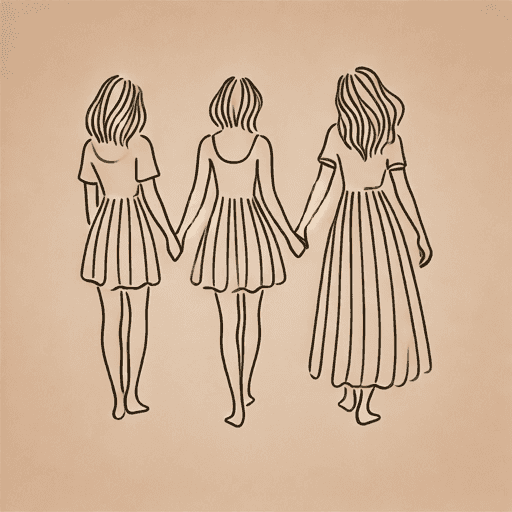
While the Shred sisters seem natural foils—and they are, in many ways, the polar opposites of each other—they also share the same genetics and family environment, and each is, in some sense, a reflection of the other. That is, while some distinctions create gulfs between them, other differences are only of degrees: Amy’s struggle to accept herself and forge a happy life may not be marked by mental illness, but she struggles, nonetheless. Ironically, it is Ollie who often reveals to her the possibilities for joy and gratitude. A relationship that begins in rivalry therefore becomes a bond born of shared experience and love. As the author puts it in an epigraph, which the narrator repeats near the end, “No one will love you more or hurt you more than a sister” (258). Like a shadow of the self, the novel suggests, a sister reminds one of their own failures and foibles, triumphs and tenacity.
Amy initially characterizes their relationship as wholly combative: “Ollie and I fought as if the world existed to fuel our rivalry” (8). Her words highlight not only the competitive spirit of their sisterhood but also the central role they play in each other’s lives. For example, if Amy cannot be bold and daring, like Ollie, she will instead be smart and accomplished; her presence balances Ollie’s out but is also a response to it. Amy is particularly fascinated by her sister even as she is also repelled by her: “I snooped, spied, and studied her. The smallest details about her life intrigued me” (11). Ollie is Amy’s subject, sparking envy but also awe. She wants to understand this “shadow sister” (74), a doppelganger who haunts her life.
As they grow up and apart, Ollie leaves and returns, again and again, in a cycle that swings between courting transience and seeking support. Amy is cynical about the gestures that Ollie makes toward the latter: “I told myself it wouldn’t last, as if I didn’t want it to last, and that made me feel punky and small. I didn’t want to bet against Ollie, but I couldn’t put my money on her either” (120). Amy has learned not to trust her sister, and though she has never learned to trust herself either, this does not prevent her from contrasting herself directly to her main rival. When Amy interviews for the editorial job at the publishing house, she shows up dressed in a manner that echoes Ollie, wearing “a miniskirt, tights, and Doc Martens” (131). When the publisher asks why he should hire Amy, she responds, “I’m a good bet” (132). In direct contrast to her thoughts about her sister above, Amy considers herself a wager worth the risk. Nevertheless, the confidence with which she makes this pronouncement is partially bestowed by disguising herself as Ollie, underscoring the links between the sisters.
These links grow even stronger as the sisters deal with the deaths of their parents. When Mom is placed in hospice care, “Ollie and [Amy] [sit] beside her bed, laughing and crying, playing gin rummy, and eating Tootsie Rolls from the hospice gift shop” (211). It is as if they are children again, allies united by their love for their mother and for each other. This reconnection further strengthens when Ollie gives birth to Raine. Though Amy initially struggles with resentment at Ollie’s need for her support, she eventually allows herself to love both the baby and her sister. Indeed, in the process of telling her story, Amy pays tribute to her sister; the book itself is an act of reclamation: an attempt to restore a relationship once broken. As Amy departs her therapist’s office for the final time, she “[leaves] the door open” (264), an apt metaphor for her future with Ollie.

Unlock every key theme and why it matters
Get in-depth breakdowns of the book’s main ideas and how they connect and evolve.
- Explore how themes develop throughout the text
- Connect themes to characters, events, and symbols
- Support essays and discussions with thematic evidence