Snoop
54 pages • 1-hour read
Gordon KormanSnoop
A modern alternative to SparkNotes and CliffsNotes, SuperSummary offers high-quality Study Guides with detailed chapter summaries and analysis of major themes, characters, and more.
Chapters 1-9Chapter Summaries & Analyses
Chapter 1 Summary
Twelve-year-old Carter Peregrine skis down a mountain in Colorado during spring break, distracted by thoughts of the viral “Chattanooga Chop” dance. His father, waiting at the bottom, questions his wobbling, but Carter does not admit that he was thinking about videos, an ongoing source of conflict with his divorced parents, who disapprove of his screen time. When his father leaves to ski the difficult “Widow-Maker” slope, Carter is tasked with supervising his eight-year-old brother, Martin, on the bunny hill.
Pleased at the opportunity, Carter retrieves the phone he smuggled in his long underwear and begins watching videos. Absorbed in a clip of an underwater diver doing the dance with a spear gun as a jellyfish swims nearby, he looks up too late to see Martin skiing out of control directly at him. Martin collides with Carter just below both knees, and Carter loses consciousness.
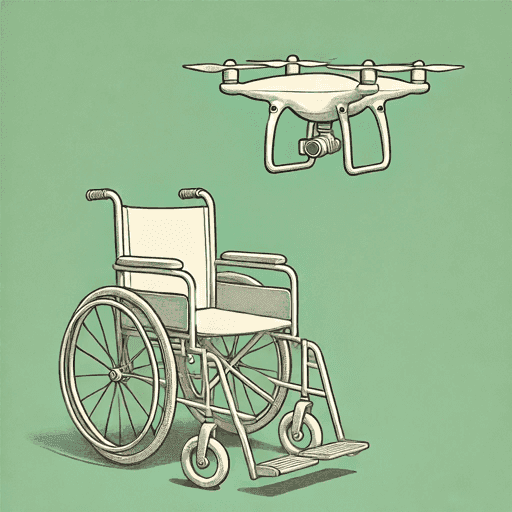
Carter has blurry memories of an ambulance ride before waking in a hospital bed. His father and a tearful Martin are present. Dr. Samuels explains that both of Carter’s legs are broken in nearly identical fractures and are encased in casts from above the knee to the toes. Carter will need a wheelchair for six to eight weeks. His mother is preparing their ground-floor guest room, “the onion room” (8), for his recovery in North Carolina. His father suggests that the accident might have been prevented if Carter had not been on his phone. Carter resents this but recognizes that his immobility provides the perfect excuse for unlimited screen time.
Chapter 2 Summary
Back home in North Carolina, Carter struggles with wheelchair mobility in his house. Transferring from chair to bed feels undignified to him and sometimes results in falls if he forgets to set the brake, occasionally leaving him injured and dependent on his mother to lift him into bed. His mother blames his father for leaving the two boys alone on the mountain. Carter observes that since the accident, both parents have stopped complaining about his screen time, and his phone and other devices remain within easy reach.
Carter will attend Sterling Township Middle School virtually via Zoom, allowing him to sleep later since he is excused from homeroom. After his mother leaves for work and Martin goes to school, Carter remains alone in the house. His best friend, Ethan Harouni, arrives early to discuss Carter’s student ambassadors—classmates who will bring him physical materials from school. Carter has chosen Ethan and Lacey D’Agostino, a girl he has had a crush on since kindergarten. Carter’s mother asked Lacey’s mother to ensure her participation. Ethan is excited about working with Lacey, which irritates Carter.
During his first virtual math class with Mr. Grimes, Carter sees his classmates on screen, including Maddox Miller, who reacts with visible smugness since he is seated beside Lacey. After class, Mr. Grimes keeps Carter for a brief check-in, explaining that he is exhausted because his brother is staying with him and disrupting his routine. Carter jokes about the damage that brothers can cause, and Mr. Grimes responds with a faint smile before dismissing him.
Chapter 3 Summary
Carter’s lunch during a Zoom school day becomes chaotic when he spills mayonnaise on the kitchen floor and is unable to clean it up within the short lunch period. Unable to bend down, he later improvises a solution by using a mop, soaking it in toilet water because he cannot use a bucket or sink from his wheelchair. While cleaning, the doorbell rings, and Carter answers the door while holding the mop. Lacey has brought an overcooked muffin from class, and Maddox waits outside holding a sign that reads “STICK” for his prank group, the “Chairmen of the Bored” (18). Lacey tells Carter that she’s considering joining the group and leaves with Maddox after Carter awkwardly nudges her with the damp mop. Carter recalls his failed attempt to join the Chairmen of the Bored in sixth grade, when Maddox banned him for paying for a snow globe that he was supposed to steal as part of an initiation.
Later, Ethan tells Carter that Lacey and Maddox are spending significant time together, including walking home and holding hands. Still confined at home, Carter increasingly orders Martin to fetch items for him, taking advantage of his brother’s lingering guilt over the accident, though their mother warns that this will not last.
While watching news footage of lightning destroying the gazebo in Sterling Park, Carter’s mother explains that the video came from a public security camera and that the town’s camera feeds are accessible online. Carter realizes that Lacey and Maddox would pass one of these cameras on their walk home. That night, he visits the Sterling Police Department website and accesses the live feed for Camera 12 in Sterling Park, deciding to use it to watch the path they take.
Chapter 4 Summary
After school, Carter watches the live feed from a camera in Sterling Park, observing a pregnant woman struggling to control her toddler. Lacey and Maddox appear on the screen walking together. Although they are not holding hands, Lacey laughs at something Maddox says. They walk out of frame, prompting Carter to check other nearby camera feeds. He briefly spots Maddox crossing a baseball field alone, suggesting that they separated before heading home.
Later, Carter’s mother drives him and Martin to a follow-up doctor’s appointment. Getting into the SUV is difficult and painful, and Carter must be lifted and maneuvered into the seat. Dr. Patel confirms through X-rays that his legs are healing properly. In the parking lot, Martin comments on a bad smell coming from the nearby condemned courthouse scheduled for demolition. As Carter struggles to transfer from his wheelchair back into the car, Maddox arrives with members of the Chairmen of the Bored, including Lacey. Maddox greets Carter’s mother and mentions that he and Lacey were talking about Carter, while Martin blurts out that Carter spends most of his time staring at screens. Embarrassed, Carter forces himself into the car despite the pain.
As they drive away, Carter notices Maddox smiling in the side mirror. He reflects that, although he cannot follow the group in person, he can continue monitoring their activities downtown through the town’s network of security cameras.
Chapter 5 Summary
Carter continues using the town’s public security cameras and observes a completed prank by the Chairmen of the Bored: a “TOILETS R US” sign duct-taped to the window of Osterman Plumbing Supply (31). Switching camera views, he watches Louie, the owner of Lunch With Louie, alter the sign outside Janine’s Sandwich Emporium by raising the price of a grilled cheese sandwich from $7 to $37 and changing “pot roast” to “hot roach” before quickly returning to his own diner.
Carter attempts to distract himself with online videos but finds it difficult to stay engaged and returns to the police camera feeds. He observes several unrelated scenes, including the pregnant woman struggling with her toddler in Sterling Park, a red Maserati blocking traffic, and a Zippy Airport Service van. On Roswell Street, Carter notices a thin man with a pointed nose repeatedly pacing back and forth along the sidewalk, looking at the window of the Paris Art Shop each time he passes.
Carter notes his personal connection to the shop: A photograph taken by his mother showing him as a baby in a sagging diaper is displayed in the window. He also observes that the shop contains valuable items, including silver objects, jewelry, and a replica British crown priced at $4,500. Carter begins to wonder whether the man, whom he privately nicknames “Needle-Nose,” might be watching the store in preparation for a crime, but he recognizes that no law has been broken. Reflecting on what he is seeing through the cameras, Carter questions whether observing the town in this way carries a responsibility to report wrongdoing. When the man leaves the area, Carter decides to continue monitoring the camera feed in case he returns.
Chapter 6 Summary
Days later, Ethan brings Carter a receipt that he retrieved from a dumpster after following Needle-Nose. The receipt is from a locksmith, which disappoints Carter. Ethan speculates about what the purchase might mean, including whether it involved lock-related tools, but Carter questions whether it indicates anything criminal. Ethan also reports that Mr. Grimes is in a bad mood at school and that the Chairmen of the Bored labeled his classroom door “ALCATRAZ.” He adds that Lacey and Maddox are meeting at Topping Mad, a frozen-yogurt shop not covered by the public security cameras.
Carter remembers that the shop has a private security camera inside. Despite Ethan’s objections about privacy, Carter searches for hacking videos and attempts to access the camera feed. He succeeds by guessing the password, which turns out to be “yogurt.” The feed shows Lacey and Maddox sitting together and sharing a large sundae. Ethan declares that they are in love, while Carter disputes that conclusion. As the pair leave the shop, an animal runs past them on screen; Ethan suggests that it’s a rat, while Carter argues that it’s too large and may be a cat.
Ethan urges Carter to stop watching the cameras. Carter pretends to agree but privately resolves not to forget the password.
Chapter 7 Summary
During a Zoom math class, Carter watches in split-screen as Janine places a sign on Louie’s diner warning of extermination in progress. He observes Louie discover the notice and scrape it off the glass with a meat cleaver. Distracted by the unfolding conflict on Main Street, Carter fails to answer Mr. Grimes’s question about integers. Although the teacher initially responds with patience, Carter’s continued inattention frustrates him.
While remaining logged into class, Carter continues monitoring town activity through hacked camera feeds. He notices the red Maserati parked elsewhere, a young girl carrying a leaking bag with a goldfish, and a college-aged man dropping a package that turns out to contain a lacrosse stick. Carter blurts out, “A lacrosse stick?” (47), prompting Mr. Grimes to lose patience and state that Carter cannot be trusted to fully participate in class remotely. He decides that a student ambassador will deliver the lesson in person and assigns Lacey for the task. Carter is pleased to see Maddox’s disappointed expression.
Chapter 8 Summary
Lacey arrives at Carter’s house to help him with math. Carter has prepared for her visit by ordering pizza, cleaning himself, and placing flowers on the table, but Lacey declines the food and explains that she plans to meet friends at Donut Domain afterward. After working briefly, Lacey realizes that Carter already understands the material and questions why she was asked to come.
To prolong the visit, Carter shows Lacey his mother’s photography drone and demonstrates flying it in the driveway. When Maddox arrives to walk Lacey to Donut Domain, Carter impulsively swoops the drone toward him. Maddox freezes, and Carter veers away at the last moment, crashing the drone into a hedge. Carter assures Lacey that everything is fine so that she’ll leave, though he is unsure whether the drone is damaged.
Later, Carter waits for Martin to return from school and uses his brother’s lingering guilt to persuade him to climb into the bushes and retrieve the drone, which turns out to be undamaged. Martin is unable to help Carter get his wheelchair back into the house, forcing Carter to crawl inside while dragging the chair behind him. Their mother returns home, unaware of how close Carter came to damaging her equipment.
Chapter 9 Summary
Carter’s injury and virtual schooling have disrupted his normal sleep schedule. Awake at three o’clock in the morning, and aware that exhaustion may be affecting his judgment, he turns to his surveillance cameras. He watches the quiet town, observing night cleaners, security guards, and the Zippy Airport Service van driving down deserted Main Street. After the van passes, a large animal with a bushy ringed tail emerges to rummage in a garbage can. When a motion light illuminates it, Carter sees a white muzzle and reddish-brown fur.
He identifies it as a red panda, an endangered species he studied in sixth grade. A Google search confirms that red pandas are native to China and the Himalayas, not North Carolina. Carter dismisses the possibility of an escaped pet due to laws surrounding endangered species. The animal disappears, but the mess it leaves behind convinces Carter that he did see something unusual.
Still unsettled by the late hour, and aware that his injury and screen-heavy routine have blurred his sense of normalcy, Carter begins to doubt himself. He tries to rationalize that he must have seen a common raccoon instead, despite the specific features he observed suggesting otherwise.
Chapters 1-9 Analysis
The initial chapters establish Carter’s wheelchair as a condition that reshapes his daily life rather than as a simple symbol of confinement or liberation, linking his physical limitation to an increased reliance on technology. The accident, a result of his digital distraction, ironically provides him with justification for unlimited screen time. His father’s warning that the incident is “the perfect opportunity to reevaluate the amount of time [he] spend[s] staring at screens” is subverted by Carter’s realization that his immobility permits the very behavior that caused it (9). Confined to the ground-floor “onion room,” Carter’s physical world shrinks while his virtual world expands. The wheelchair, a reminder of his dependence, also becomes the fixed position from which he monitors and interprets the town through screens. Screens evolve from portals for consuming trends like the “Chattanooga Chop” into tools for observation, granting him access to information that his body can no longer gather directly. This dynamic introduces the novel’s exploration of Redefining Strength Beyond Physical Ability, suggesting that agency can be reclaimed through intellect and technology when physical prowess is absent.
Carter’s technological empowerment initiates an exploration of The Blurred Line Between Observation and Intrusion. His monitoring initially takes the form of watching publicly accessible police cameras, an act he frames as harmless while keeping track of his crush, Lacey, and his rival, Maddox. This ethically ambiguous watching intensifies when jealousy leads him to hack the private security feed of the Topping Mad frozen-yogurt shop. The move marks a shift from viewing shared public space to accessing a private one without consent. Carter’s reasoning for this escalation remains self-serving and tied to adolescent insecurity. The narrative traces this progression to show how personal desire shapes digital behavior, presenting surveillance as an act influenced by motive rather than as a neutral or objective practice.
The narrative contrasts Carter’s detached, screen-mediated existence with the unscripted life of his town, which he finds more compelling than curated online videos. He observes that while online videos are “make-believe,” “the cameras out there are the real thing!” (33). Through this lens, he witnesses mundane dramas: a “food war” between rival restaurateurs, a pregnant woman’s struggles with her toddler, and the regular appearance of a man in a red Maserati. These vignettes represent the reality from which he has been insulated, first by habitual screen use and later by physical constraint. This appreciation for unscripted behavior is complicated by his position as an unseen observer. His access to information creates a one-way connection that deepens his social distance while encouraging a sense of informal familiarity with the town. Observation begins to function as a substitute for participation, offering a limited sense of connection without direct involvement.
These early chapters introduce the theme of The Burden of Knowledge by placing Carter in a position of awareness without immediate authority or obligation to act. His observation of the man he dubs “Needle-Nose” near the Paris Art Shop prompts him to consider his role as a witness rather than a participant. He wonders whether he has a “responsibility to [his] fellow citizens to report it” (36), yet this question remains provisional rather than decisive. Carter possesses information, but he lacks the willingness to attach himself to it publicly or accept the consequences of acting on it. Knowledge, at this stage, functions as a private burden rather than a civic duty, establishing the gap between seeing something and taking responsibility for what is seen.
At the same time, these chapters begin to outline the theme of Redemption Through Accountability by showing what prevents Carter from moving beyond observation. His attention remains anchored in personal concerns, particularly the art shop window that displays an embarrassing baby photograph that he calls “The Diaper Shot” (35), a reminder of his own vulnerability and fear of exposure. Carter’s decision to continue watching rather than reporting does not yet signal moral growth; instead, it reflects avoidance and self-protection. Redemption is not enacted here but delayed. The narrative positions Carter’s hesitation as the necessary starting point for later accountability, making clear that redemption will require not insight alone but the willingness to accept visibility, consequence, and loss of control.
The narrative structure of these chapters plants key clues for the central mystery within the routine details of Carter’s surveillance. The recurring appearance of the Zippy Airport Service van, the foul odor surrounding the old courthouse, and Mr. Grimes’s visible exhaustion attributed to his visiting brother are presented as incidental background details rather than immediate points of emphasis. This arrangement requires both Carter and the reader to process information without knowing its significance at the moment it appears. The sighting of the red panda at the end of Chapter 9 functions as a catalytic revelation, reframing earlier observations and elevating the stakes beyond interpersonal conflict and everyday town activity. Rather than completing a transformation, this discovery marks the point at which Carter’s watching acquires narrative weight, setting the conditions for his later shift from observation toward investigation.

Unlock all 54 pages of this Study Guide
Get in-depth, chapter-by-chapter summaries and analysis from our literary experts.
- Grasp challenging concepts with clear, comprehensive explanations
- Revisit key plot points and ideas without rereading the book
- Share impressive insights in classes and book clubs