Snoop
54 pages • 1-hour read
Gordon KormanSnoop
A modern alternative to SparkNotes and CliffsNotes, SuperSummary offers high-quality Study Guides with detailed chapter summaries and analysis of major themes, characters, and more.
Chapters 10-18Chapter Summaries & Analyses
Chapter 10 Summary
Carter observes the pregnant mother and her toddler, whom he nicknames “Frankenkid,” at the park through surveillance cameras. During a playdate with another child, Frankenkid behaves appropriately while the mothers are watching but becomes violent when they turn away, striking the girl with a Barbie doll. Carter has been monitoring the town’s cameras more frequently, partly in hopes of seeing the red panda again, though he briefly suspects that his earlier sighting may have been a raccoon. When Frankenkid pulls the doll’s head off and tries to force it into a sewer grate, Carter switches to another feed.
At 7:15 pm, Carter notices the red Maserati parked on Lavender Street and sees Needle-Nose walking toward the closed Paris Art Shop. Earlier that afternoon, Carter watched a woman buy a dress at Fashion Mode and then lose the bag when it slid off her car roof into a puddle. Later, a Zippy Airport Service van parks on the bag while its driver eats at Lunch With Louie, which is running a promotion as part of its ongoing food rivalry with Janine’s Sandwich Emporium across the street.
After the van leaves and Main Street empties, Carter notices glowing eyes in a nearby alley. An animal that he identifies as a swift fox appears and darts across the street. The sighting convinces Carter that his earlier glimpse of a red panda may also have been genuine and that endangered animals are moving through Sterling. Unable to intervene himself, he calls the police from the family landline to avoid having to explain how he knows the animals are there. The officer dismisses his report as a prank and, after a second call, warns him to stop tying up emergency lines. Carter does not call again, believing that someone else will eventually see the animals and report them in a way the police will take seriously.
Chapter 11 Summary
Ethan joins Carter as they monitor the surveillance feeds and watch Needle-Nose head toward the Paris Art Shop while the red Maserati pulls up near the corner of Roswell and Lavender. Instead of attempting a break-in, Needle-Nose enters the shop during business hours. Carter switches to the store’s internal camera and sees Needle-Nose speaking with the clerk and pointing toward the front window, which leads Carter to assume that the visit as a fact-finding effort. Outside, Needle-Nose meets a short, very thin man, and Carter labels him an accomplice. When Ethan suggests calling the police, Carter declines, recalling how the department dismissed his earlier animal report. Ethan remains skeptical about Carter’s sightings and argues that nighttime camera footage can be misleading. Carter does not tell Ethan that he saw a nonhuman figure outside the medical building last night that moved on all fours and struck him as a miniature ape.
Later that week, Mr. Grimes comes to Carter’s house to administer a state standardized algebra test, which Carter completes successfully. While Mr. Grimes speaks with Carter’s mother in the kitchen, Carter notices that the teacher has left his phone on the coffee table and sees the lock-screen family photo. Carter is shaken because he recently watched Mr. Grimes having dinner with a different woman than the one in the picture, making him realize that people in Sterling have private lives that he would not have known about before he began watching the town’s camera feeds.
Carter calls the police again to report an ape that he believes is a bonobo and explains that he has been seeing endangered animals around town late at night. The desk sergeant questions why no one else has reported the sightings and tells him to come to the station with his parents to make a formal statement. Carter cannot agree without exposing how he knows what he knows and hangs up, deciding to keep calling until someone listens. When he calls again after midnight, another desk sergeant demands his name, number, and address and refuses to proceed without them. Carter will not identify himself and hangs up when he hears someone suggest tracing the call. He recognizes that refusing to give his name makes the police trust him even less, but he fears that revealing himself will lead to him losing access to the camera feeds and screens that now structure his days. Carter compares his situation to the endangered animals he has been trying to protect, describing himself as feeling like an endangered species too.
Chapter 12 Summary
Carter finds Martin assembling a large Lego Titanic in the living room and orders him to move it because his student ambassador, Lacey, is coming over. When Carter tries to take a Lego smokestack to force the issue, the two struggle over it, and Martin pulls Carter out of his wheelchair, sending him face-first into the pile of blocks. As Martin helps Carter back into the chair, Lacey arrives and sees the aftermath, accepting Martin’s account that Carter ruined the project. She delivers a geometry set from Mr. Grimes and prepares to leave, but Carter notices a sign reading “HAT” in her backpack. Lacey explains that it’s connected to the Chairmen of the Bored and mentions that Maddox told her about Carter’s lifetime ban. After she leaves, Carter resolves to find out where the sign will be placed.
Rather than guessing, Carter decides to use the town’s surveillance cameras to follow the Chairmen. After a long period of watching, he spots Maddox and other members gathering outside Lunch With Louie. The group goes inside, eats French fries, and is later joined by Lacey, who brings the sign. Growing impatient with their inactivity, Carter switches to another camera feed and sees Needle-Nose walking up Roswell Street carrying a baseball bat.
Chapter 13 Summary
Believing that Needle-Nose is about to rob the Paris Art Shop, Carter calls the police on his cell phone to report an active break-in. A desk sergeant recognizes his voice from earlier calls, but Carter insists that the robbery is real and gives his full name and address to prompt a response. Carter asks his mother to take him to Roswell Street, and she drives him and Martin there, where two police cars are already outside and the shop window is still intact. When Carter sees Needle-Nose still holding the bat and warns the officers, they laugh.
An officer explains that the man is Mr. Grimaldi, a young artist who has been repeatedly stopping at the shop window to check whether his first painting, displayed near the replica crown, has sold, and that the bat is from a softball game. When Carter’s mother asks how he knew about Mr. Grimaldi’s behavior, Carter admits that he’s been monitoring public surveillance cameras online but does not reveal that he has accessed private systems. The officer warns him to stop making false reports, including claims about exotic animals. Carter’s mother makes him apologize to Mr. Grimaldi in person, and during the apology, she mentions that her own work is displayed in the shop, which alarms Carter because it’s The Diaper Shot.
Martin notices the “HAT” sign attached above the replica crown on the shop window. The police bring the Chairmen of the Bored, including Lacey and Maddox, out of a second cruiser. When Martin asks how long they will be in jail, the officer laughs and explains that nobody is going to jail but that the group will have to pay to clean the window or replace the glass. When Maddox confronts Carter, Martin announces that Carter called the police. Carter tries to explain that he didn’t call because of the “HAT” sign but for other reasons, and Lacey reacts with visible disgust.
Chapter 14 Summary
The following Monday, Lacey angrily delivers Carter’s homework and announces that she and the other Chairmen of the Bored are grounded because of his involvement with the police. She accuses Carter of snooping, quits as his student ambassador, and storms out after throwing the papers at him. Carter soon learns that the backlash extends beyond the Chairmen: Ethan explains that his parents have forbidden contact after the “mom network” labeled Carter a troublemaker and that word has spread at school portraying Carter as the one who called the police out of spite.
Carter tries to convince his mother that his reports about endangered animals were genuine, but she dismisses his claims as the result of exhaustion and excessive screen use. She tells him that she and his father have agreed on new restrictions, confiscating his phone immediately and limiting computer use to schoolwork only. With his devices removed, Carter feels abruptly cut off from the outside world. Martin witnesses the scene silently and mouths an apology.
Carter describes the first day of what he calls “The Great Disconnect” (94), marked by restlessness and sleeplessness without access to his phone. The next morning, his mother returns his laptop solely for school and reminds him that he is forbidden from accessing the surveillance cameras. During his Zoom class, Carter receives hostile looks from Maddox and Lacey while the rest of the class ignores him, except for a furtive wave from Ethan.
Chapter 15 Summary
To combat boredom during his technology ban, Carter creates a wheelchair obstacle course on his street using orange cones. As he attempts the final maneuver, his mother pulls into the driveway, forcing him to swerve and fall from his chair onto the grass. After checking that he is uninjured, she yells at him for risking further injury but then softens when he explains that he’s trying to learn how to manage the wheelchair while his legs heal. She calls his effort admirable, and Carter briefly hopes that this will lead to his technology being returned. Instead, his mother declares that his adjustment proves that taking it away was the right decision. Disappointed, Carter channels his frustration into physical effort, pulling himself up on a tree branch and recognizing that his wheelchair training has strengthened his arms.
Isolated from his friends and without access to his phone or computer, Carter spends his evenings watching children’s television with Martin. He also reflects on his unresolved suspicions about events in town and begins to doubt his earlier claims about the animals after having been wrong about Needle-Nose. That night, Martin wakes Carter and offers him his iPad mini so that he can get back online while their mother is asleep. Carter is moved by his brother’s kindness and aware of the risk involved, but he refuses the device, explaining that they would be caught and should not deceive their mother. He hugs Martin, calls him a great brother, and thanks him for the offer.
Chapter 16 Summary
At a follow-up appointment, Dr. Patel says that Carter’s legs are healing well but that he must stay in the wheelchair for another three weeks before switching to walking boots. On the way home, Carter asks to stop for frozen yogurt, but his mother refuses because she needs to get back for Martin’s school bus. Near the old courthouse, Carter notices that the unpleasant smell from his earlier visit is still present and stronger.
Carter recognizes the odor as an animal smell, recalling a childhood visit to a petting zoo, and this leads him to connect it to the endangered animals he previously saw. He considers telling his mother but stops himself because it would raise the issue of the security cameras again and bring more consequences. Carter also realizes that he cannot report the animals without proof since the police already dismissed his earlier calls, so he decides that he needs photographs or video.
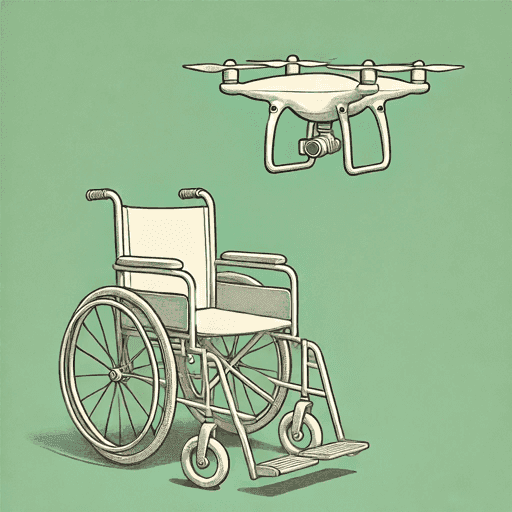
When they arrive home, Carter watches his mother and Martin carry her photography drone into the garage. He realizes that the drone could help him get the evidence he needs without using the surveillance cameras since his promise only covered the cameras.
Chapter 17 Summary
During his Zoom class, Carter endures pointed remarks from Maddox and Lacey. He fakes an illness by listing symptoms he looked up online, convincing Mr. Grimes to let him sign off. He immediately takes his mother’s drone outside and launches it from the driveway, navigating using the drone’s attached camera for the first time. He briefly gets distracted by views of his neighbors’ yards before directing the unit toward the old courthouse, a mile away.
Carter locates the courthouse surrounded by a chain-link fence, with a Zippy Airport Service van parked by the gate. Flying low and circling the building, he sees no animals and cannot see through the boarded windows. He nearly crashes into a flagpole but pulls up sharply. His neighbor, Mrs. Jensen, sees him outside and assumes that he’s playing a video game; Carter plays along. He realizes that the animals are more likely to appear at night, based on when he previously saw them on the surveillance cameras, and that a daytime flight is unlikely to provide proof, even though a night flight will be riskier.
Before returning home, Carter spots the red Maserati and follows it with the drone, enjoying the feeling of surveillance again. He flies over Main Street and observes that the food war has escalated: Lunch With Louie has hired a burly bouncer, while Janine’s has contracted with a security company. As he starts to fly toward the park to check on the pregnant woman, a low-battery warning suddenly flashes on the controller, forcing Carter to abort his mission. The drone barely makes it home, landing with only 2% battery remaining. Though shaken by the close call, Carter resolves to continue using the drone until he solves the town’s mysteries.
Chapter 18 Summary
During dinner, Mr. Grimes calls to check on Carter, who maintains his lie about being sick. After Carter’s mother leaves for a photography job and Martin falls asleep, Carter takes the drone to the back patio for a nighttime launch. He navigates toward downtown using the illuminated clock tower of a tall bank building as a landmark. Struggling to find the unlit courthouse in the dark, he realizes that he can locate it by identifying the one completely dark block.
Carter flies the drone low, circling the courthouse but seeing nothing. Searching the surrounding streets, the camera spots a strange, miniature-bear-like animal. It moves awkwardly on the ground but becomes extremely agile after leaping into a hedge, using its long tail to move through the branches. Carter recognizes it from a school unit as a tree kangaroo, an endangered marsupial from Australia. He takes several photos with the drone’s camera, believing he has the proof he needs.
A Zippy Airport Service van suddenly appears, nearly colliding with the drone. Two men wearing padded gloves jump out, capture the tree kangaroo, and throw it into the back of the vehicle. Carter follows the van with the drone and watches it enter through a padlocked gate in the fence at the old courthouse. He concludes that the courthouse is being used as the base for an illegal animal operation. Recalling a childhood field trip where he saw holding cells in the courthouse basement, he believes that the animals may be kept there and that some of the animals he has seen were likely escapees, with the Zippy vans used to recapture them.
To navigate home in darkness, Carter turns on all his backyard patio lights. The plan works, and he safely lands the drone and returns it to the charger. Unable to sleep, Carter thinks through what he has learned and decides that the animals are being held illegally in Sterling, likely for profit.
Chapters 10-18 Analysis
These chapters examine The Blurred Line Between Observation and Intrusion, tracing Carter’s transition from passively observing to increasingly intrusive digital monitoring. His initial justification for watching others is rooted in the belief that observation without detection is harmless, as he wonders, “If you don't notice the fly on the wall, does it really matter if it's there?” (61). This rationale enables him to access progressively more private aspects of his neighbors’ lives, from the struggles of a young mother to the personal dinner engagement of his teacher, Mr. Grimes. Carter’s physical confinement coincides with an intensified reliance on screens, allowing the surveillance network to function as an alternate social space where he can exercise perceived control. This access fosters a mistaken sense of comprehensiveness, leading him to construct speculative narratives about figures like Needle-Nose, whom he frames as a master criminal. The narrative makes clear that Carter’s intrusion is not neutral; it is an interpretive act that, without contextual knowledge or reciprocal engagement, produces serious misjudgment. The collapse of his theory about Mr. Grimaldi exposes the limits of disembodied information and highlights the ethical risks of observation detached from relational accountability.
Carter’s journey also explores The Burden of Knowledge, particularly the limits of information wielded without accountability. After uncovering evidence of endangered animals, he attempts to act on this knowledge while insulating himself from personal risk. His anonymous calls to the police represent a form of detached responsibility: He seeks to intervene while concealing his identity, fearing that disclosure would expose his methods and lead to the loss of his technology. This refusal to attach his name to his claims undermines their legitimacy. From the perspective of authority, his reports lack credibility, positioning him not as a concerned citizen but as an unreliable informant. The narrative thus frames knowledge as ineffective when it is separated from transparency, emphasizing that information alone does not confer responsibility unless the knower is willing to stand behind it.
The confrontation at the Paris Art Shop initiates Redemption Through Accountability by forcing Carter out of digital anonymity and into the tangible consequences of his behavior. Lacey’s public condemnation—calling him “a snoop—and a pretty lousy one at that!” (90)—articulates a communal judgment that redefines his actions as intrusive rather than protective. This moment marks a shift from private rationalization to public accountability. The resulting social ostracism, which Carter names “The Great Disconnect” (94), strips him of his perceived authority and access to technology, dismantling the power structure he had built around surveillance. This enforced disconnection functions as a corrective phase rather than a punishment alone, compelling Carter to confront the real-world impact of his actions and laying the groundwork for ethical growth through loss and reflection.
The period of forced disconnection from technology prompts Carter’s exploration of Redefining Strength Beyond Physical Ability. Deprived of digital access, he is compelled to develop alternative forms of resilience. His frustration and boredom are redirected into learning to navigate his wheelchair more effectively, resulting in increased upper-body strength. This physical development emerges as a response to imposed restriction rather than as a corrective ideal and marks a shift in how Carter understands his sense of competence. His mother’s approval of this progress, framed as validation of her decision to remove his screens, reinforces the narrative association between limitation and growth without positioning physical capability as moral compensation. Carter also develops moral and emotional resilience. His refusal of Martin’s offer of the iPad signals growing self-regulation and an emerging awareness of relational responsibility. He recognizes the risk that his brother is assuming and places family trust above his own desire for digital connection. This moment marks a significant stage of maturation, in which Carter reframes strength not as recovered mobility or technological mastery but as restraint, accountability, and consideration for others.
Throughout these chapters, technology functions as a complex and dualistic symbol. The surveillance cameras initially represent a form of perceived power, offering Carter an escape from spatial confinement and a mediated window into what he understands as the town’s hidden routines. Yet they also foster misinterpretation and isolation, replacing reciprocal interaction with one-sided observation. The drone, introduced later, extends this symbolism. It operates as a more mobile technological extension, enabling Carter to traverse the town in ways unavailable to him offline. Unlike the fixed surveillance network, the drone requires active coordination and decision-making, repositioning Carter from a passive watcher to an intentional actor. While he initially uses the drone to continue intrusive monitoring, it gradually becomes a means of substantiation rather than speculation. By capturing photographic evidence of the tree kangaroo, the drone moves Carter beyond speculation and self-doubt toward certainty about what he has seen. In this sense, the drone reflects technology’s double-edged role: It is a tool that enables intrusion yet also creates the possibility of responsible action without resolving it in advance.
The narrative structure of these chapters builds tension through a pattern of escalating discovery and consequence. The author layers Carter’s findings—the successive sightings of endangered animals, the clues surrounding Needle-Nose, and the revelation of Mr. Grimes’s personal life—to draw both Carter and the reader deeper into the town’s emerging mysteries. This expanding surveillance arc contributes to Carter’s growing overconfidence and eventual collapse of judgment. The public confrontation at the Paris Art Shop in Chapter 13 functions as a structural climax for this phase of Carter’s journey, precipitating The Great Disconnect and significantly altering his circumstances. This moment operates as a narrative consequence of his prior actions, positioning his subsequent isolation and reflection as outcomes rather than imposed punishment. By alternating between the mundane reality of Carter’s confinement and the discoveries of his secret digital life, the author heightens the narrative stakes by creating a sustained gap between Carter’s interpretations and the consequences that follow, grounding his eventual shift in purpose in a period of hardship and moral reflection.

Unlock all 54 pages of this Study Guide
Get in-depth, chapter-by-chapter summaries and analysis from our literary experts.
- Grasp challenging concepts with clear, comprehensive explanations
- Revisit key plot points and ideas without rereading the book
- Share impressive insights in classes and book clubs