Snoop
54 pages • 1-hour read
Gordon KormanSnoop
A modern alternative to SparkNotes and CliffsNotes, SuperSummary offers high-quality Study Guides with detailed chapter summaries and analysis of major themes, characters, and more.
Symbols & Motifs
The Wheelchair
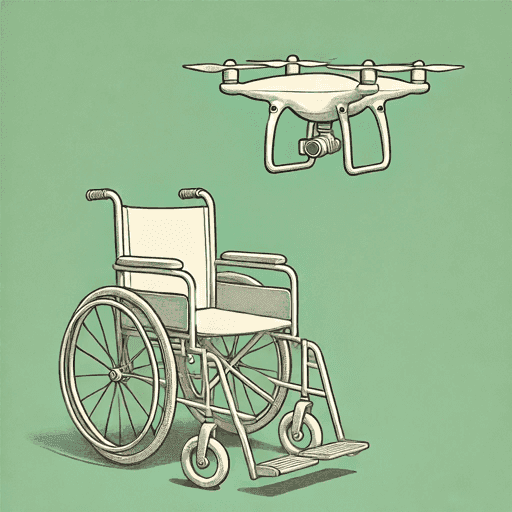
The wheelchair is a powerful symbol that charts Carter’s internal transformation throughout the novel. Initially, it represents the sudden restrictions placed on his independence after the skiing accident. Confined to “the onion room” (8), Carter experiences the wheelchair less as freedom of movement and more as a reminder of what has changed in his daily life. His frustration and reliance on others reinforce its role as a marker of reduced agency. This early phase connects to his desire for control, which he seeks through surveillance cameras and online feeds, using digital access as a substitute for direct participation in the world around him.
However, the symbol’s meaning evolves as Carter begins to adapt to his circumstances. Rather than defining himself by what he cannot do, he redirects his energy toward mastering the chair. He constructs an obstacle course and practices speed, balance, and precision, gradually transforming the wheelchair from a reminder of limitation into evidence of skill and competence. When he tells his brother, “I’ve got wheels that are faster than walking […] I’ve been practicing” (172), the statement reflects not denial of his condition but pride in the control he has developed. The wheelchair ultimately supports the theme of Redefining Strength Beyond Physical Ability, showing that strength in the novel emerges through adaptation, discipline, and responsible action rather than physical dominance alone.
The Drone
The drone functions as a symbol of Carter’s expanding agency, representing both the risks of technological overreach and the possibility of responsible action. As a boy adjusting to life in a wheelchair, Carter views the drone as a way to extend his reach beyond the limits of his physical mobility. Its ability to move freely through space gives him a sense of control and access that contrasts sharply with his restricted movement at home. Early on, however, he uses that control impulsively. When he decides to “buzz [Maddox] a little” while targeting him (53), the gesture exposes how easily distance and anonymity can encourage reckless behavior. The drone in these early scenes supports the theme of The Blurred Line Between Observation and Intrusion, illustrating how access to private space—without immediate consequences—can distort judgment and erode trust.
As the narrative progresses, the drone’s meaning shifts alongside Carter’s moral development. The information he gathers forces him to confront situations that demand accountability rather than entertainment. His use of the drone to intervene in the park and later to obstruct the smugglers’ escape reframes the device from a toy into a tool with real consequences. By the climax, when he deliberately crashes it into the smugglers’ van to prevent their getaway, the drone becomes an instrument of deliberate, high-stakes action rather than petty surveillance. Its final symbolic function underscores that technology itself is neutral; what defines it is the user’s intent and willingness to accept responsibility. In this way, the drone completes Carter’s arc from impulsive observer to someone who understands that power requires ethical judgment.
The Endangered Animals
The endangered animals function as a central symbol in the novel, representing vulnerability, the burden of secret knowledge, and the moral responsibility that follows discovery. Smuggled from their natural habitats and hidden in the old courthouse, the animals—such as the red panda and snow leopard—are placed in conditions they cannot control. Their captivity gives concrete stakes to Carter’s surveillance: Once he uncovers their existence, he is no longer observing trivial pranks or personal rivalries but a situation with legal and ethical consequences. His anonymous call to the police marks a turning point, especially when he insists, “These animals are endangered. If we don’t protect them here, it could speed up whole species going extinct!” (73). The urgency of this statement reflects his growing awareness that information carries obligation. The animals shift the narrative from curiosity to accountability.
As the crisis intensifies, the animals also compel Carter to move beyond remote observation. The escaped snow leopard creates a danger that cannot be managed through a screen, forcing him to confront events directly. In the climax, his actions place him physically in harm’s way to protect others, narrowing the distance between what he sees and what he does. The animals therefore support the theme of The Burden of Knowledge, illustrating that awareness alone is insufficient. What matters is the willingness to act when action involves personal risk. Rather than functioning as abstract symbols of redemption, the animals ground Carter’s growth in tangible stakes, making his transition from watcher to participant necessary rather than symbolic alone.

Unlock the meaning behind every key symbol & motif
See how recurring imagery, objects, and ideas shape the narrative.
- Explore how the author builds meaning through symbolism
- Understand what symbols & motifs represent in the text
- Connect recurring ideas to themes, characters, and events