Spirited Away
A modern alternative to SparkNotes and CliffsNotes, SuperSummary offers high-quality Study Guides with detailed chapter summaries and analysis of major themes, characters, and more. For select classroom titles, we also provide Teaching Guides with discussion and quiz questions to prompt student engagement.
Summaries & Analyses
Quizzes
NEWReading Tools
Prologue-Part 1Chapter Summaries & Analyses
Prologue Summary
The first graphic novel in the five-part Spirited Away series, based on the motion picture and depicted using screenshots from the same, begins with a picture of a goodbye note. It is addressed to Chihiro, the story’s protagonist, and seems to be from her best friend, Rumi. Rumi says she will miss Chihiro, and the note is surrounded by a bouquet of pink flowers, which likely symbolize Rumi’s wish for Chihiro to have a happy journey to her new home and new life. Chihiro’s mother can be heard commenting about how they seem to be “in the middle of nowhere” (6) as Chihiro lies in the back seat of the Ogino family car, looking listless and forlorn. Chihiro’s father points out Chihiro’s new school as they drive by, trying to instill some excitement into his daughter, but she sticks her tongue out and spits at it instead. Chihiro says, “It’s gonna stink. I liked my old school” (9) and buries her face in the seat. Suddenly, she sees a petal drop off the flowers while holding them and panics because they are dying. Across many pages of the graphic novel, “katakana” drift across the pages, indicating sound effects such as the car’s “vrooooom” (10) sound or the “fwish” (10) that Chihiro’s flowers make as she swishes them around in panic. Chihiro’s mother tells her to stop whining, insisting that “it’s fun to move to a new place. It’s an adventure” (12); Chihiro does not seem impressed.
Part 1 Summary
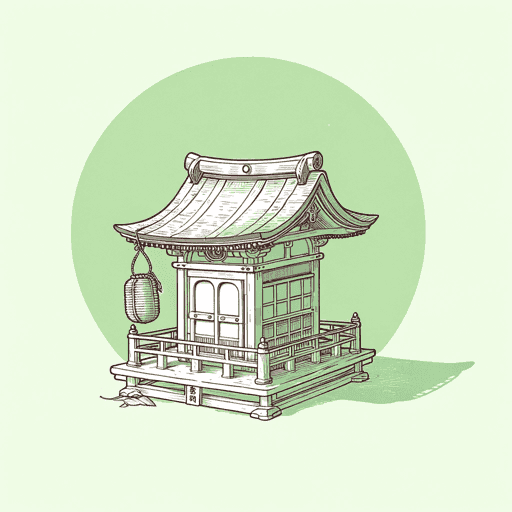
The family continues driving and leaves the last sign of civilization, entering a forested area with a road that climbs a steep and shadowy hill. Mother sees their house on the top of the hill, but it is unclear how to get there, and Father wonders if they are lost but soon regains his confidence. Mother warns against shortcuts, but he continues along the road. Chihiro notices a pile of discarded Hokora, or small Shinto shrines dedicated to spirits, strewn along the side of the road. Her mother explains they are shrines and that “some people think spirits live there” (19). The woods seem to be getting thicker and thicker, but Father has a confident smirk on his face and decides to speed up, feeling the thrill of the danger.
Not knowing much about shrines or spirituality, Chihiro sees a strange statue in the woods that appears to be smiling at her. This is a Dosojin statue, a Shinto guardian that protects against evil spirits. There is a constant “fwak” (26) sound as the car hits the branches driving by. Suddenly, they arrive at a red wall with a small dark tunnel carved out into it. The same statue Chihiro saw in the forest is standing in front of the entrance, this time with a second face that also is grinning. The red wall turns out to be a large Shinto temple. Father is overcome with curiosity and gets out to see where it leads. Mother mentions that they will be late to their new home, but after Chihiro follows Father, she gets out of the car too. At the entrance to the tunnel, Chihiro notices that the wind seems to be pulling them all toward the tunnel. Father remarks, “I want to see what’s on the other side” (33). Chihiro resists, saying, “This place gives me the creeps” (34). Her parents encourage her to come with them, but she begs them to leave. As they entire the tunnel, Chihiro stands firm, waiting outside. Noticing the Dosojin beside her, Chihiro is spooked into chasing after her parents. She clings to her mother’s arm as the three walk through the dark tunnel, making a “tok tok” (39) sound with their feet.
They find themselves in a large dark building that appears to be a station of some kind. Mother hears train whistles off in the distance. They continue walking, Chihiro still nervous and frightened, and emerge on the other side in a large, grassy clearing. Even Chihiro cannot help but marvel at how beautiful the scenery around her looks. However, she notices strange buildings in the distance and asks what they are. Her father guesses that it must be “an abandoned theme park” (45), explaining that many were built in the 90s, and most did not last when the economy collapsed. Chihiro points out that they should head back to the car, but her parents ignore her, and a large “whirrrr” (47) of wind pushes her forward again.
Prologue-Part 1 Analysis
Spirited Away begins as innocently and typically as any story. A child, Chihiro, is whisked away from her home and familiar life by her parents to move to a new place. She is distraught and listless as she lies in the backseat, staring at the ceiling and holding onto a flower bouquet that her best friend gave her as a goodbye gift. Chihiro’s connection with nature thus far ends here; it is superficial and store-bought. However, the moment that Chihiro’s father takes a wrong turn and ends up in a forest, the normal world that Chihiro knows is gone. Chihiro’s intuition tells her something is amiss when she sees the pile of discarded Hokora (small Shinto shrines). Her mother explains that “some people believe spirits live there” (19), looking at the pile with disinterest and even a slight disdain; this comment indicates that Chihiro’s family is not particularly spiritual. The lack of care for the shrines illustrates Modern Humanity’s Abandonment of Spirituality and Nature. When Chihiro spots a Dosojin (two-faced guardian of the Shinto temple) staring at her in the bushes, her expression looks as if she knows she and her parents are headed for a strange experience.
A Dosojin appears again when they arrive in front of the amusement park entrance (and the entrance to the spirit world). It beckons Chihiro to follow her parents inside, and she does so out of fear, going against her instincts. Father ironically remarks, “I want to see what’s on the other side” (33), indicating their full transition into the spirit realm. This combination of a spirit realm with regular human beings creates a magical realistic atmosphere that Chihiro must navigate to survive. A Dosojin will appear again at the end of Spirited Away, this time with no face at all; the appearance of this statue might symbolize Chihiro’s commencement and completion of a journey. When Chihiro’s parents begin exploring the amusement park, they hear train tracks, foreshadowing Chihiro’s later journey with No Face. They smell food, a key motif in the story that acts as the mechanism by which humans and the spirit world connect with each other.
The parent-child dynamic established here shows unsympathetic parents who fail to support their daughter in a period of transition, uncertainty, and fear. On the car ride, Chihiro is upset about losing her familiar life, a natural reaction for a child. In response, Mother and Father only scold her for her lack of enthusiasm, for smashing the flowers from her best friend, and for whining. They show no compassion. Later, at the temple, when her parents decide to enter the temple and Chihiro is hesitant, Father calls her a “scaredy cat,” and Mother tells her to “just wait in the car then” (37). Chihiro’s parents are determined to satisfy their curiosity and bodily appetites with no regard to their safety or their daughter’s. Chihiro stands alone as the voice of restraint and reason. After entering the spirit realm, Chihiro demonstrates wisdom and self-control, while Father and Mother exhibit foolishness and selfishness, reversing the typical parent-child dynamic. This role reversal leaves Chihiro isolated and alone to navigate the spirit world without the help of her parents, who are supposed to care for her and keep her safe.
The manga adaptation of Spirited Away is written from right to left in traditional manga fashion. It utilizes screenshots from the film and katakana to illustrate sounds the characters hear or those they make as they perform actions. Adding katakana to the manga and screenshots allows the reader to feel immersed in a film story, rather than just a traditional manga. Furthermore, the screenshots chosen are of key moments and expression changes, providing a full picture of what Chihiro and the other characters are feeling and expressing. Isolating the story into five parts, beginning with its prologue and first act, creates opportunities for a deeper and more complete experience and analysis of the story as the reader is forced to slow down and examine each moment with its symbolism, foreshadowing, and detailed imagery.

Get in-depth, chapter-by-chapter summaries and analysis from our literary experts.
- Grasp challenging concepts with clear, comprehensive explanations
- Revisit key plot points and ideas without rereading the book
- Share impressive insights in classes and book clubs