Spirited Away
67 pages • 2-hour read
Hayao MiyazakiSpirited Away
A modern alternative to SparkNotes and CliffsNotes, SuperSummary offers high-quality Study Guides with detailed chapter summaries and analysis of major themes, characters, and more. For select classroom titles, we also provide Teaching Guides with discussion and quiz questions to prompt student engagement.
Summary
Background
Chapter Summaries & Analyses
Character Analysis
Themes
Symbols & Motifs
Important Quotes
Essay Topics
Tools
Symbols & Motifs
The Spirit World
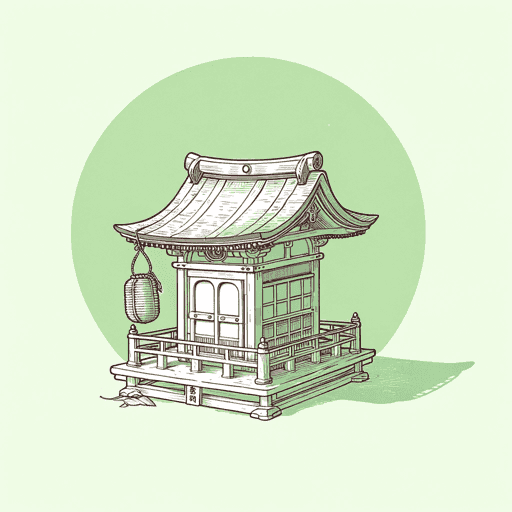
The spirit world or realm is a central motif in Spirited Away. It is a world apart from the everyday human world, but Chihiro and her parents find themselves drawn right into it as they drive to their new home on the hilltop. Chihiro’s father makes a wrong turn and starts careening down a forested path. As he drives, Chihiro notices shrines and guardian statues in the woods. First, she sees a pile of Hokora strewn in a pile beside the road. These miniature Shinto shrines are usually meticulously placed, and to see them this way is odd. Chihiro’s mother scoffs at the shrines, showcasing her lack of regard for nature and the spirit world. Although Chihiro is not spiritually aware, she still senses that something is wrong. Still, her father drives on, and she spots a Dosojin statue staring at her in the trees. A Dosojin is a Shinto guardian deity with two faces. They are commonly placed at entrances and barriers, and in this case, the Dosojin are guarding the entrance to the spirit realm.
A Dosojin is standing right in the middle of the road, and Father grinds the vehicle to a halt when he sees it. This Dosojin stands in front of the tunnel leading to the amusement park where the spirits reside. Chihiro stares at it with apprehension, but her parents take no notice and continue on. On the other side of the entrance, a wide field exists, and it is lined with many Dosojin. Chihiro and her parents follow the path to a dried-up river and cross it. As they do so, they enter the spirit world and begin smelling food.
Spirits themselves hold a significant place in Spirited Away, and the title plays on the word spirit, meaning to “remove” or “kidnap.” In the story, spirits also exist as living characters who can influence Chihiro and her parents and smell and interact with them. Yubaba, a witch who has gained control of a spirit bathhouse, runs it for profit. The bathhouse exists to cleanse spirits of dark energy, emotions, memories, and filth. It also houses several workers, all of whom seem to be of a toad or frog. As night falls on the park, Chihiro witnesses a riverboat full of spirits enter the park. She also walks across the bridge to the bathhouse and is instructed to hold her breath by Haku, who has used a spell to make her invisible to them: “Even the tiniest breath will break the spell…And then everyone will see you” (123). There is a duck spirit with a leaf on its head, a No-Face greed spirit that Chihiro later befriends, and many others. Chihiro and Haku overhear the workers saying they can smell a human, and Haku tells Chihiro to seek out Kamaji, the boiler man, to get a job at the bathhouse. In doing so, she will become part of the spirit world for a time and be able to stay there and save her parents. Now that Chihiro is trapped by the river and bound by love for her parents, she has no choice but to follow Haku’s advice.
Food
Food symbolizes greed, decadence, lack of consideration for nature and what it provides, and the risks of allowing oneself to be absorbed in abundance. Chihiro’s parents seem to have no care for nature, as Mother scoffs at a pile of shrines and Father speeds through the brush as if it does not even exist. They trample through the abandoned amusement park, now slowly being taken over by nature once more, as if they belong there. Chihiro knows they should not be there, but her parents see her as a naïve child and do not listen. When her parents smell food cooking after they cross the river into the spirit realm, they are completely overtaken by greed and desire, and they follow the smell toward a horrible fate, going so fast that Chihiro can barely keep up.
The entire street is filled with nothing but restaurants, and Chihiro’s parents walk with tunnel vision toward the smell. They find a restaurant filled with platters of decadent foods, many of which they do not recognize: “I wonder what this is called. Oh, it’s delicious!” (60). They seem to act as if they are invincible, given their total lack of belief in the spiritual. They begin eating the food as if it does not matter that nobody is around to consent to do so. Father remarks that he has money, so there is no need to worry. They sit down and dig in, and what follows is a montage of Chihiro’s parents gorging on mounds of unknown foods as their cheeks seem to get larger and larger. Chihiro stands behind them, staring in horror and begging them to stop: “We’re going to get in trouble. Let’s just get out of here!” (60). Chihiro wanders off to find help, and when she returns, she finds that her parents have turned into pigs. They are massive, sweating, and still eating. Overstuffed and exhausted, Father suddenly falls to the ground and begins squealing at Chihiro as spit flies out of his mouth. Chihiro’s parents have fully succumbed to their greed, and now it is up to Chihiro, a much younger yet much wiser person, to save them.
Rivers
Rivers are a recurring symbol in Spirited Away and are used to illustrate nature as a giver of life and as an example of how human activity is destroying nature. The idea of a water god or water spirit that personifies the divinity of water (Suijin) is popular in many cultures but originates in Japanese culture from the Shinto religion. The spirits that inhabit the amusement park, including Haku, live in another time and place in which nature is untouched, the river is full and vibrant, and humans are nowhere to be found. This is all the result of Yubaba, the witch who runs the bathhouse, and the other spirits who live and work there. Haku, who was a river spirit of the Kohaku River, became displaced when the river was filled in and developed. He found a new home at the bathhouse, albeit this home is more like a trap.
When Chihiro and her parents first cross the river, they cross over into this other realm. The river is dried up in the human world, a remnant of a beautiful and natural past. Chihiro’s parents seem to have no concern for where they may be headed; their only worry is finding the source of the delicious smell. When Haku finds Chihiro later, he warns her she must cross the river before nightfall: “You’ve got to get across the river!” (75). Chihiro does not make it, and the river not only fills up but widens significantly. The amusement park entrance appears to be far off in the distance. Chihiro is now trapped in the spirit realm until she can figure out how to free herself and her parents.
Enjoying this free sample?
See how recurring imagery, objects, and ideas shape the narrative.
- Explore how the author builds meaning through symbolism
- Understand what symbols & motifs represent in the text
- Connect recurring ideas to themes, characters, and events