54 pages • 1-hour read
Strange Pilgrims
A modern alternative to SparkNotes and CliffsNotes, SuperSummary offers high-quality Study Guides with detailed chapter summaries and analysis of major themes, characters, and more.
Symbols & Motifs
Content Warning: This section of the guide includes discussion of death, child death, gender discrimination, animal death, and death by suicide.
Sleeping Beauty
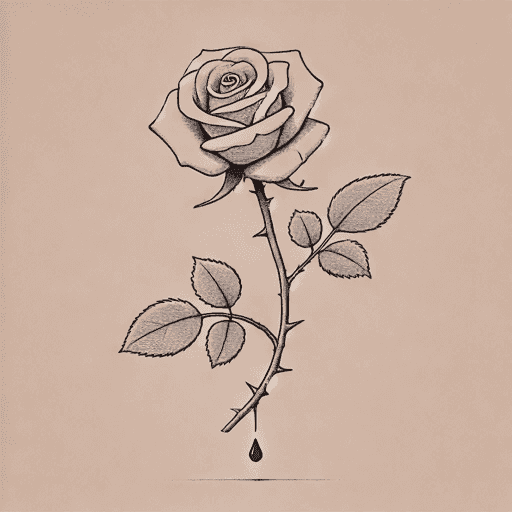
The fairytale character of Sleeping Beauty is referenced or alluded to several times in these stories, serving as a prominent motif. In the original story, a princess is cursed to fall into a death-like sleep after she pricks her finger on a spinning wheel. She is finally woken by a prince who discovers her sleeping form and kisses her. After she wakes, they marry. In “The Saint,” the child’s body is tacitly compared to Sleeping Beauty when she is described lying in her coffin, looking like a sleeping bride. In the following story, “Sleeping Beauty and the Airplane,” the attractive woman—directly referred to as “Sleeping Beauty”—sleeps while the male narrator admires her and engages in romantic fantasies about her, wishing that he could wake her. In “I Only Came to Use the Phone,” the moment when Saturno knows his wife has capitulated to his control is when he finds her sleeping on the couch, “with the crown of orange blossoms and long tulle train worn by virgin brides” (79). “The Trail of Your Blood in the Snow” features a young woman who dies after pricking her finger on a rose, a flower linked to the Sleeping Beauty story, as the sleeping woman’s name is “Briar Rose” in some versions of the story.
A key part of the Sleeping Beauty story is the central figure’s passivity. She falls into her death-like sleep after an accident caused by others’ malevolence. She cannot rescue herself and simply becomes the site of another’s heroism and control. The Sleeping Beauty figures in Strange Pilgrims are similarly passive—a dead child, sleeping women, and a young newlywed who accidentally pricks her finger and dies as a result. Their function is to highlight the actions of the men around them and to characterize these men through their response—or lack of response—to the helpless female figure. The motif thus hints at the intersection of the Latin American Experience in Europe with gendered oppression.
The motif also connects to the collection’s exploration of the border between sleep and death, as in the original story, the princess sleeps for so long—100 years—that it is, functionally, as if she has died. In “The Saint,” Duarte’s deceased child is described as “still sleeping after a long stay underground” (38). In “Sleeping Beauty and the Airplane,” the unnamed “Sleeping Beauty” takes pills to help her sleep, and she sleeps so soundly that the narrator worries “that the pills she had taken were not for sleeping but for dying” (59). In “I Sell My Dreams,” the woman who has just died spent a lifetime selling the product of her sleep—her dreams—and is given an allusive nickname that invokes the Mexican painter Frida Kahlo, who famously painted El Sueño (La Cama)—“The Dream (The Bed)”—as an exploration of the relationship between sleep and death. In “The Ghosts of August,” Ludovico’s ghost appears only when the narrator is sleeping.
Many Latin American traditions see sleep as a transitional state linking the conscious, living world to the spiritual world of the dead. Dreams are sometimes believed to bring messages from this spiritual realm into the everyday world of the living—which is exactly what happens in “I Sell My Dreams.” The repeated association of women with sleep and death in Strange Pilgrims suggests that they are more intimately connected with the unseen world than are the collection’s male characters.
Catholicism
As one of the most visible legacies of colonialism in Latin America, the Catholic Church plays a central role in the collection’s examination of the relationship between Europe and its former colonies. In stories like “I Only Came to Use the Phone,” the relationship is an overtly oppressive one, and Catholic imagery mediates the atmosphere of subjugation; the psychiatric hospital in which Maria finds herself has cathedral-like stained glass windows, observes the Church’s canonical hours of prayer, and is likened to a “cloister.” Here, the motif of Catholicism contextualizes Maria’s plight within the history of European colonialism and, specifically, forced conversion. In this respect, it is significant that the collection’s Catholic imagery frequently evokes the pre-modern Church. For instance, Prudencia Linero wears a hair shirt and undertakes a religious pilgrimage in “Seventeen Dead Englishmen”—practices more common in the medieval era than the modern one, even among believers. The strictness of the collection’s Catholicism—its emphasis on self-mortification—evokes the ethos of the Spanish Inquisition, which lasted through the mid-19th century and thus shaped the imposition of Catholicism in the colonies.
The motif is not solely negative in its connotations, however. In particular, the collection explores the devoutness of Latin American Catholics, associating it with innocence and a capacity for wonder. This is particularly true of the story “The Saint,” where the titular phrase refers both to the incorruptible body of Duarte’s young daughter and to Duarte himself. The child’s body, “dressed as a bride who was still sleeping after a long stay underground” (38), invokes the text’s Sleeping Beauty motif and suggests a kind of purity waiting for the right man’s love and faith. This symbol of pure, innocent faith is hidden away from the mundane and corrupt world of Rome (ironically, the seat of the Catholic Church) in a simple pine box, reinforcing the sense that the girl’s body is something intended to be seen only by the truly faithful. Indeed, the miracle of her incorruptible, weightless body is wasted on the Vatican functionaries whom Duarte contacts: They scoff at him and dismiss the evidence of their own eyes. It is only the story’s Andean characters who fully understand the miracle and believe in the child’s sainthood.
Duarte, of course, is the chief representative of this phenomenon. He believes so deeply in his daughter’s sainthood that he devotes more than 20 years to the effort to have her canonized. Duarte is a serious, scholarly person unmoved by the pleasures of Rome. He spends his time reading and composing scrupulous accounts of his finances to send back to his Andean village to assure the people supporting him that he is using their funds responsibly. During his long battle to have his daughter recognized as a saint, Duarte’s physical appearance gradually changes to that of “an old Roman” (40). This changed appearance functions like the pine box, hiding the inner purity of his Andean soul. It is this inner purity that explains the film teacher’s desire to make a film in which Duarte resurrects his daughter. Duarte, symbolically, has the “weightlessness” and “incorruptibility” that make him a suitable candidate to “wake” the holy Sleeping Beauty.
Birds
Birds feature in several of the collection’s stories, typically as symbols of innocence under threat. In “The Trail of Your Blood in the Snow,” the narrator compares Nena to a “happy bird” to evoke her gentle spirit, which cannot withstand either her marriage or the honeymoon trip through Europe. “Seventeen Dead Englishmen,” too, uses birds figuratively, comparing Prudencia to a caged chicken, but it also references actual birds, including baby chicks trampled on the docks of Naples and the Neapolitan practice of eating songbirds. The fate of these birds foreshadows Prudencia’s own, as the story implies that she is unsuited to the corrupt world of Italy.

Unlock the meaning behind every key symbol & motif
See how recurring imagery, objects, and ideas shape the narrative.
- Explore how the author builds meaning through symbolism
- Understand what symbols & motifs represent in the text
- Connect recurring ideas to themes, characters, and events