Swift River
53 pages • 1-hour read
Essie ChambersSwift River
A modern alternative to SparkNotes and CliffsNotes, SuperSummary offers high-quality Study Guides with detailed chapter summaries and analysis of major themes, characters, and more.
Symbols & Motifs
Pop’s Sneakers
Content Warning: This section of the guide contains discussion of death and racism.
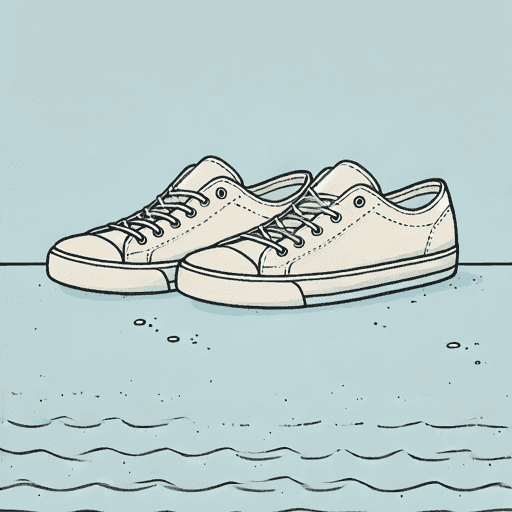
The image of Pop’s sneakers opens the novel: “Picture my Pop’s sneakers: worn-out and mud-caked from gardening, neatly positioned on the riverbank where the grass meets the sand” (1). These sneakers, left by the Swift River with his wallet and keys tucked inside, are the only trace of Pop left after he vanishes. Ma and Diamond work to get Pop declared dead so that they can receive the life insurance money that would help them to pay their bills, but the mysteriousness of his disappearance complicates their efforts, as does the fact that people report seeing Pop in the area. On one level, the sneakers therefore represent the mystery of Pop’s disappearance, one of many family secrets that Diamond must grapple with, and the difficulty of moving on in the absence of certainty.
The detailed imagery Chambers uses to describe the sneakers also holds symbolic significance. The age and wear on the sneakers demonstrate Pop’s inability to get a new job after being fired from the mill: He cannot afford new sneakers. The mud refers to his precious vegetable garden, which he cultivated with great care, taking college courses in botany and putting the lessons into practice even after he was forced to give up the classes due to lack of employment.
Diamond’s Bicycle
Diamond’s red bicycle is her only transportation given that her mother refuses to drive anymore and Diamond does not yet have her driver’s license. However, by the time the 1987 storyline opens, it no longer serves even this function, as Diamond explains, “The summer after I turn sixteen, I am so fat I can’t ride my bike anymore. So I let it get stolen on purpose” (7). The bicycle, a means of transportation that cannot transport Diamond, represents the fact that she is seemingly bound to Swift River even as she desperately wants to leave and make a new life somewhere else. Recognizing this, Diamond abandons her bike and signs up for driver’s education classes that will give her a license and a chance to escape.
Bikes resurface again in the novel’s conclusion. When Ma and Diamond return home from the courthouse, Diamond discovers that Ma has purchased matching bikes for them. Looking back on that moment, Diamond says, “You had propped them up against the side of the car, hidden from street view—two beautiful bikes. One red, one blue” (284). Diamond has a mixed reaction to the new bikes: “Ma, I didn’t thank you. I couldn’t bring myself to do it, couldn’t tell you how much it meant to me. It felt like a concession, like absolution. I wasn’t ready” (285). The new bikes that Ma purchases indicate her belief that they will stay in Swift River—that things will stay the same, except with a little more money. Diamond is unwilling to settle for that: She needs to stretch out and drive away to find her own destiny. In retrospect, however, she also regrets how she responded to Ma’s gift, which was lovingly unintended. The gift thus symbolizes the broader miscommunications in the mother-daughter relationship, where both parties genuinely care for each other but often struggle to understand one another.
Swift River
The town of Swift River represents the hold that systemic racism holds over the Newberry family, illustrating The Intergenerational Harm of Racism. As Lena writes to Diamond, “[Sweetie] never forgave his father for taking Robbie away from her, especially to go to Swift River, of all places. Hating that town is like inheriting your granddaddy’s eyes—it’s in the Newberry DNA, crouched down inside every cell” (22). The family hatred for Swift River relates to its abuse of its Black residents in the early 20th century; this extends into the next two generations, who continue to struggle with the town’s racism.
In this context, Swift River feels like a trap to Diamond. She describes her hometown, saying, “Swift River is a valley town. Once the sun starts to set behind the two ranges that surround us, they look like outstretched, muscly arms, tricking us all into feeling protected. Keeping us from ever leaving” (46). Here, Diamond remarks on the deceptive nature of the town’s geography, a symbol of the town’s attitudes. While the residents might allow her and her family to live there, they are only tolerating her while also holding her back from achieving her potential. No matter how hard Clara, Pop, or Diamond might work, Swift River will prevent them from attaining lasting success and happiness.

Unlock the meaning behind every key symbol & motif
See how recurring imagery, objects, and ideas shape the narrative.
- Explore how the author builds meaning through symbolism
- Understand what symbols & motifs represent in the text
- Connect recurring ideas to themes, characters, and events