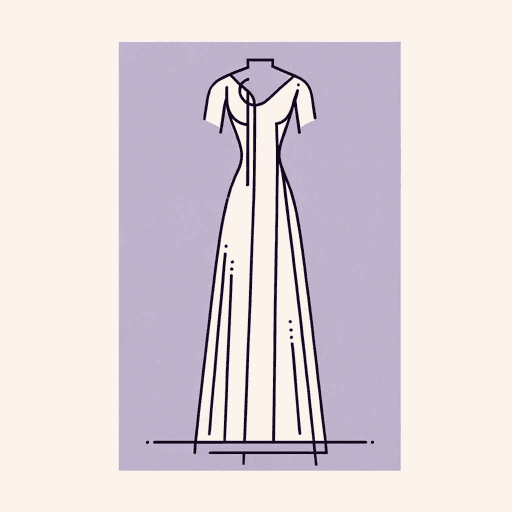
Tender Buttons [A Long Dress]
Tender Buttons [A Long Dress]
A modern alternative to SparkNotes and CliffsNotes, SuperSummary offers high-quality Study Guides with detailed chapter summaries and analysis of major themes, characters, and more.
Themes
Domesticity
Tender Buttons may be a sweeping 20th-century masterpiece characterized by its experimentation and perceived difficulty, but it remains grounded in the experience of the every-day. The three sections, “Objects,” “Food,” and “Rooms,” constitute encounters with things Stein (and, presumably, all of us) have every day in our own homes. This poem, “A Long Dress,” is also threaded through with domesticity. Certainly clothing itself is domestic, as is the poem’s evocation of sewing “machinery,” “crackl[ing]” with “current” (Line 1). The poem asks “what is this current” that runs through the “machinery” but also that “presents […] a necessary waist” (Line 1). The current, here, implies domestic use of electricity but also the rhythms of life that “present a long line” that “make[ it’s] machinery” (Line 1). These forces are just as pervasive, boundless, and indefinable as “the wind” (Line 3).
The last paragraph of the prose poem presents a series of choices and demarcations (nonrepresentational as they may be) between colors: “only a white and red are black,” “a yellow and green are blue,” and “a pink is scarlet” (Line 4). Among other things, this sequence can be read as an echo of the little choices we make every day in domestic life as, for instance, in the sewing of a dress. The speaker is sure of herself, particular, and almost fastidious in her matter-of-fact list of definitions and decisions. The tone of this sequence almost recalls a home chef in her kitchen, making the series of mundane choices that constitute an average day. The decisions and definitions themselves map only absurdly on to universal truths or declarations: How can it be true that “only a white and red are black” (Line 4)? However, that does not make the actions of these little choices any less important as pieces of a life lived. The choices themselves “distinguish” (Lines 5 and 6) and draw the “line[s]” (Lines 5 and 6) that demarcate the shapes of a day.
Definition and Identity
While it is true that, far more than most poetry, “A Long Dress” (and Tender Buttons in general) refuses to be pinned down, defined, or identified, the actions of definition and identity remain primary themes of the text. While the string of “What is” (Line 1) questions that dominate the beginning of the poem are never exactly answered, the form of the question quests for identity. The closest thing to an answer the poem provides is in its conclusion: “A line distinguishes it” (Line 5). While ambiguity infuses this statement (what is this “line” that haunts the poem, to what does the “it” refer, etc. [Lines 5 and 6]), the form of the answer is one of definition. A boundary—“a line”—distinguishes one thing from other things. Searching for more clarity than that seems as fruitless as searching for the bounds of “the wind” (Line 3). However, it is undeniable that the poem is threaded with a search for identity.
Of course, this thematic preoccupation with identity and definition pairs well with the poem’s relationship to gender. The act of wearing gendered clothing like a “long dress” is one of demarcation, declaring a certain type of gender identity. However, actually declaring the limits of some identity can be as nonsensical as declaring that “pink is scarlet” (Line 4) or “white and red are black” (Line 4). The actions of identity and definition do not “distinguish” something as itself. Instead, they “just distinguish[] it” (Line 6) from other things or, perhaps, “just distinguish[]” (Line 6) it only so far, “present[ing] a long line” (Line 1) without exactly pinning a thing down. However a reader understands the conclusions of the poem on identity, the actions and language of identity and definition form a central part of the poem’s grammar.
Perception
As a Modernist poem, “A Long Dress” naturally pays close attention not simply to representing objects but to the ways that objects are perceived. Many of the art movements in the 19th and 20th centuries involved a turn away from objective representation, focusing instead on the nature of human perception. This is, in part, a result of the impact of earlier shifts in philosophy finally trickling their way down to the art world. The “transcendental turn” of philosophy happened about a century before its impact hit the art world, centered largely around the 18th-century work of Immanuel Kant. While the history of Western philosophy had so far focused its attention on the world itself, the transcendental turn focused on how people perceive the world instead of the world as such. Similarly, art movements began to focus on subjective experience instead of an objective reality. Impressionism is one of the most well-known and earliest examples of this shift, where the painters depicted not objects per se but the way that people perceive objects.
“A Long Dress” experiments with these tactics, depicting not the “Objects” referred to in the title of the section themselves, but to the linguistic clouds through and by which people perceive those objects. The poem is not a description of a “long dress” but a series of word-impressions that form an object in their own right. The “What is” (Line 1) and “Where is” (Line 4) questions of the poem refer both to identity and the active grasping that defines any act of perception. The poem is filled with visual qualities, the “dark place [that] is not a dark place” (Line 4), the flurry of colors, the “long line” (Line 1) and the “distinguish[ing]” “line” (Line 6), and more. Perception is not simply sensory features but also already infused with meanings and contexts. Consider the “necessary waist” (Line 1) of the first paragraph, or the “serene length” (Line 4) of the last—in each of these, a perceived thing is infused with meaning even before it is given context. While impressionistic painting may provide color, line, form, and shadow before it provides a solid object, Stein goes even further. “A Long Dress” provides color, form, and sound colored by emotion and syntax before (and without) locating them in a narrative or complete picture.

Unlock every key theme and why it matters
Get in-depth breakdowns of the book’s main ideas and how they connect and evolve.
- Explore how themes develop throughout the text
- Connect themes to characters, events, and symbols
- Support essays and discussions with thematic evidence