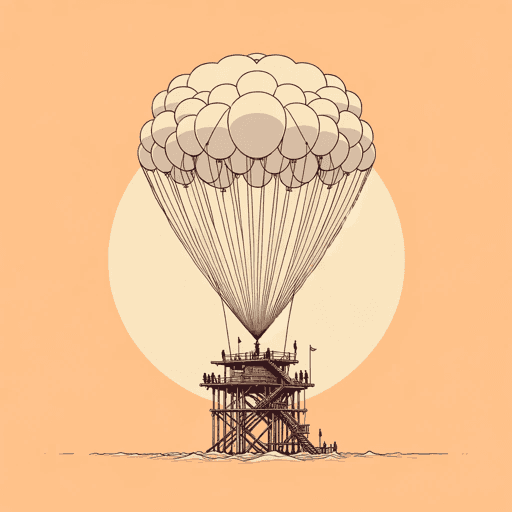
The 21 Balloons
69 pages • 2-hour read
William Pene du BoisThe 21 Balloons
A modern alternative to SparkNotes and CliffsNotes, SuperSummary offers high-quality Study Guides with detailed chapter summaries and analysis of major themes, characters, and more. For select classroom titles, we also provide Teaching Guides with discussion and quiz questions to prompt student engagement.
Before Reading
Reading Contex
Use these questions or activities to help gauge students’ familiarity with and spark their interest in the context of the work, giving them an entry point into the text itself.
Short Answer
1. What does the word “utopia” mean, and how is it related to literature?
Teaching Suggestion: The main story of The Twenty-One Balloons takes place in a utopian society. Because students may be more familiar with the idea of dystopia than with the long tradition of utopian literature, they might begin by describing dystopian stories and then speculate about the characteristics of dystopia’s opposite or contrast the two. This prompt is designed to ensure that all students have the necessary background knowledge to appreciate how the novel fits into this tradition. The resources below may be helpful in providing background on utopian literature from which select pieces of information might be shared with students, depending on readership level and goals of the unit.
- This 3-minute video from BBC Ideas explores the history of utopianism. (Teacher-appropriate; not student-facing without teacher guidance due to maturity of content and images)
- This article defines and gives examples of different types of utopian fiction. (Teacher-appropriate; not student-facing without teacher guidance due to maturity of content and examples)
2. What is a satire? How does this literary form compare with parody? What are some examples of satires that you have watched, read, or played?
Teaching Suggestion: The Twenty-One Balloons pokes fun at politicians, new technology, and general human foibles. Students are likely to have encountered satire before, but they may be unaware of the term itself and may lack prior knowledge that will help them analyze du Bois’s purposes in this novel. The prompt might be used to assess whether there are gaps in students’ knowledge; students might work together before or after responding to the prompt to generate examples of satire (and/or parody). Students may enjoy discussing the examples of satire they have encountered before either in small groups or as a class; doing so will enrich their understanding of the term.
- This resource offers examples of satire. (Teacher-appropriate; not student-facing without teacher guidance due to maturity of content and language)
- This 5-minute video from Oregon State University thoroughly explains the concept of satire. (Teacher-appropriate; not student-facing without teacher guidance due to mature examples)
Short Activity
In the book you are about to read, a man goes on a long trip in a custom-designed hot air balloon. The basket of his balloon is designed like a small house. Imagine that you are about to embark on a long trip like this; you want to be comfortable, safe, and content on your journey. What would your balloon and basket look like? Draw and label a picture of your balloon and basket.
Teaching Suggestion: Students are likely to have widely varying background understanding of what hot air balloons are; this activity is designed to make sure they are all familiar with the concept and to offer them a fun way to connect with Sherman’s adventures personally. The resources listed below explain the typical parts of a hot air balloon and show the potential variety of these parts.
- This site displays a labeled illustration of a hot air balloon and offers brief explanations of each of its parts.
- This 10-minute video features a compilation of unique hot air balloons. The video has no narration and can be clipped to suit the time available.
Differentiation Suggestion: Students with visual or motor impairments may not be able to complete this assignment as written. Students might write a paragraph describing their custom basket instead.
Personal Connection Prompt
This prompt can be used for in-class discussion, exploratory free-writing, or reflection homework before reading the text.
In the story you are about to read, the main character travels to an unusual place that is in some ways an ideal community—a “utopia.” What would an ideal community be like, in your opinion? What does your answer reveal about the qualities that you value in yourself and others?
Teaching Suggestion: Sherman travels to a community that has no financial worries and where everyone cooperates to create a welcoming environment full of amazing and helpful technology. This utopian vision represents the personality and values of the book’s author. Students might spend 5-6 minutes in reflection, imagining their own utopias; afterward, they might address the first question in the form of a brainstormed list. Then, students can consider how their visions reflect their personalities and values. Students may enjoy discussing their answers, either in small groups or as a class, after they have finished responding to this prompt. Considering what most people’s imagined utopias have in common and in what ways they differ is a useful foundation for later discussion of thematic elements of the novel related to Balancing Risk and Planning, Building Community, and Ingenuity as an Engine of Happiness.

Unlock all 69 pages of this Study Guide
Get in-depth, chapter-by-chapter summaries and analysis from our literary experts.
- Grasp challenging concepts with clear, comprehensive explanations
- Revisit key plot points and ideas without rereading the book
- Share impressive insights in classes and book clubs