The Bite of the Mango
89 pages • 2-hour read
Mariatu KamaraThe Bite of the Mango
A modern alternative to SparkNotes and CliffsNotes, SuperSummary offers high-quality Study Guides with detailed chapter summaries and analysis of major themes, characters, and more. For select classroom titles, we also provide Teaching Guides with discussion and quiz questions to prompt student engagement.
Chapters 1-3Chapter Summaries & Analyses
Chapter 1 Summary
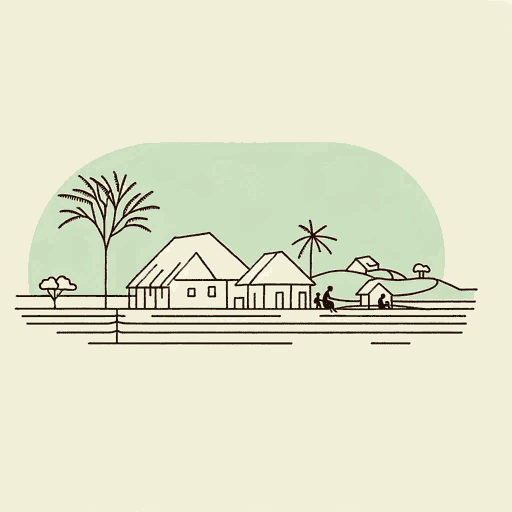
The book opens with Mariatu, age eleven, living in Magborou, a small village in Sierra Leone. Mariatu lives with her aunt, Marie, and uncle, Alie, a common practice in her country. They share a clay house with relatives and several other families. Life in the village is lively and communal and Mariatu spends her days working on the village farm and her evenings “dancing to the sound of drums and to people singing” (15).
Mariatu spends time with her older cousins, the friendly joker Mohamed, bossy and impatient Ibrahim, and Marie’s youngest daughter, Adamsay. Mariatu is a little jealous of Adamsay and is sometimes unkind to her but, for the most part, the two are close. Earlier in her life, Mariatu had also enjoyed spending time with her half-brother, Santigie, but he died several years ago.
One day, an older man named Salieu accosts Mariatu and, standing “so close I could feel his hot breath on my cheek” (20), he tells her that he will marry her one day. Mariatu is upset because she wishes to marry her friend Musa but Marie insists that the marriage will go ahead because Salieu is a family friend.
The village chairman reports that armed rebels are drawing closer to Magborou. Whenever a fresh report comes in, the villagers hide out in the bush, sometimes for days. The following year they decide to move to a larger village named Manarma, believing that this will offer them protection.
Chapter 2 Summary
When Mariatu was seven, her grandmother taught her that “Whenever you dream of palm oil […] blood will spill by the end of the day” (25). Since then, she has dreamt of the dark orange cooking oil several times and always accidentally drawn blood the following day. On her first night in Manarma, she has a harrowing dream in which “the thick oil coated my body from head to toe” (25). The next day, Alie orders Mariatu and her cousins to return to Magborou for supplies. Remembering her grandmother’s warning, Mariatu does “something children are never supposed to do in Sierra Leone” (27) and refuses, but Alie ignores her protests.
After they hear gunshots, the adults accompanying the cousins decide to send Mariatu and Adamsay back to Manarma for safety and a palm oil salesman asks Mariatu to take a jug of oil with her. When they arrive, they find rebels ransacking the village.
After the rebels capture the girls, Mariatu notices that the palm oil salesman has also returned to Manarma and is forced to watch as the man is gunned down by a rebel almost as young as she is. The rebels also force Mariatu to watch many other terrible things. Mohamed and Ibrahim are captured and beaten, her friend Mariatu is killed in a burning building, a woman carrying a baby is beheaded, and Salieu is shot “in the head and stomach” (33).
Part of Mariatu wishes to join the dead but, when a rebel asks if she enjoyed the atrocities she has witnessed, she remembers Marie directing her to “always say you like what you see, no matter how bad it gets” (34). Mariatu says “Yes” and the rebel concedes that they “may keep you alive after all” (34). As the chapter closes, Adamsay is dragged into a hut and Mariatu says goodbye to her in her heart.
Chapter 3 Summary
Mariatu prays to Allah to “let me die quickly” (35). When she opens her eyes, she sees rebels so young that it reminds her of opening her eyes “during a game of hide-and-seek, and finding the village kids smiling in front of me” (36). Unexpectedly, the rebels announce that she can go free. First, however, they say she “must choose a punishment” (39). When she asks what they mean, a rebel asks her, “Which hand do you want to lose first?” (39).
Kicking and screaming, Mariatu tries to fight her captors as all around rebels are firing guns. Again, she prays for a quick death, begging “Allah, please let one of the bullets stray and hit me in the heart so I may die” (39). Desperately, she asks them why they are doing this, a rebel replies that “I don’t want you to vote” and another adds that, “We want you to go to the president and show him what we did to you […] Ask the president to give you new hands” (40).
The rebels then cut off her hands with a machete, taking two attempts to remove her right hand and three attempts to remove her left. As she loses consciousness, she asks herself, “What is a president?” (41).
Chapters 1-3 Analysis
Sierra Leone’s civil war began in 1991 when the Revolutionary United Front rebelled against the rule of Joseph Momoh, accusing his government of corruption. It continued for eleven years until 2002, is believed to have cost 50,000 lives, and resulted in the displacement of two million citizens. Along with the use of rape, sexual slavery, and other forms of torture, cutting off the limbs of civilians was a tactic widely employed by the rebel forces. It is against this violent backdrop that much of Mariatu’s story takes place.
The opening chapters introduce some of the key themes of the book. One of the most prominent is the loss of childhood innocence. The reader only briefly sees Mariatu as a child, undisturbed by tragedy, abuse, and terrible burdens. Even within the first chapter, while Mariatu is only eleven years old, there is already a threat of forced marriage to a far older man, which promises to disrupt her youthful hopes and dreams.
Shortly after this, rebel violence also begins to taint Mariatu’s early life. After witnessing terrible atrocities and then suffering a violent mutilation, it is apparent that Mariatu will no longer lead a “normal” childhood. This loss is further emphasized by the youth of the child soldiers perpetrating the violence who, at one stage, remind Mariatu of village children playing hide-and-seek and yet are capable of shocking barbarity.
The second chapter also contains one of the first symbols employed in the book: palm oil. First appearing in a dream which Mariatu has been taught forewarns of blood being shed, palm oil crops up again in the lead-up to the rebels’ assault. When Mariatu and Adamsay are sent back to Manarma, a palm oil salesman asks Mariatu to take a jug of oil with her and, as though carrying a curse with her, she is still carrying it on her head when the rebels capture them. Shortly afterwards, the first death Mariatu witnesses is the palm oil salesman himself being shot by the rebels.
Faced with the extreme violence of the rebels, Mariatu partly wishes to die herself, to escape the suffering, and yet she also chooses to appease the rebels by saying that she enjoys witnessing their violence in order to save her own life. This tension between the will to survive and the desire to die is a recurrent theme throughout the book. By the third chapter, Mariatu is already praying for death as preferable to maiming, something which not only displays what will become a recurrent wish to die but also highlights Mariatu’s early understanding of disability as worse than death. As the third chapter closes, the book deftly conveys the futility and senselessness of this violence when the rebels claim to be maiming her in order to stop her voting for the president and Mariatu, entirely ignorant of the politics of her country, can only wonder, “What is a president?” (41).

Unlock all 89 pages of this Study Guide
Get in-depth, chapter-by-chapter summaries and analysis from our literary experts.
- Grasp challenging concepts with clear, comprehensive explanations
- Revisit key plot points and ideas without rereading the book
- Share impressive insights in classes and book clubs