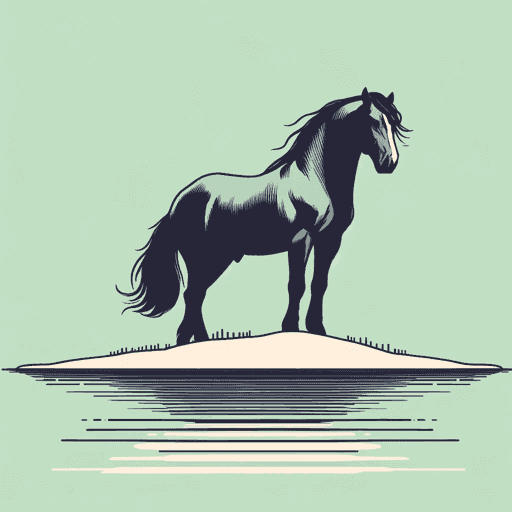
The Black Stallion
The Black Stallion
A modern alternative to SparkNotes and CliffsNotes, SuperSummary offers high-quality Study Guides with detailed chapter summaries and analysis of major themes, characters, and more.
Summaries & Analyses
Quizzes
NEWReading Tools
Symbols & Motifs
The Untamed Force
The most frequently used motif in The Black Stallion is the idea that the Black is wild and cannot be tamed. From Alec’s first sighting of the horse, when the stallion injures one of the deckhands trying to bring aboard the Drake, until the final scene where Alec prevents the Black from fighting with Sun Raider twice, Farley misses no opportunity to stress the feral nature of the Black. Those who observe the horse, even in the mitigating presence of Alec, uniformly express the idea that the Black will never be anything but wild. Jake expresses this while watching Alec ride him at Belmont. Henry tells Mr. Ramsay that no person but Alec can ride the Black. At every stage when Alec and Henry make progress in training the horse to race, Farley has a counter example of the Black’s wildness to reaffirm the horse is not tame.
Farley uses the continual affirmation of the Black’s feral nature to reveal Alec’s character in contrast. Alec is persistent, good natured, devoted, and courageous. On each occasion that Farley reveals the horse’s wildness, he follows with an example of Alec handling the Black successfully, even in the presence of awed professionals. Symbolically, as noted in the section on themes, for Farley the Black represents the emerging manhood of the remarkable boy Alec. The steadfast efforts of the boy to control the beast are an expression of Farley’s faith in youth to counter, control, and master the forces of adulthood irresistibly growing within them.
Cooperative Strangers
Alec, as a young man, has little power. If the might of the stallion is one motif, the corresponding helplessness of Alec in being able to determine his destiny is another. Alec must be rescued from the man who tries to steal his lifejacket and from the barren island. He has no way to repay those who saved him from the island, going to extremes to save the Black. Further, he has no money to pay for passage to New York, no permission to keep the horse, and no place to stable the horse. When he decides to race the Black, he has no idea how to train him, no track to use, no ability to put him in a race, and, once entered in a race, no way to get him to Chicago.
In each of these circumstances, Alec is saved by the kindness of adults—in most cases, cooperative strangers. The ships’ captains and sailors, the US animal inspectors—who ignore the Black’s attack on an officer—the Daileys, Jake, Joe, and Jim all reach out, along with Alec’s parents, to pave the way for Alec’s adventures to reach their zenith. Farley uses this motif to reinforce a typical theme of adventure stories: The worthy boy is rewarded and succeeds. Alec is the essence of the person people just want to help.
Saved by Serendipity
Along with helpful adults, Alec has more than his share of good luck throughout the story. Often what seems to be bad fortune turns out to be salvation. Knocked into the water by the Black before he can make it to a lifeboat, Alec becomes the only human survivor of the shipwreck. The wind sets his island shelter ablaze, destroying his sanctuary, but alerting sailors aboard a ship that just happens to be passing.
The motif of Alec’s good fortune continues through the narrative. Serendipitously, his new neighbor, Henry, just happens to be a world class jockey and horse trainer with a mostly empty barn and an adjacent field. Ironically, on the very day the columnist Jim Neville convinces the owners of Sun Raider and Cyclone to hold a match race, Joe Russo—Jim’s co-worker—shows up to check on Alec and the Black. Alec’s adventures highlight the idea that good fortune follows good people. This motif is characteristic of most youth adventure novels of the 19th and 20th centuries.
Women as Placeholders
Farley utilizes cliches and stereotypical characterizations in The Black Stallion. These characterizations are most prominent when he describes women, and there are only three female characters in the narrative: Alec’s mother, his aunt, and Henry’s wife. The conversations he has with his mother and Mrs. Dailey portray them as similar: plump, middle-aged ladies who are fretful and uninterested in the pursuits of the men in their lives. Both Alec and Henry exclude these women from the plans they make as well as from explanations about what’s happening.
More telling than the stereotypical way the male characters treat these women are the monochromatic responses the women make. Mrs. Ramsay, who believed for weeks her son had drowned, then waited several more weeks for him to arrive in New York, only to see him fall beneath a massive wild horse whose hooves land on either side of his head, responds by hugging her son and crying without saying a word. Her comments at the end of the book, after she watches her son nearly fall off the wild horse while winning a championship match race and setting a new world record, are equally tepid: “all I care about is that it’s over and he’s safe” (196). The women in The Black Stallion do not have much to say or do, which is a stereotypical characteristic of many similar adventure books.

Unlock the meaning behind every key symbol & motif
See how recurring imagery, objects, and ideas shape the narrative.
- Explore how the author builds meaning through symbolism
- Understand what symbols & motifs represent in the text
- Connect recurring ideas to themes, characters, and events