The Children Act
The Children Act
A modern alternative to SparkNotes and CliffsNotes, SuperSummary offers high-quality Study Guides with detailed chapter summaries and analysis of major themes, characters, and more.
Summaries & Analyses
Quizzes
NEWReading Tools
Games
Symbols & Motifs
Piano
Content Warning: This section of the guide includes discussion of illness and death.
Fiona Mayes’s piano is symbolic of freedom and escape. The piano is located in her sitting room at home and is covered in “the silver-framed photos it support[s] in country-house style” (25). In Chapter 1, Fiona mentally retreats from a conversation with Jack about their marriage in order to study the piano. Her focus on the piano instead of on Jack suggests that she feels trapped in her marriage. Staring at the instrument and the photographs on its top is a manifestation of her longing for freedom. Furthermore, the framed photos on the piano mirror Fiona’s self-imposed containment. The photos present discrete, contained moments in time, echoing the self-containment Fiona practices at the court. She is as trapped as the images in their frames.
In the scenes where Fiona is physically playing the piano, she is free to transcend the bounds of reality. When she and Mark practice in Chapter 5, Fiona is glad that for almost an hour she doesn’t have to think or talk about the law. Playing the piano thus lets her escape from her professional worries. This phenomenon is even more acute when Fiona performs her Christmas concert at the end of the novel. While playing, Fiona “enter[s] the horizonless hyperspace of music-making, beyond time and purpose. She [is] only faintly aware that something wait[s] for her return, for it [lies] far below her, an alien speck on a familiar landscape” (206). Playing the piano liberates Fiona from her other life conflicts; in this ethereal, uncharted space, she feels most like herself. The piano thus lets her access a higher state of being. She can’t access these ineffable facets of her interiority via legal principles, moral codes, or marital relationships, so the piano frees her.
“Down by the Salley Gardens”
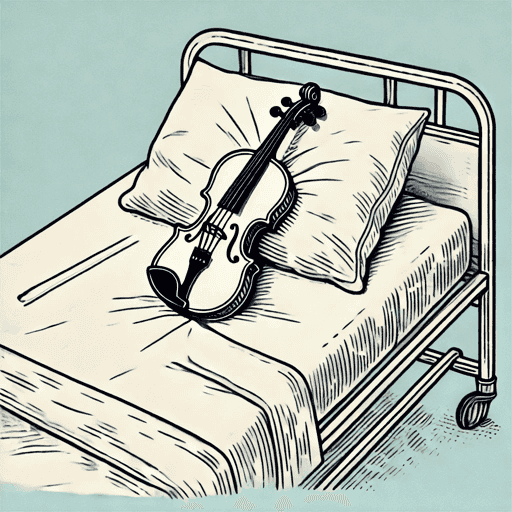
Fiona and Adam Henry play a song together during Fiona’s hospital visit. The song’s lyrics are based on a William Butler Yeats poem called “Down by the Salley Gardens,” a melancholy piece that addresses lost love. The song affects an emotional mood when Fiona and Adam play it together. The song is thus symbolic of emotional connection. The way the narrator depicts this scene from Chapter 3 captures the connective power of the song and poem:
On the first verse they were tentative, almost apologetic, but on the second, their eyes met and, forgetting all about Marina, who was now standing by the door, looking on amazed, Fiona sang louder and Adam’s clumsy bowing grew bolder, and they swelled into the mournful spirit of the backward-looking lament (121).
Fiona and Adam’s eyes meet while they’re playing the song, a moment of physical connection that mirrors their indelible, heartfelt connection. The song lets them communicate a more complex truth about longing that they otherwise can’t articulate in spoken language.
When Fiona plays the song at her concert in Chapter 5, she senses that something has happened to Adam; the song thus reiterates her innate bond with him. During the performance, she conveys “the spirit of tranquil resignation” required for the piece (207), but eventually, the tranquility mutates into unease. Playing the song again reminds her of her connection with Adam and alerts her to his fate before she confirms it. The song captures how two people can be connected in an ineffable manner that transcends the bounds of time, space, and logical reality, an idea further validated by the context and theme of the Yeats poem.
Adam’s Letters and Poems
The letters and poems that Adam writes to Fiona symbolize the search for meaning and purpose. He first shares his poetry with her when she visits him in the hospital. These early poems revolve around Adam’s faith and his anticipation of death, demonstrating his attempts to reconcile his beliefs with his medical condition and legal situation. After Adam receives the transfusion and begins to recover, he starts mailing Fiona letters and poems. In these letters, Adam expresses his gratitude to Fiona for saving his life, but he also reveals his newfound spiritual and existential questions since leaving the Jehovah’s Witness community. His heartfelt, imploring, and earnest tone in the letters captures his longing for direction. He sees Fiona as an archetypal guide and reaches out to her in hopes that she might help him navigate his newly confusing circumstances. His newer poems convey a similar need for direction and understanding; without his faith, Adam must reorient to a world without God and without his family and congregation.
Adam’s letters and poems are his way of seeking meaning and purpose, so Fiona’s decision not to write back to Adam drives him back to his parents, church, and former faith. “Without faith,” Fiona realizes after learning of Adam’s death and rereading his last poetic ballad, “how open and beautiful and terrifying the world must have seemed to him” (219). In turn, without a guide to this new expansive unknown, Adam was compelled back to his old beliefs. His life felt void of meaning and purpose outside the church because he lacked a new spiritual guide. His letters and poems capture these facets of Adam’s personal journey.

Unlock the meaning behind every key symbol & motif
See how recurring imagery, objects, and ideas shape the narrative.
- Explore how the author builds meaning through symbolism
- Understand what symbols & motifs represent in the text
- Connect recurring ideas to themes, characters, and events