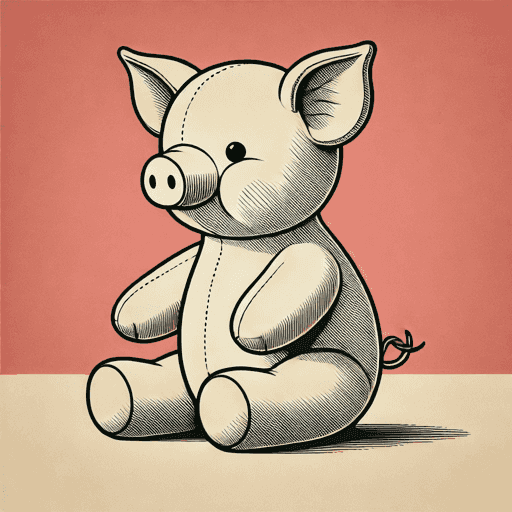
The Christmas Pig
47 pages • 1-hour read
J. K. RowlingThe Christmas Pig
A modern alternative to SparkNotes and CliffsNotes, SuperSummary offers high-quality Study Guides with detailed chapter summaries and analysis of major themes, characters, and more.
Important Quotes
Content Warning: This section of the guide includes descriptions of bullying and divorce.
“DP liked doing exactly the same things Jack did: crawling under bushes and into hidey-holes and being thrown up in the air, Jack by his Dad, and DP by Jack. DP didn’t mind getting dirty, or being dropped accidentally in a puddle, as long as he and Jack were having fun together.”
(Part 1, Chapter 1, Page 2)
In this passage, the overview of Jack and DP’s everyday adventures illustrates the boy’s deep emotional attachment to his toy, emphasizing the dynamic of Childhood Toys as Friends and Confidantes. By describing scenes from DP’s point of view, as when DP “didn’t mind getting dirty,” Rowling introduces the idea that DP is already a full-fledged person in his own right.
“‘Yes,’ said Mum, ‘but there’s a school very near our new house. I know you’ll love it.’ ‘I don’t think I will,’ said Jack. He didn’t want to move and he didn’t want a new school. Mum didn’t seem to understand: Jack didn’t want any more changes. He wanted to stay with his school friends and in the old house, where he and DP had had so many adventures.”
(Part 1, Chapter 3, Page 8)
Faced with the daunting prospect of Coping with Loss and Change, young Jack recoils from new possibilities and longs for the stability of his old life. However, he must contend with the fact that his parents’ changing relationship has turned his world upside-down. Jack’s uncertainty and sadness over his parents’ divorce later plays a significant role in his determination to rescue the lost DP at any cost.
“Beneath the blankets, DP understood everything without being told. He knew Jack felt strange about Brendan holding Mum’s hand, even though Jack liked Brendan a bit more, now that he’d gotten to know him. DP understood that Jack would rather it had been his dad holding Mum’s hand. DP shared Jack’s worry that if Brendan stopped wanting to be Mum’s friend anymore, she’d get sad again. DP was the only one Jack could tell how much he wanted things to stop changing. He never needed to pretend with DP.”
(Part 1, Chapter 6, Pages 16-17)
DP is Jack’s main confidante because the boy has few friends in his new neighborhood and does not want to upset his parents by revealing the true extent of his worry and sadness over their recent divorce. Relying upon DP to “listen” to him, Jack finds a creative outlet for his fears, even though he never fully articulates his emotions out loud.
“He made the L shape, held it up, and glared at Holly. So fast that he had no hope of stopping her, Holly leaned forward, seized DP out of Jack’s lap, and threw him out of the open window. For a brief second, Jack saw DP frozen against the steely sky, his little trotters spread-eagled; then he was whipped away out of sight.”
(Part 1, Chapter 10, Page 31)
Jack is horrified when Holly throws DP from the window of their car, sending him flying onto the highway. This tense scene highlights the tension and hostility that has been building between the two children, both of whom are overwhelmed by the necessity of considering each other siblings and learning to live with one another. Additionally, because the narrative has spent a great deal of time in establishing DP as a “person” in his own right, a moment that would otherwise be a quick show of childish pettiness, it takes on emotional dimensions, and Rowling’s descriptions linger over the anguish that Jack feels upon losing DP forever.
“Jack got slowly off the bed and held out a hand for the Christmas Pig. He felt, as Jack had expected, horrible: slippery smooth instead of rough and worn. Jack hated his shiny black eyes and perky pink ears, which ought to be lopsided and gray. ‘There’s a good boy,’ said Grandpa. At these words, Jack went into his worst frenzy yet. They thought a brand-new pig could be the same as DP, which showed how little they understood. DP was the only DP in the world and this new pig was nothing…nothing.”
(Part 1, Chapter 12, Page 38)
Jack is resentful and angry when his grandparents try to replace DP with a new pig that looks the same but can never duplicate the spirit of the toy that Jack has loved for so long. Jack’s anger reflects his deep emotional attachment to DP, whom he imagines to be his best friend. This scene clearly illustrates the intense nature of the boy’s attachment, developing the novel’s focus on childhood toys as friends and confidantes.
“‘I thought the Land of the Lost was supposed to be frightening,’ Jack said to the Christmas Pig. The huge warehouse was certainly noisy and confusing, but Jack wasn’t scared. ‘We haven’t gotten outside yet,’ said the Christmas Pig.’”
(Part 2, Chapter 16, Page 62)
The Land of the Lost provides a rich setting for the story, as Jack and the Christmas Pig traverse a warehouse, a run-down town, a beautiful city, and a treacherous wasteland. Because Jack and the Christmas Pig are yet surrounded by a plethora of unknowns, this early passage builds tension in the story, and Jack wonders what will await him once he sneaks past the warehouse guards.
“And then it struck him that there was no way back now, unless he found DP. He was starting to fear that the Land of the Lost was even stranger and more complicated than he’d first thought. For instance, what would the Things who’d gone through the other doors see when they got to the other side? And most importantly: which door had DP gone through?”
(Part 2, Chapter 19, Page 72)
Faced with the impossible task of searching an entire world for his lost friend, Jack’s increasing fear arises from his sudden realization of the high stakes of his mission. His unspoken and unanswered questions create a sense of anxiety even as Jack’s strong sense of purpose foreshadows his willingness to continue Forging Bonds through Loyalty and Sacrifice.
“‘What does ‘Unlamented’ mean?’ asked Jack. ‘It means no human cares you’ve gone,’ said the Christmas Pig, staring out over the bleak landscape. ‘It’s where Surplus goes—Things that are unloved and unwanted and useless. They don’t get any shelter. They just roam around on the Wastes, until the Loser catches them.’ ‘Well, DP definitely can’t be on the Wastes,’ said Jack.”
(Part 2, Chapter 20, Page 77)
Jack’s certainty that DP is not on the Wastes of the Unlamented illustrates the boy’s deep and abiding love for DP. Rowling also turns the story into an educational tool when she incorporates precise definitions for more challenging vocabulary words. In this way, she uses her writing to expand young readers’ knowledge of the English language even as she offers fantastical descriptions to further enhance her world-building.
“‘A pig with button eyes and lopsided ears?’ said Specs, pausing in the darkness to peer at Jack again. ‘No, son, I can’t say I’ve seen any pig matching that description.’ Jack was disappointed but not really surprised. Specs pushed open the creaking door of bedroom twenty. ‘Sleep well, fellas,’ he said. But he gave Jack a very suspicious look as he closed the door behind him.”
(Part 3, Chapter 22, Page 93)
Jack’s desperation to find DP leads him to drop his guard and ask too many suspicious questions. This passage suggests that despite the protagonists’ earnest mission, they have entered a world that contains many hidden dangers and hostile agents. Sheriff Specs’s sudden wariness of Jack also foreshadows the fact that this particular ally will soon become an enemy.
“The new town was nothing like Disposable. Everything was clean and well-tended. The snow-covered houses were all as snug, neat, and pretty as if they were made of gingerbread, their front doors painted in different colors.”
(Part 4, Chapter 25, Page 110)
The town of Mislaid impresses Jack with its quaint and colorful design, and this shift toward more upbeat, welcoming descriptions indicates that items that have been merely “mislaid” are sent to a more desirable fate than “Surplus” items that are useless and unwanted. This passage helps to establish the hierarchy of different Things and towns within the Land of the Lost, with the more treasured toys living in increasingly better circumstances.
“When there was silence again, the mayor said, ‘Now, listen! That pig and action figure are breaking the law, and when the law gets broken, it gives the Loser an excuse to break the law back! Ten years ago, to this very day, the Loser came crashing into Bother-It’s-Gone, kicking in the fronts of houses and lifting off roofs, and it’s not going to happen again, not on my watch!’”
(Part 4, Chapter 27, Page 119)
The threatening hunt for Jack and the Christmas Pig illustrates the risks that the two are taking to break local laws in their search for DP. This passage also explains why some Things choose to follow the Loser’s cruel laws rather than simply helping Jack to complete his quest.
“Jack turned back to Poem. ‘Thank you, Poem.’ She leaned down to whisper a final word in Jack’s ear. ‘The Loser hates the power of Christmas Eve. He swears, once midnight chimes, you’ll never leave.’ ‘What?’ said Jack, startled. But Poem had already closed the door.”
(Part 4, Chapter 30, Page 135)
Poem’s words of warning increase the stakes of Jack’s mission as he realizes that he might become trapped in the Land of the Lost forever. As he takes serious risks to find DP, his brave actions demonstrate his willingness to work on forging bonds through loyalty and sacrifice, and the Christmas Pig’s actions will prove that he is just as resolute as the boy he has sworn to help.
“If Christmas Eve was the one night in the year a living boy could get into the Land of the Lost, mightn’t it also be the only night when a boy could return to the Land of the Living? But as Jack couldn’t say any of this out loud without revealing to Compass that he was human, he kept quiet.”
(Part 5, Chapter 31, Page 135)
Jack’s midnight deadline echoes the patterns of classic fairytales like Cinderella, and Rowling uses this particular trope to create suspense, as Jack realizes that the magic could wear off in an instant and ruin all of his plans. His clandestine mission grows even riskier as he struggles to hide that he is a living human, not a toy like his companions.
“‘This is strange,” said the fist, in Holly’s voice. ‘What is, Bullyboss?’ asked a giant ear, in a sly voice. It slid closer. ‘I love hearing strange things.’ ‘I’m down here because I chucked a toy pig like him out of a car window,’ said Bullyboss, in Holly’s voice.”
(Part 5, Chapter 34, Page 153)
In this passage, Jack is stunned to encounter a manifestation of his step-sister’s bullying habit, and Rowling adds this encounter to expand her world-building and explore new categories of “lost” things. The very presence of Bullyboss in the Land of the Lost implies that Holly herself has “lost” her bullying attitude. The scene foreshadows her admission of remorse at the end of the novel and suggests that she will no longer be hostile to Jack when he returns to the Land of the Living. Jack also gains greater insight into his step-sister’s mindset, as Bullyboss helps him to understand that Holly only bullies Jack because she is jealous of him.
“They lay for a while without talking, but Jack could tell that the Christmas Pig wasn’t asleep. ‘We’ll still see each other,’ said Jack, now feeling drowsy, ‘when we get home. We might even all play together. You’ll like DP.’ ‘I’m sure I will,’ said the Christmas Pig. ‘We’re brothers, after all.’”
(Part 5, Chapter 36, Page 162)
Jack’s offers kind words to the Christmas Pig because his heart is softening toward the replacement toy, but the scene also contains a hidden undercurrent, given that Jack is mistaken in his belief that he will still be able to play with the Christmas Pig after retrieving DP. Although the boy does not yet know it, he will be forced to choose which of the two toys to rescue, and at this early stage, the Christmas Pig is already aware that this sacrifice lies in the near future.
“Now the nutcracker, the nail file, and the dagger were standing right beneath the suspended bunny, clearly astounded that a Thing so dirty and badly made might have a chance of being found. ‘Jack, now,’ whispered the Christmas Pig. ‘Run.’ ‘But—’ ‘It’s our only chance!’ said the Christmas Pig. ‘We can get through the gates while they’re watching the bunny!’”
(Part 5, Chapter 38, Page 171)
The author blends humorous descriptions with tense decision-making strategies as she describes how Jack and the Christmas Pig try to sneak into the City of the Missed. Because the nail file, the dagger, and the nutcracker have inherently edges or destructive purposes, they are apt candidates to serve as the Loser’s “Loss Adjusters,” and the author uses personification to imbue them with mean, violent personality traits. At the same time, the absurdity of this imagery leavens the more serious aspects of the story.
“On the other side of the gates were no streets: only a canal bordered by beautiful tall houses with wrought iron balconies. Floating on the water were a number of empty gondolas, which were moored to a striped post sticking up out of the green water. The snow dappled the boats and spotted the water with flakes.”
(Part 6, Chapter 39, Page 172)
These descriptions establish the idea that the City of the Missed is a beautiful place that is full of highly treasured Things. Because they are “missed,” their loss in the human world is mourned, and they therefore enjoy a higher status in the stratified world that is the Land of the Lost. However, the fact that DP is not here implies that an even higher level exists within this fantastical world.
“‘This is the first time anybody’s told us they know where DP is!’ said Jack, now starting to get angry. ‘You heard what Poem said! We’ve got to succeed before Christmas Day, or I’ll be trapped and I’ll never be able to take DP home! There can’t be much time left!’ When the Christmas Pig didn’t answer, Jack said, ‘Fine, don’t come—but I’m going!’ And with that, Jack turned and strode back toward the violet lady, who stood burning in the shadowy archway like a purple flame.”
(Part 6, Chapter 42, Page 192)
The mysterious “violet lady” claims to be able to help Jack and the Christmas Pig, who finds her suspicious. In Jack’s desperation, he makes the rash decision to ignore his steadfast friend’s instincts and follow the strange woman into an unknown situation. Ominous details like the “shadowy archway” and the comparison of the woman to a “purple flame” suggest that Jack is making a deadly mistake and is about to venture beyond the point of no return.
“‘This,’ said Ambition proudly to Jack and the Christmas Pig, ‘is Power, our king. Your Majesty, these are the two you’ve been waiting for: the ones who’re looking for the lost pig.’ By screwing up his eyes, Jack was able to make out the figure casting the scarlet light. He was a big, fierce-looking man with a sour expression and a jutting jaw.”
(Part 6, Chapter 45, Page 199)
In this scene, Rowling personifies abstract emotions to deliver a broader critique of real-world political dynamics. The mysterious woman, now revealed to be Ambition, serves a king named Power, and this whimsical depiction echoes the long-held truism that ambitious people often commit to serving more powerful figures in the hopes of one day rising to power themselves.
“Unlike her fellow royals, she had wings: not stiff, upstanding wings of golden plastic, like those of Broken Angel back on the Wastes, but vast feathery wings of white shading to deep pink, which trailed behind her on the floor like a train. ‘How lovely to see you two again,’ said Happiness, smiling at Jack and the Christmas Pig. ‘This,’ she said, indicating her companion, ‘is my friend Hope.’”
(Part 6, Chapter 47, Page 207)
The pattern of personification continues as Happiness and Hope take the stage together; their close proximity implies that these two traits often support one another in the real world as well. When they interrupt the king’s conversation about Jack and the Christmas Pig, their arrival foreshadows Jack’s imminent escape, implying that good can always overcome evil if hope is part of the mix.
“‘SEIZE THEM!’ roared Power, and for a moment Jack was certain that they were going to be captured and taken to the Loser’s Lair, and that he’d never see Mum or DP again. But then, to his amazement, Jack felt a warm, strong arm encircle him, heard a great whoosh of wings, and felt himself rising into the air […]. Hope had caught Jack up in one arm and the Christmas Pig in the other, and she now flew on her huge wings across the room, while Power screamed in rage.”
(Part 6, Chapter 48, Page 211)
In this scene, Hope acts as the proverbial deus ex machina to extricate Jack and the Christmas Pig from their predicament. When she risks King Power’s wrath to save them, her kindness renders her a hero and enhances the novel’s focus on forging bonds through loyalty and sacrifice.
“Jack splashed through the water, his arms wide open, and DP’s button eyes were leaking tears, and then they reached each other and hugged as tightly as ever a boy and his toy hugged, and Jack breathed in DP’s smell of bed, and garden, and of the trace of Mum’s perfume, from where she kissed DP good night. ‘DP, I found you, I found you!’ sobbed Jack, and behind the old pig a hundred battered old toys cheered and clapped their hands, their paws, and their hooves, and one little puffin turned a somersault.”
(Part 7, Chapter 50, Page 244)
In this joyful scene Jack is finally reunited with DP in his new home on the idyllic Island of the Beloved. The celebratory and sentimental scene emphasizes the mutual love between the boy and his lost toy. The vision of a fully animated DP also cements the novel’s focus on childhood toys as friends and confidantes.
“They flew on, the reindeer’s harness jingling, the icy air numbing Jack’s face. His thoughts were full of CP, who’d surely have reached the Wastes of the Unlamented by now. He’d be wandering there, missing Jack, loving Jack, but believing that Jack had already returned to the Land of the Living, too happy with DP to care what had become of his Replacement.”
(Part 7, Chapter 53, Pages 236-237)
Jack feels deeply guilty when he realizes the sacrifice that the Christmas Pig has made on his behalf, and he realizes that he has not properly appreciated his new friend’s guidance and advice throughout their adventures together. Now, he makes a sacrifice of his own by leaving DP behind and heading out on a new mission to save the Christmas Pig from the Wastes.
“The Loser’s Lair was a gigantic underground cavern, in the middle of which burned the huge fire. Cages hung all over the walls, all of them crammed with the Things the Loser hadn’t yet eaten, and it was the cries of some of these imprisoned Things he could hear, although not all of them were screaming. Many were simply huddled at the bottom of their cages, silent and sad, knowing that their end had almost come.”
(Part 8, Chapter 56, Page 249)
This vivid description portrays the Loser as a cruel and monstrous being who causes nothing but pain and destruction. The scene marks the beginning of the novel’s climax as Jack prepares to confront the Loser in his stronghold. As Jack beholds the imprisoned Things, the forlorn descriptions of their imprisonment foreshadows his decision to save them all from a bitter fate.
“The hole grew larger and larger. It was wide and golden, and then the real magic happened: instead of dropping a single shaft of golden light, and saving one Thing, the sparkling, circling light descended in a spiral and whooshed up inside it hundreds and hundreds of astonished, delighted Things. Out of their dirty cages they rose, the tin and the cardboard, the wooden, the paper, and the plastic, each of them laughing as they were drawn into the sparkling, whirling cyclone.”
(Part 8, Chapter 57, Page 259)
Jack’s hopeful speech changes the Things’ mindset for the better, helping them to break free from the Loser’s cages and travel upwards toward the Land of the Living. Their energetic and joyful passage reaffirms the author’s message that hope can overcome darkness, and the exodus from this dire place creates a dramatic conclusion to Jack’s adventure, leading naturally into the denouement as he returns to his family and makes amends.

Unlock every key quote and its meaning
Get 25 quotes with page numbers and clear analysis to help you reference, write, and discuss with confidence.
- Cite quotes accurately with exact page numbers
- Understand what each quote really means
- Strengthen your analysis in essays or discussions