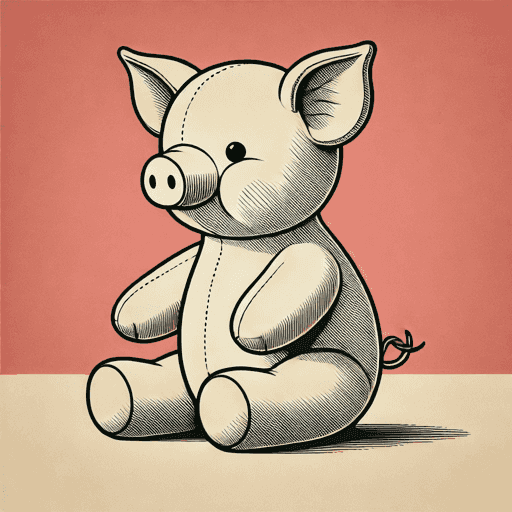
The Christmas Pig
47 pages • 1-hour read
J. K. RowlingThe Christmas Pig
A modern alternative to SparkNotes and CliffsNotes, SuperSummary offers high-quality Study Guides with detailed chapter summaries and analysis of major themes, characters, and more.
Parts 3-4Chapter Summaries & Analyses
Part 3: “Disposable” - Part 4: “Bother-It’s-Gone”
Part 3, Chapter 21 Summary: “Disposable”
In the area for “Disposables,” Jack and the Christmas Pig meet Sheriff Specs, a cheery sheriff who welcomes them. As various Things such as combs and batteries share their sadness about being put in Disposable, Sheriff Specs tries to reassure them. As the Things get ready for bed, everyone hears a terrible scream, but the Sheriff just tells them to ignore the sounds coming from the Wasteland.
Part 3, Chapter 22 Summary: “Adjustments”
The Sheriff reassures everyone that they might yet be found or their value might change. If the people who lost them try to find them, the lost objects might move to the next town, called “Bother-It’s-Lost.” Hearing this, Jack becomes convinced that DP must be in that town. The Sheriff shows Jack and the Christmas Pig to their room and says that no other stuffed pigs have come to their town. Jack pretends to be “Pajama Boy,” but the Sheriff acts a bit suspicious as he says good night.
Part 3, Chapter 23 Summary: “The Plan”
The Christmas Pig scolds Jack for behaving suspiciously and attracting attention. Jack is frustrated but tries to blend in more effectively. The Christmas Pig explains that each Thing’s “alivening” happens when humans use them and become emotionally attached to them. This event gives each Thing a sense of purpose.
As they chat, the two hear the Sheriff speaking to a group called the Loss Adjusters outside. The Loss Adjusters say that some Thing is there that shouldn’t be, and the Sheriff reveals that he met someone suspicious. They urge him to report the suspicious Thing and tell the Sheriff that the lunchbox must move onward to Bother-It’s-Gone. Jack and the Christmas Pig decide to take the risk of hiding inside the lost lunchbox in order to travel to the next town.
Part 3, Chapter 24 Summary: “Lunch Box”
Jack and the Christmas Pig visit the lunchbox and tell her the good news about her adjustment. They suddenly hop inside her, upsetting her, but she allows them to stay when they threaten to make up bad stories about her if she refuses to carry them. Now safely hidden, Jack and the Christmas Pig hear the Sheriff come in to talk to the Lunch Box and tell her that it is time to move onward. The lunchbox boards a wagon, which goes through the checkpoint to Bother-It’s-Gone.
Part 4, Chapter 25 Summary: “Bother-It’s-Gone”
As the wagon ride draws to a close, Jack and the Christmas Pig jump into the snowy streets. Jack notices that this town is much nicer than the last one. It has rows of cute houses, and the Things walking down the street seemed happy and friendly. The two notice an address book lecturing a chess piece. They approach the chess piece and ask about DP, but he says there aren’t many toys in this town.
Part 4, Chapter 26 Summary: “Addie the Address Book”
The Christmas Pig and Jack follow Addie the Address Book, a bossy and annoying Thing who loves to give tours. They think they might find DP if they follow her tour and meet the new trainload of lost Things. As they walk, they meet Poem, who is Addie’s enemy. Poem is kind to them and makes fun of Addie before quickly leaving. The mayor of the town, a cheese grater, comes by in a huff and announces that the Loser is looking for two toys: a pajama action figure and a pig.
Part 4, Chapter 27 Summary: “Mayor Cheese Grater”
The Christmas Pig and Jack scramble into an alley and hide in a garbage bin while the mayor tells everyone to keep their eyes out for the wanted criminals. The two wait for darkness to fall before they come out of the garbage can. They decide that DP is not living in Bother-It’s-Gone, so they plan to sneak onto the train and ride it to the last village. A voice on a loudspeaker announces that the Christmas Pig and Jack are on the move and that all residents should lock their doors. Avoiding the Loss Adjusters, Jack and the Christmas Pig make it to the station, only to find that the train is gone. Then they hear the voice of a big boot behind them, threatening to crush them.
Part 4, Chapter 28 Summary: “Crusher”
Jack turns to see Crusher, the hobnail boot, glaring at him. Frightened, he imagines being stomped to death and never seeing his mum again. The Christmas Pig quickly tells the boot to wait, claiming that he and Jack will show him something extraordinary. In the nick of time, the boot’s owners find him, and the boot is taken back to the Land of the Living again. Jack and the Christmas Pig are relieved, and their good luck continues when they hear friendly voices behind them, offering to hide them.
Part 4, Chapter 29 Summary: “Poem and Pretense”
The Christmas Pig and Jack rush into the home, reuniting with Poem (the gentle, rhyming piece of paper) and Pretense (an obnoxious rock star toy). Poem and Pretense explain that they have been to every town in the Land of the Lost. At first, their owners missed them greatly, and they were in Mislaid, but as time went on and they were missed less and less, they continued to be downgraded to new locations. As they explain how they met, Pretense hears noises and realizes that the mayor is searching their street for the Christmas Pig and Jack.
Part 4, Chapter 30 Summary: “The Tunnel”
Poem reveals that she has hidden many “surplus” Things in order to save them from the Loser. She reassures the Christmas Pig and Jack that she has a friend who can help them reach the City of the Missed, where DP might be. Poem sends the two down her secret trapdoor to her friend, Compass, who will guide them across the Wastes of the Unlamented to the City of the Missed. As Poem says goodbye, she hints that they must get home by midnight, or else they will be trapped there forever.
Parts 3-4 Analysis
In these passages, The Land of the Lost resolves into a series of different regions and towns corresponding to different categories of lost Things. This whimsical approach to world-building positions The Christmas Pig in the tradition of popular children’s fantasies like The Phantom Tollbooth, which also creates abstract representations of real-life dilemmas and problems. As Jack and the Christmas Pig navigate the various towns, the shadowy and much-feared “Loser” is introduced as the key antagonist, and his reign of terror over the lost Things becomes an analogy for real-world dictatorships. The unwanted and unmissed Things collectively represent oppressed citizens, while the Loser himself represents power-hungry leaders who rule through fear and intimidation. In this way, Rowling continues a pattern that she also demonstrated in her popular Harry Potter series: using fantastical settings and premises to critique real-world social issues and conflicts.
The looming threat of the Loser, who still remains largely unseen, adds an undertone of fear to Jack’s journey, especially with characters’ frequent mentions of the Wasteland. For example, Jack, the Christmas Pig and the Things are frozen in fear when “a horrible scream echoed down the street outside” (88), indicating that a Surplus thing is being hunted by the Loser. However unfair his rules may be, the lost Things carefully abide by them in order to protect themselves from a dreaded demise in the Wastes. As Scissors tells Jack and the Christmas Pig, “What happens on the Wastes is best ignored. […] Just do as you’re told and if you’re lucky, you’ll never find out what causes the screams” (88). By showing how the lost Things encourage others to submit to the Loser’s rule, Rowling suggests that tyrannical leaders manipulate people into defending unjust laws in order to escape punishment themselves.
The ominous setting and high stakes provide ample opportunities for the author to illustrate the importance of Forging Bonds through Loyalty and Sacrifice. A prime example can be found in the minor character of Poem, who extends her friendship to the Christmas Pig and Jack even though she does not know them. By helping them to evade the authorities and escape Bother-it’s-Gone, she risks her own safety, and her heroic efforts suggest that even in dark places, heroes can always arise and resist unfair persecution. Similarly, Compass also proves willing to take risks for others. As Poem tells Jack and the Christmas Pig, “[Compass is] loyal and brave, And many are the Things that she’s helped save. For I’ll confess, now we’re all safe inside, You’re not the only Surplus we’ve helped hide” (131). Compass lives up to Poem’s glowing descriptions by eagerly accepting her new mission to help the Christmas Pig and Jack. With their courage and kindness, Poem and Compass mirror the bravery that Jack himself shows in his endeavor to find and rescue DP.
As they carry on their adventure, the Christmas Pig and Jack work on building a stronger friendship and overcoming their fraught first meeting. The shared goal of finding DP gives them common ground, and they work together to stay safe and solve problems. For instance, they help each other to hide in the garbage bin to avoid the search squad. However, their growing bond is most evident when they narrowly miss being crushed by the mean boot, for “without realizing what he [is] doing” (124), Jack reaches for the Christmas Pig’s hand, and the Christmas Pig returns the earnest gesture. Their growing friendship allows them to collaborate more easily as they pursue their quest. When Poem suggests that they next travel to the City of the Missed, Jack and the Christmas Pig “exchanged excited looks” (129), and this body language hints at their new sense of familiarity and mutual trust.
Jack’s determination to find and rescue DP proves his immense love for a toy that he sees as a genuine friend and companion, and his dedication emphasizes the novel’s focus on Childhood Toys as Friends and Confidantes. However, Jack’s desperation to find DP makes it hard for him to be subtle and strategic in his search, and his earnest efforts to find his friend sometimes cause him to raise the suspicions of potential enemies, as when he asks the Sheriff if he has seen any stuffed pigs in Disposable. When Jack’s efforts only make matters worse, he learns that he must try harder to blend in so that he can survive the Land of the Lost and complete his quest. The dangers of the setting and the pressing nature of the boy’s mission heighten the tension of the story.

Unlock all 47 pages of this Study Guide
Get in-depth, chapter-by-chapter summaries and analysis from our literary experts.
- Grasp challenging concepts with clear, comprehensive explanations
- Revisit key plot points and ideas without rereading the book
- Share impressive insights in classes and book clubs