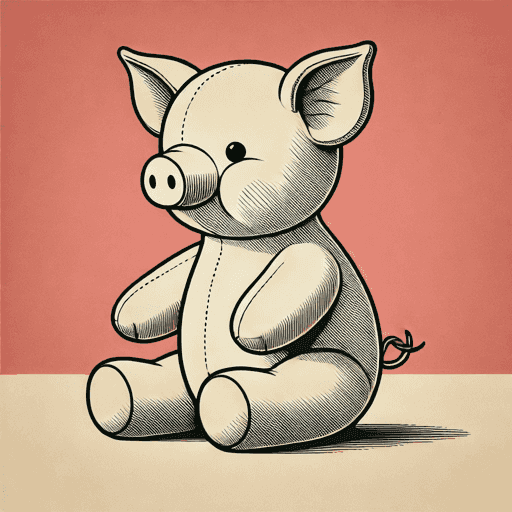
The Christmas Pig
47 pages • 1-hour read
J. K. RowlingThe Christmas Pig
A modern alternative to SparkNotes and CliffsNotes, SuperSummary offers high-quality Study Guides with detailed chapter summaries and analysis of major themes, characters, and more.
Symbols & Motifs
The Loser
In The Christmas Pig, the merciless hierarchy and strict rules of the Land of the Lost echoes the dynamics of real-life dictatorships, and within this framework, the novel’s main antagonist, the Loser, comes to represent all greedy, tyrannical leaders who revel in oppressing others. Because the Loser is motivated by greed, he stands as a physical manifestation of humanity’s selfishness and violence. As Santa explains to Jack, “Some say he was created by people, that there is so much greed and cruelty Up There that some of it oozed down here, where it began kidnapping Things to help it make a body” (236). The Loser’s robotic body is a mosaic of metal made from the Things he has eaten, and his appearance is designed to give him an inhuman aura. His metallic body adds to the impression that he has lost all of his own “aliveness” and can only feel alive by preying on others.
The Christmas Pig tells Jack that the Loser finds discarded Things and “‘tears them to pieces” in order to “[suck] out the Alivened bit. Then, if he likes their bodies, he makes them part of his armor” (159). This description hints that the Loser revels in destruction in order to mitigate his own inner pain and inadequacy. By extension, the author is suggesting that in the real world, the cruelty of tyrannical leaders stems from their own personal suffering. This philosophical undercurrent is confirmed when Jack hears the Loser’s voice, which sounds like “the scream of brakes, high and pained” and compels Jack to realize that “the Loser must be suffering almost as much as the Things waiting for their death” (252). As a physical embodiment of greed and power, the Loser stands as a representation of real-life tyrants and despots.
The Island of the Beloved
In the novel, the Island of the Beloved symbolizes the protective effects of love. Jack’s immense love for DP grants the toy a measure of immortality and a toys’ version of “heaven,” for after DP’s demise on the highway, he does not descend to the uncertain towns of the Land of the Lost. Instead, he goes to the peaceful Island of the Beloved. As Jack lands in the island’s “crystal clear sea” and sees “swaying palm trees and soft white sand” (223-224), these picturesque descriptions suggest that love creates peace and beauty even as it offers protection.
Jack’s love for DP enables the lost toy to exist forever in this protected, heavenly place. As DP says to Jack, “You made that happen, by loving me so much. This island’s a familiar place to me, you know. Things that are deeply loved drop straight down onto the Island of the Beloved whenever we’re lost” (225). These words reference the many times that DP has been temporarily lost in the past, and it is clear that the toy is secure in Jack’s love, which has “made [him] immortal” (226).
The Wastes of the Unlamented
In The Christmas Pig, the Wastes of the Unlamented serve as a symbol for real-life places in which impoverished people suffer. The fantastical setting of the Wastes allows the author to further develop the implicit parallels that she draws between her own fantastical setting and the real world. Filled with broken or unwanted Things, the Wastes represent real-life locations like refugee camps and ghettoes, where underprivileged people live in poverty and danger.
Rowling confirms this idea when she depicts the Wastes as a place that most Things avoid at all costs, since being condemned to live there means eking out a miserable survival in a desolate, inescapable area. The illustrations of this “bleak landscape” (79) show Jack and the Christmas Pig walking over rugged, scrubby ground that is half-covered in snow and a few short plants. The cold climate emphasizes the lifelessness and hopelessness of the Wastes, whose residents have nothing to enjoy. The lack of shelter, food, and infrastructure is meant to reflect places in the real world where people cannot survive or thrive without basic necessities.
Additionally, the Wastes are the only place where the predatory Loser hunts for Things to capture and eat. The Christmas Pig explains that those unfortunate enough to be sent to the Wastes have no chance to escape or to enjoy life before they are devoured. This dire prospect reinforces the constant danger of the Wastes, deepening its symbolism as a representation of real-world places where people endure poverty and many physical dangers.

Unlock the meaning behind every key symbol & motif
See how recurring imagery, objects, and ideas shape the narrative.
- Explore how the author builds meaning through symbolism
- Understand what symbols & motifs represent in the text
- Connect recurring ideas to themes, characters, and events