22 pages • 44-minute read
The Circle Game
A modern alternative to SparkNotes and CliffsNotes, SuperSummary offers high-quality Study Guides with detailed chapter summaries and analysis of major themes, characters, and more.
Poem Analysis
Analysis: “The Circle Game”
Two alternating storylines—childhood play, adult observations and conversations—develop throughout six sections of this narrative poem with the final seventh section bringing the two stories together.
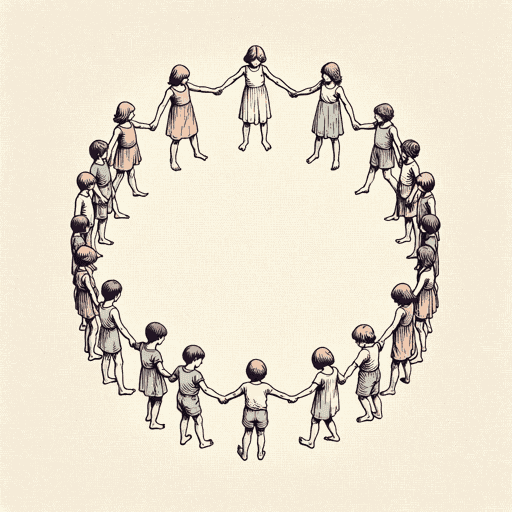
The poem opens with the titular “circle game,” an image of innocence and playfulness (which Atwood will soon complicate). With this image, Atwood introduces the symbol of the circle, which pervades and governs the poem. The circle game is reminiscent of “Ring around the Rosie”; the speaker observes “each arm going into / the next arm” (Lines 4-5) and continues with “They are singing” (Line 10). Line 14 presents the first instance of first-person speech, as “we” watch the children: “We can see / the concentration on / their faces” (Lines 14-16). The reader soon learns that while this is a plural pronoun, the speaker is singular but referring to themselves and another person (the “you” figure, their partner).
This initiates Atwood’s viewpoint on the darker underbelly of the playfulness: “We might mistake this / tranced moving for joy / but there is no joy in it” (Lines 20-22). Like many children’s games and fables, there is a dark subtext that often the adults detect and children do not. The speaker continues with this warning by discussing how the playing children ignore the nature around them: “the lawn / ignored, the lake ignored” (Lines 29-30). Instead,
the whole point
for them
of going round and round
is (faster
slower)
going round and round (Lines 31-36).
The children do it just to do it.
In section ii, the focus switches to the two adults, who are in the same room and have an intimate relationship. The speaker introduces the symbol of a mirror: “You refuse to be / (and I) / an exact reflection” (Lines 43-45). The mirrors—the room is full of “many mirrors” (Line 50)—symbolize relationship. However, while two adults may not be in sync with each other, they also cannot “walk from the glass, / be separate” (Lines 46-47). Atwood introduces a second room with “arguing, opening and closing drawers” (Line 57). This second room and mirror prove a distraction and reinforce the waning connection:
You look past me, listening
to them, perhaps, or
watching
your own reflection somewhere (Lines 59-62).
Atwood uses symbolic details, emphasized in parentheticals, to suggest the interpersonal disconnect is a regular problem:
There is always
(your face
remote, listening)
someone in the next room (Lines 68-71).
The image of the circle, in this section, is invisible and symbolic: The speaker and their partner are caught in a futile pattern, or cycle, and seem unable to break free.
Section iii goes back to the children, as the speaker tries to ascertain the reason for their games. They explain that the children “scarcely listened” (Line 84) to their parents’ bedtime stories of “monstrous battles and secret / betrayals in the forest” (Lines 81-82). However, the next day, the children put the essence of the stories into action, as the parents “found the trenches / they had been making” (Lines 98-99). The speaker describes the creations in detail, emphasizing their worth to the child creators: “fortified with pointed sticks / driven into the sides / of their sand moats” (Lines 100-102) and “secure from the reach / of whatever walks along” (Lines 111-112). It is worth noting that these games take place in and utilize environmental features.
In section iv, the poem offers yet another inflection of the concept of games. The narrative returns to the room with the speaker observing the verbal tactics (a form of a game, word “play”) of the other and how a distance accelerates between them. The speaker compares themselves to “a wart perhaps” (Line 132) because they notice their partner is regarding them with “taut curiosity” (Line 128). The speaker mentions one of their partner’s childhood hobbies, calling them “a tracer of maps” (138), and compares this behavior to how their partner now “trace[s] me / like a country’s boundary / or a strange new wrinkle” (Lines 146-148). These unfavorable bodily features—a wart, a wrinkle—represent how the speaker feels perceived by their partner. The figurative language of the map suggests the familiar yet unknown connection between a couple unable to clearly communicate with one another. The speaker ultimately feels “fixed, stuck / down on the outspread map” (Lines 150-151) and feels impierced at the end of this section by their partner’s “cold blue thumbtacks” for eyes (Line 159).
Section v opens with children playing at what “was once a fort / but now is a museum” (Lines 161-162), again referencing environmental elements. The imagery is violent, as the speaker mentions that the children “like the guns” (Lines 164) and that “their drawings will be full / for some days, of swords” (Lines 168-169). While the children play inside the museum, the adults distance themselves physically but also in time and lived experience as their outside walks have them noting the “crumbling” (Line 178) of the earth beneath their feet. They remember the weapons used in war, which are now for their children’s attention: “fragile / in glass cases” (Lines 186-187). The speaker poses a question in the final stanza of this section about the protection and encasing of “things that are no longer / (much) / worth defending” (Lines 194-196). This question seems to scrutinize the merit of defending a cycle that has gone on for ages.
In section vi again emphasizes games—and, again, these are adult games, not childhood ones. Nevertheless, just like the children’s game at the beginning of the poem, these games have “no joy in [them]” (Line 22). When the speaker accuses their partner of playing games, the names imply the same idea of solitude: “the orphan game / the ragged winter game / […] the game of the waif” (Line 198-203). The speaker describes the waif as a man who watches “happy families” (Line 208) at the window while loathing their “cheerful fire” (Line 214). This waif rejoices at being “left / out by himself / in the cold” (Lines 222-224). This passive, solitary adult game juxtaposes the active one the waif watches in the other family:
They have their own forms
of parlour
games: father and mother
playing father and mother (Lines 217-220).
The speaker accuses their partner of playing the waif game, and they respond, “You do it too” (Line 229). At this point, the speaker waffles but ultimately admits to their own game playing with the caveat, “I tend to pose / in other seasons / outside other windows” (Lines 233-235). The idea of seasons refers to the concept of an ongoing circle or cycle.
Section vii, the final section, returns to summer, repeating the cycle from the first two sections: “[I]n the mirrors of this room / the children wheel singing” (Lines 237-238). Atwood combines the outdoor imagery of the children with the indoor imagery of the adult sections: “[T]heir grassy lawn / and these scuffed walls / contain their circling trees” (Lines 244-246). There is then a wasp, an intruder to the circle that is drawn to the children’s sandwiches, but it is not as unwanted as expected: “[O]ne of the children flinches / but won’t let go” (Lines 254-255). The speaker repeats from earlier in the poem that the children turn, “but there is no joy in it” (Line 259). This time, they say “You make them / turn and turn” (Lines 256-257), suggesting their partner does the turning, but it also feels like a direct address to the readers, implicating them in this forced activity. The speaker then turns their attention back to their partner and states, “[Y]our observations change me / to a spineless woman in / a cage of bones, obsolete fort” (Lines 263-265). They compare themselves to the defunct fort that the children were playing in earlier (that turned into a museum). After all the observations throughout the poem, the speaker is changed, broken down, exhausted. They offer this rallying cry: “I want to break / these bones, your prisoning rhythms” (Lines 285-286). After witnessing the circular games of their adult generation and the children’s, they utter the final line (and objective) of the poem: “I want the circle / broken” (Lines 294-295).

Unlock all 22 pages of this Study Guide
Get in-depth, chapter-by-chapter summaries and analysis from our literary experts.
- Grasp challenging concepts with clear, comprehensive explanations
- Revisit key plot points and ideas without rereading the book
- Share impressive insights in classes and book clubs