Code of Hammurabi
43 pages • 1-hour read
HammurabiCode of Hammurabi
A modern alternative to SparkNotes and CliffsNotes, SuperSummary offers high-quality Study Guides with detailed chapter summaries and analysis of major themes, characters, and more.
Background
Historical Context: Hammurabi and Babylon
Hammurabi was the 6th king of the First Dynasty of the Old Babylonian Empire. He was part of an ethnic group known as the Amorites, which had begun in the Levant and gradually expanded into Mesopotamia at the beginning of the 2nd millennium BCE. They built several city-states in lower Mesopotamia, including Babylon, which sat in the fertile northwest quarter of that region, and gradually displaced the earlier imperial city-states of Sumer, Ur, and Akkad. In Hammurabi’s time, Babylonians spoke Akkadian, which was the lingua franca of Mesopotamia in the 2nd millennium BCE and a member of the Semitic language family (of which Arabic, Hebrew, and several others still persist). Like the preceding civilizations in the Mesopotamian basin, they used a writing system based on cuneiform script.
At the beginning of the Amorite First Dynasty, Babylon was not yet a major regional power. It was situated on the fertile floodplain where the Tigris and Euphrates rivers meandered close to one another before separating out again, and so it was in an advantageous position for agriculture. Babylonians became experts in the use of canals to water their fields, adding new levels of technical prowess in the field of irrigated agriculture. Babylon was also in a strategically advantageous position, with easy access to both upper and lower Mesopotamia via the rivers and the central roadways.
These advantages brought Babylon to its first climax of power during Hammurabi’s reign, as he conquered Mesopotamian city-states both to the north and the south, brought other regional powers like Assyria under tribute obligations, and extended Babylon’s governance into a Mesopotamian empire. This extension of Babylonian power also had an effect on the religion and culture of Mesopotamia as a whole, with Marduk—the patron god of Babylon—rising to an outsized role in the Mesopotamian pantheon after Hammurabi’s time, and inspiring a renewed literary culture, of which the Code was merely one example.
While Babylon would lose its position of political influence later in the 2nd millennium BCE, its cultural influence remained impressive. It would later gain political supremacy in the mid-1st millennium BCE, under the New Babylonian Empire (sometimes called Chaldean), in which the legacy of Hammurabi was kept alive as an idealized lawgiver and king. Such was the extent of Babylon’s impact that even though the latter Babylonian empire was relatively short-lived, its successor-empires under the Persians and Alexander the Great each tried to harness the mystique of its power and influence for centuries thereafter.
Textual Context: The Code’s Inscription
The Code of Hammurabi differs from many primary source documents in the nature of its textuality. Rather than being written on vellum or papyrus, as many such documents from the ancient world were, the Code of Hammurabi was inscribed into a stone monument. The particular kind of monument is called a stele, a pillar-shaped stone, usually with multiple flat faces on which writing could be inscribed.
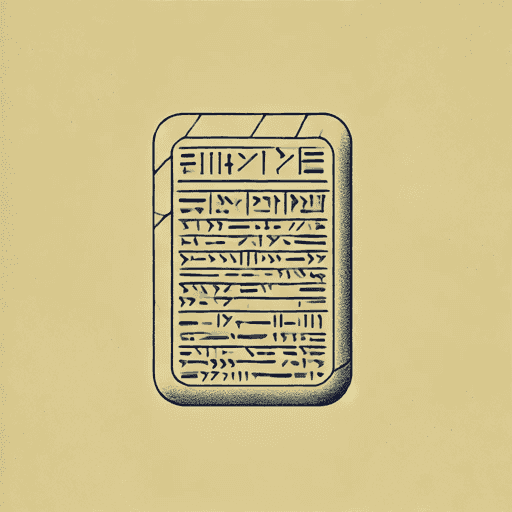
The most common form of Mesopotamian documentation was to use clay tablets as a medium of writing, but even this common form was passed over for a monumental inscription. Presenting a code of laws to one’s people in this manner had its advantages: Rather than a series of clay tablets which could easily be broken, or some tablets lost, a stone stele gave the text a practical permanence. It also added a sense of grandeur to the text, as the monument was impressively tall—likely taller than any Mesopotamian would have been—and capped with an engraved depiction of the king himself.
There were also disadvantages to this textual form, however. For one, it made the text more difficult to reproduce in the same medium. Several portions of smaller stele with the Code have been discovered, but only a few. Eventually the text began to be copied and disseminated on the medium of clay tablets, which made it more widely available. A second disadvantage was that the stone could be lost or marred, which actually happened in the case of Hammurabi’s Code. The main stele was lost to history until the turn of the 20th century, when archaeologists discovered it in Susa, a Persian capital, as part of the plunder the Persians had taken from Babylon. Further, portions of the text had been effaced from the stone because of wear, and while reconstructions of those missing texts are available from the clay-tablet manuscript tradition, the form of their appearance in the Code’s primary source document remains irretrievable.

Unlock all 43 pages of this Study Guide
Get in-depth, chapter-by-chapter summaries and analysis from our literary experts.
- Grasp challenging concepts with clear, comprehensive explanations
- Revisit key plot points and ideas without rereading the book
- Share impressive insights in classes and book clubs