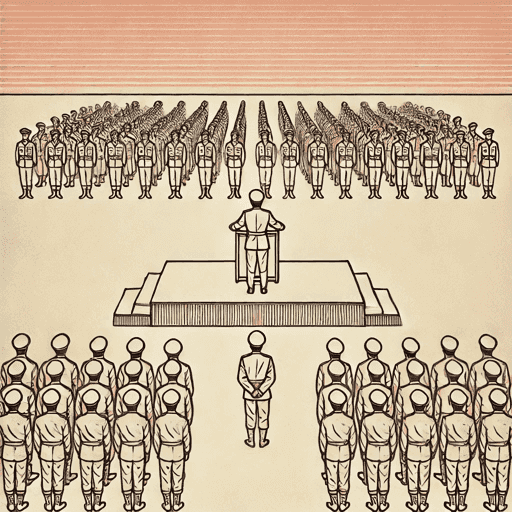
The Coming of the Third Reich
78 pages • 2-hour read
Richard J. EvansThe Coming of the Third Reich
A modern alternative to SparkNotes and CliffsNotes, SuperSummary offers high-quality Study Guides with detailed chapter summaries and analysis of major themes, characters, and more.
PrefaceChapter Summaries & Analyses
Preface Summary
Content Warning: This section discusses racism, religious discrimination, and death.
Richard J. Evans describes The Coming of the Third Reich as the first book in a planned trilogy of books detailing the Nazis’ rise to power—how they developed their government, what it was like to live under it, and the Nazis’ military policies and eventual defeat during World War II. The trilogy is meant for “people who know nothing about the subject” (xv). While many books have been written about Nazi Germany, there “have been […] surprisingly few attempts to write the history of the Third Reich on a large scale” (xvi).
Next, Evans discusses previous books that tried to provide comprehensive histories of Nazi Germany. William L. Shirer’s The Rise and Fall of the Third Reich (1960) was written by a US diplomat who witnessed events firsthand, but scholars criticized it for not being outdated in terms of historical research and overly focused on diplomacy and politics. The German Dictatorship (1969) by Karl Dietrich Bracher “was strongest on the origins and growth of Nazism and its relation to German history” (xvii), but it was written for expert audiences. As the title suggests, Ian Kershaw’s two-volume work, Hitler (1998), focuses on Hitler himself and the policies he was obsessed with rather than generally examining the Third Reich. Michael Burleigh’s The Third Reich: A New History (2000) was a “moral history” (xviii) that detailed Nazi atrocities but did not explore the cultural and political elements of Nazi rule in depth, tending to favor narrative over analysis. Evans wants to “combine the virtues” (xix) of these previous works.
Then, Evans describes his own goals. Believing that recent histories of Nazi Germany have focused more on institutions and broader trends, Evans wants to “put individuals back into the picture” (xix). Citing the Karl Marx quote, “People make their own history…but not under conditions of their own choosing” (xx), Evans also seeks to examine the historical and social contexts in which people lived during the Third Reich, but also show how the rise of the Third Reich was not “inevitable” and “things could easily have turned out very differently” (xx). While looking at the actions of individuals, Evans wants to avoid “the luxury of moral judgment” (xx), especially since he cannot know how he would have acted if he had lived in Germany during the Third Reich.
The importance of the history of the Third Reich is that it “has burned itself into the modern world’s consciousness as no other regime […] has managed to do” (xxi). Evans discusses several theories as to how the Third Reich happened. Friedrich Meinecke, who lived in Germany during the Third Reich, argued that Nazism was made possible by Germany’s focus on the military and “a narrowly technical education at the expense of broader moral and cultural instruction” (xxi). Meinecke questioned how a society as progressive as early 20th-century Germany could nonetheless fall under Nazi control with seemingly little resistance. However, Evans notes that there were other “brutal dictatorships” (xxiii) that came to power in European countries despite cultural achievements and social progress.
Another theory came from Marxists, who argued that Germany’s advanced capitalist society was dominated by powerful businesses that helped facilitate the rise of the Nazi Party to preserve their own power. However, this interpretation ignored the racism key to the Nazis’ view of the world, themselves, and the question of why Nazism did not emerge in other developed capitalist economies. Some historians argue that Germany had an inherent resistance to democracy and human rights. Evans rejects this, arguing that German history actually reveals “strong liberal and democratic traditions” (xxiv) and the Nazis faced significant resistance within Germany itself. A similar view was that German society was inherently apolitical, leaving Germans ill-prepared for democracy in the 20th century, but Evans counters that 1920s Germany was filled with intensely ideological political debates and conflicts.
German historians instead suggest that Nazism did not emerge because of anything specific to the German historical experience, but because of a general collapse in Europe’s political and social order after World War I, giving space to totalitarian regimes like Stalin’s Soviet Union and Hitler’s Germany. Evans argues that totalitarianism took very different forms in Germany and the Soviet Union, and, while there was a collapse in the old order in the early 20th century, it had different impacts in different countries.
According to Evans, the problem with any attempt to explain the origins of the Third Reich is that they present the rise of Adolf Hitler as a “foregone conclusion.” At the same time, the Third Reich “certainly did draw for its success on political and ideological traditions and developments that were specifically German in their nature” (xxviii).
Evans describes three major phases in how the Third Reich was studied by historians and political scientists. From 1945 through the 1960s, scholarship focused on questions of origins. In the 1970s and 1980s, scholars generally turned their attention to the early years of the Nazi regime before World War II, analyzing the internal politics of Hitler’s regime and “everyday life” (xxix). As an example of this type of research, instead of Nazi Germany being completely under Hitler’s control, it presented the view that the Third Reich was built on “a complex of competing power centres” (xxix). More recently, research has shifted toward the World War II years, with a focus on the study of the Holocaust and other Nazi atrocities. Evans seeks to offer “a synthesis that brings the results of these three phases of research together” (xxix).
Preface Analysis
The preface of The Coming of the Third Reich explains Richard J. Evans’s intention in writing not just The Coming of the Third Reich, but his entire planned Third Reich trilogy, situating the works within the historiography of Nazi Germany. Given how much has been written about Adolf Hitler and Nazi Germany, Evans takes care to justify why this work is important both in terms of its approach and its broad intended audience. While Evans is a social historian who believes in the importance of investigating wider trends in history, he writes that he will focus on the “experience of individuals.” By this, Evans does not mean returning to a “Great Man” theory, which argues that history is primarily shaped by the actions of influential individuals. In this view, Nazism might be presented as a product of Adolf Hitler’s decisions rather than the result of broader social, political, and economic forces. Instead, Evans uses primary sources such as diaries and speeches “to juxtapose the broader narrative and analytical sweep of the book with the stories of the real men and women, from the top of the regime down to the ordinary citizen, who were caught up in the drama of events” (xix). This allows Evans to integrate personal perspectives into the larger historical narrative, making the rise of the Nazis feel immediate and tangible rather than a distant or abstract process.
In this section, Evans lays down his theory of historical change, at least in the case of the rise of the Nazis. For Evans, the story of the downfall of the Weimar Republic and the rise of the Nazi Party is the story of The Fragility of Democracy and the Non-Inevitability of Historical Change. He argues that while certain conditions made the rise of the Nazis possible, there was nothing predetermined about their success. As with his use of sources from individuals to illustrate larger historical changes and events, Evans’s historical analysis seeks a middle ground between individual actions and wide trends. The “conditions” under which people in the past lived “included not only the historical context in which they lived, but also the way in which they thought, the assumptions they acted upon, and the principles and beliefs that informed their behaviour” (xx). This suggests that historical actors were neither completely at the mercy of structural forces nor entirely free agents shaping history through sheer will.
This is a key point in understanding Evans’s discussion about Hitler’s regime and the rise of the Nazi Party not being inevitable. However, the Third Reich was not a “foregone conclusion,” but it was also not a “historical accident” (xxviii). By rejecting both extremes, Evans challenges simplified narratives—those that frame Hitler’s rise as fate and those that treat it as a total anomaly. Likewise, Evans does not see the Third Reich as made inevitable by either the actions of powerful individuals or by historical developments and patterns, even ones that expand across decades or centuries. Instead, Evans argues that the Nazis’ rise was the result of a complex interplay between economic instability, political miscalculations, and ideological radicalization, all occurring within a fragile democracy vulnerable to exploitation.

Unlock all 78 pages of this Study Guide
Get in-depth, chapter-by-chapter summaries and analysis from our literary experts.
- Grasp challenging concepts with clear, comprehensive explanations
- Revisit key plot points and ideas without rereading the book
- Share impressive insights in classes and book clubs