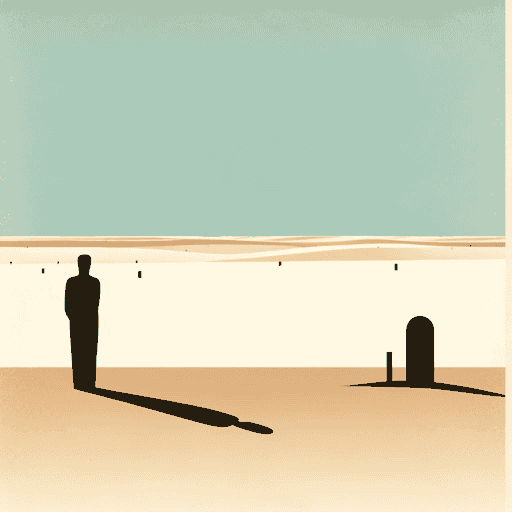
The Crossing
The Crossing
A modern alternative to SparkNotes and CliffsNotes, SuperSummary offers high-quality Study Guides with detailed chapter summaries and analysis of major themes, characters, and more.
Summaries & Analyses
Quizzes
NEWReading Tools
Games
Part 4Chapter Summaries & Analyses
Part 4, Pages 333-363 Summary
Billy crosses back into America in Columbus, New Mexico, and learns that America has entered World War II. He tries to enlist at the recruitment office, where the officer says he needs a next of kin’s signature, since he isn’t yet 18. Billy explains he has no kin, and the officer tells him to get his mother’s signature “if she has to come down from heaven to do it” (336), giving Billy tacit permission to forge the document. He does so, but not with his mother’s real name.
The medical examiner reveals that Billy has a heart murmur and rejects him. Billy wanders around New Mexico for the next several months, working as a day laborer or ranch hand and applying for the army at different recruitment offices. He is always rejected. When a doctor asks him why he’s so determined, he says “If I’m going to die anyway why not use me?” (341).
He goes to visit the SK Bar ranch and talks with Sanders, who is dismayed by the state of the world and his own aging. Billy hires on with another ranch for several months. In a bar, he’s mocked by a soldier for not being in the army. He works another nine months and earns enough for new clothes, gear, and a packhorse. He rides into Silver City and checks into a hotel without realizing its Christmas Day. He eventually visits Sanders again, whose health is beginning to fail. After seeing Sanders alone, being cared for by a hired nurse instead of family, Billy resolves to go find his brother.
Billy crosses the border into Chihuahua. After several days’ riding, he stops at a bar in Janos. Inside, several men drink mezcal, including one very drunk man, Alfonso. Billy asks for a bottle of nice American whisky and shares it around. Alfonso refuses to drink the whisky, and one of the other men says he was a soldier in the Mexican Revolution. Billy takes Alfonso’s glass and fills it. Alfonso pours it out, saying he “objected to the seal [on the bottle] which was the seal of an oppressive government” (360). Alfonso has them pour a round of mezcal instead, and Billy spits his on the floor. The tension rises, and one man warns Billy in English that he is about to be shot. Billy makes to leave, but before he does, Alfonso opens his shirt to show him the bullet wounds he received during the war.
Part 4, Pages 364-388 Summary
Billy, incredibly drunk, decides to sleep in an abandoned home in the pouring rain. In the morning, he meets some children. He lets them ride his horse until a woman comes and warns him that the rain was the only thing that kept him from being robbed in the night. The woman reads his palm and tells him she sees two brothers, “Uno que vive, uno que ha muerto” (One who lives, one who is dead, 369). Billy does not know which is which.
Billy rides San Diego to find the Muñoz house empty. A man tells him they’ve all gone. He continues riding through towns he visited three years ago on his journey, then rides to Namiquipa. On the way, he passes wedding party. No one else seems to be in town, and he enters a random home to find a dead man dressed in a suit awaiting burial. Billy meets up with the wedding party and learns that the girl Boyd ran away with is long gone and is known as a bandida with a price on her head. She may have been killed. The woman who tells him this reveals she knows who Billy is. Billy asks her where Boyd is, and she tells him that he is buried in San Buenaventura.
Billy rides for several weeks asking after his brother, He learns that Billy has become a folk hero in corridos. Billy stops at a carnival one night and is given a tarot card with a skull on it, which wins him free entry. When he recognizes the opera troupe’s wagon, painted over with the new attraction, he walks off without seeing the show and rides on.
A few days later in Barbícora, Billy is woken by one of the men he rescued the girl from with Boyd. The man tells him his companion is dead and that it was a fate he made for himself. He says that he holds no grudge toward other men, especially over a woman, and he rides off again.
At a hotel in Casas Grandes, Billy hears a woman singing a corrido about a young, fearless güerito. He asks her to sing the rest, but she does not know it, just that it’s a sad story of a blond man and his lover dying in each other’s arms when they run out of ammunition.
Billy rides into the mountains and camps there for some time until he runs into Quijada, who invites him into his home. Quijada tells him the true story of Boyd: He is dead, buried in San Lorenzo, and the girl was taken away covered in blood, but no one knows what became of her. Boyd killed two men, including a friend to Pedro Lopéz, the local alguacil. Quijada still works for Lopéz and the Hearst estate, and Billy realizes they should be enemies. When Billy asks him about the corrido, Quijada says “Even if the güerito in the song is your brother he is no longer your brother. He cannot be reclaimed” (386). Billy says he’d like to take Boyd’s body home, and Quijada cautions him against it, in part because of the danger and in part because it is a denial of Boyd’s fate.
Part 4, Pages 388-400 Summary
Billy rides to San Lorenzo and finds his brother’s grave. It bears no name, but a wooden cross has a dedication from “sus hermanos en armas” (his brothers in arms, 389). In the church, he meets an old woman praying for her dead family but finds no gravedigger. He digs Boyd up himself, working through the day. When he uncovers the body, he tries to use the horses to pull the coffin out, but it breaks. He doubts his goal, thinking he could just fill the hole back in, before wrapping Boyd’s uncovered remains in a blanket and placing them on the pack horse.
He rides unceasingly through the night toward America, passing Casas Grandes on the second night, before he is stopped by a group of riders. They surround him and demand to know what’s on the pack horse. Billy tells them the truth, but one of the men takes a knife, cuts the pack loose, and sends the horse off. He opens up Boyd’s blanket and kicks at his corpse, demanding to know where the money is while Billy tries to get to his pistol in Niño’s saddlebag. The man comes after Billy and grabs Niño’s reins; Niño panics and tramples Boyd’s remains, and while the other men look on laughing, the man stabs Niño in the chest.
Billy tries to hold Niño’s wound closed while the man rummages through his belongings. He finds Billy’s pistol and holds it to his head, demanding money, to which Billy replies, “You go to hell” (397). The other men convince the man with the gun that they need to leave.
Billy puts clay in the wound to try and stop it bleeding and leads Niño to water. They go into the shade and Billy gathers up his brother’s remains; the pack horse is nowhere to be found. He covers Niño with a blanket and goes to sleep. When he wakes, he recovers the man’s knife and dries out his things. That night, he dreams of Boyd approaching his fire; when he wakes, he tries to think of where Boyd could be, but “Boyd was dead and wasted in his bones” (400).
Part 4, Pages 400-426 Summary
In the morning, a group of nomadic muleteers passes by carting an ancient, disassembled airplane. They help Billy tend to Niño; one of them offers to buy the horse, which gives Billy confidence that it will live. While they wait for the men to prepare the medicine, Billy asks about the airplane, and the leader of the group explains that it is one of two very similar airplanes lost in the mountains. This one was commissioned to be recovered by the father of the pilot, who died. Billy asks what it would mean if they had the wrong plane, and the man muses on the nature of men’s attachment to objects and their meaning. He considers that the father wants the plane because as long as it is in the mountains, the son’s story ends there and will continue to haunt the father. The man tells the story of the other plane, which was washed away in the Rio Papigochic after he and his men tried to float it downriver. The men were caught in 10 days of flooding rains that washed away their endeavor. They climbed out of the gorge and hitched a ride back to their client. In this way, the man says, God decided which plane was the correct one. The man tells Billy that there is a third story to tell that contains the truth, which is the story of telling the story: “Es que ultimadamente la verdad no puede quedar en ningún otro lugar sino en el habla” (Ultimately the truth cannot remain anywhere but in the telling, 411).
The wanderers treat Niño and ready to leave. The man tells Billy one more story of his father, who collected old daguerreotypes and hung them from his wagon. As a boy, the man realized that the pictures represented a futile desire for permanence. He concludes that people are both victims of impermanence and the very embodiment of it. The muleteers depart, refusing payment.
In the evening, a man who speaks English meets Billy at his camp. He claims to be the man who hired the muleteers to recover the plane. He is incredulous about Niño’s stabbing and impressed with the muleteers keeping their word in recovering the plane. He makes small talk with Billy about his dislike for Mexico; Billy tells him “This is my third trip. It’s the only time I was ever down here that I got what I come after” (416). Billy asks the man about the airplane. The man tells him that the Muleteer’s stories aren’t true and warns Billy about the dangers of Mexico. Billy begins to tell the man about his father, his mother, and finally his deceased sister, but the man says he needs to go. Billy tells him Boyd was better than him at everything. When the man says, “This world will never be the same,” Billy responds “It aint now” (420).
Billy rides home and enters the Animas Valley on Ash Wednesday, where he buries Boyd. He wanders and works again throughout New Mexico. One night, he finds an abandoned building to sleep in near the Organ Mountain so he can stay out of the rain. As he’s eating dinner, an old dog comes to the doorway. Billy throws mud at the dog, then advances on it with a length of pipe, yelling at it to leave. He chases it down the road throwing rocks at it as it howls.
That night, he wakes, thinking it’s daylight. Billy is actually witnessing the Trinity nuclear weapons test. As the light fades, he calls for the dog to return to no avail. He sits down in the road and weeps as the sun rises.
Part 4 Analysis
After losing everything that matters to him except his father’s horse, Billy returns to America to find it utterly changed: America’s involvement in World War II began without his knowledge as he wandered the Mexican countryside. His absence from the trauma that the nation went through and its response is another kind of orphaning that happens to him, as he’s now fully dissociated from his culture. Nevertheless, he tries to enlist, though it’s clear that these attempts have more to do with his own internal lack of purpose and resultant death drive; he would rather die doing something meaningful than continue living. It’s notable that Billy is not willing to disrespect his mother’s memory by forging her signature, indicating that he still holds some things sacred, including his family relationships.
The heart murmur that keeps Billy out of the army is one more reason that he’s distanced from the world, as indicated by the disrespect he’s given by the veteran. Billy’s tacit resentment toward nationalism in general—and his detachment from the present—is an outgrowth of this sense of being rejected by his country. This is also a factor in his encounter with Alfonso, the veteran of the Mexican Revolution. The exchange is full of spite and informed by Billy’s nihilism and his growing bitterness toward Mexico as a nation and a culture—he’s become the uncaring outlaw he pretended to be in that moment.
Billy only has three connections left in the world in Part 4: Sanders, his brother’s memory, and Niño. Sanders is a touchstone for him, but he also sees how quickly Sanders is fading from the world, and it’s this realization that drives him back to Mexico to find out what happened to Boyd. When he hears the rumors and corridos about Boyd, he seeks out the facts instead. Quijada and others try to make Billy see the difference between the factual truth of the world and the metaphorical meaning offered by corridos and folk heroes, suggesting that the ability to choose a narrative—and thereby shape reality—is essential. Once again, Billy cannot accept the positive brand of nihilism that’s being offered to him, in which the only meaning is what is agreed upon by humanity and present in the connections they make. When he dreams about Boyd in death, he cannot reconcile the idea of him as existing in some kind of afterlife with the remains he has under his care. For Billy, the story of Boyd has ended, though he doesn’t want it to. The only thing left for Billy at the novel’s end is his father’s horse, Niño, and even that comes under threat of senseless violence before being rescued by the equally random appearance of the wandering muleteers.
The final scene of the novel takes place within sight of the Trinity nuclear test of July 16th, 1945. The blast, which appears as a false dawn to Billy and disrupts the wildlife in the area, symbolizes The End of Frontier Life and asserts humanity’s inherent cruelty toward each other. Throughout the novel, Billy has experienced and heard stories of the indifferent violence of men asserting their power over each other, whether it’s the German Huertista torturing his prisoners or the bandido who stabs Niño in a moment that’s beyond the pale for his fellow robbers. The nuclear bomb is the natural endpoint of this kind of senseless violence.
With the Trinity nuclear test, the world Billy knew is truly over. Sanders will die soon, a world of globalization and apocalyptic threat is on the horizon, and Billy is bereft and unable to offer kindness to other creatures because of how much he’s had taken from him by a cruel world that he can only view as empty of meaning. The view the novel puts forward is a nuanced one: Though it’s presented as the end of an era, the threat of nuclear devastation is a new twist on a world that’s already been ruined by humankind. Billy’s response about the world never being the same—“It aint now”—indicates that there’s no past of morality and goodness to look back on in the first place (420). Instead, McCarthy proposes that the only thing that can save people is their connection to one another, and even that is an impermanent, ever-fleeing comfort. It's a grim portrait of the human species as the author of its own tragedy.

Get in-depth, chapter-by-chapter summaries and analysis from our literary experts.
- Grasp challenging concepts with clear, comprehensive explanations
- Revisit key plot points and ideas without rereading the book
- Share impressive insights in classes and book clubs