Symbols & Motifs
Content Warning: This section of the guide includes discussion of mental illness, graphic violence, sexual content, and cursing.
The Crochet Doll
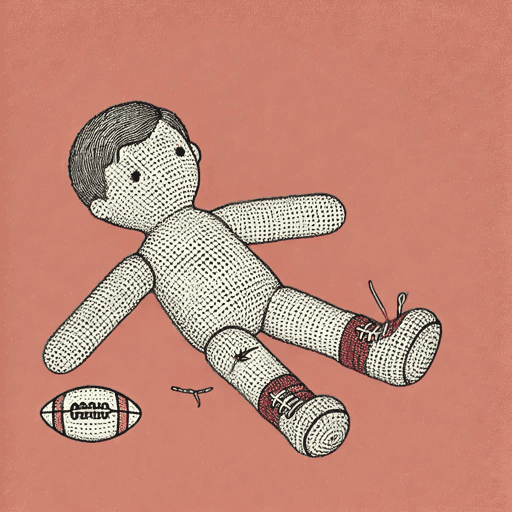
The crochet doll acts as a symbol of The Perils of Fame and Parasocial Relationships, highlighting the violation of privacy that accompanies modern celebrity. Vincent’s discovery of the doll left by an intruder who breaks into his home catalyzes the novel’s central plot, prompting Vincent to seek refuge in Brooklyn’s flat. The handmade doll—a gift that in another context would be charming—contrasts sharply with the threatening nature of its delivery. This juxtaposition illustrates how admiration can curdle into obsession, transforming a fan’s affection into a breach of personal safety.
The personal details included in the doll emphasize the faux-intimacy of parasocial dynamics. When Vincent shows his sister the doll, she immediately flinches, noting the crocheted replica of Vincent’s childhood scar. Vincent admits: “I had a faint white scar on my knee from a childhood injury. Most people didn’t know about it. It was too small to see from afar, and magazines usually airbrushed it out of my photoshoots” (21). The doll forces Vincent to confront the reality that his success has made him a target, creating an anxiety that pierces his confident public image and makes his need for a safe space—both physically and emotionally—all the more urgent.
The symbol recurs when a photograph of the doll is left on Vincent’s car, accompanied by the message, “Did you like your gift?” (100). This escalation confirms that the intrusion was not an isolated event but the work of a persistent stalker. This sustained danger pushes Vincent and Brooklyn closer together as they navigate the shared threat, cementing the doll’s narrative function as a catalyst for both the novel’s suspenseful subplot and the couple’s deepening emotional bond.
The “Do Not Contact” Reminder
The recurring motif of Vincent’s calendar reminder for “THE DAY (Do Not Contact)” points to the unresolved trauma of Vincent’s childhood abandonment, underscoring the novel’s thematic engagement with The Redefinition of Family Beyond Blood Ties. Appearing early in the novel, this digital ghost haunts Vincent annually on October 3, his birth mother’s birthday. The reminder is a form of self-inflicted torment, a testament to a past he cannot escape and a biological tie that brings him only pain. This motif provides the crucial backstory for his character, revealing the profound insecurity and need for validation that lie beneath his confident, public-facing persona as a celebrated athlete.
Vincent’s fixation on this day highlights the disconnect between his external success and his internal need to prove he’s wanted and worthy. As he admits to himself, “I couldn’t stop obsessing over it once or twice a year” (6). This quiet confession underscores his vulnerability that stands in stark contrast to the strength and control he projects on the football pitch. The motif contrasts the pain of his biological origins with his supportive, chosen family—his adoptive parents, Scarlett, and eventually Brooklyn—who offer him unconditional love and acceptance, arguing that true belonging is not defined by blood.
As Vincent and Brooklyn learn to trust each other, Vincent confides in her about his adoption and his annual struggle with “THE DAY.” This act of trust marks a pivotal turning point in their relationship, moving it beyond playful banter and physical attraction into a space of deep emotional intimacy. By sharing his most fiercely guarded secret, he allows her to see his authentic, flawed self, cementing their connection and enabling his own healing.
The Bet
The series of bets between Vincent and Brooklyn serves as a central motif that provides the structure for their romantic relationship. Proposed by Vincent, the initial wager to see who will “cave and kiss the other first” (60) creates a competitive framework that allows them to explore their mutual attraction without having to admit genuine emotional vulnerability. It acts as a mask, permitting them to engage in escalating acts of flirtation and intimacy under the guise of a game—a common element of the sports romance subgenre. From watching The Great British Bake Off in close quarters to engaging in domestic chores together, every interaction becomes a move in their ongoing match. This sustained tension, fueled by their shared desire to win, becomes the primary engine of their romantic and sexual chemistry while they live together.
The genius of the initial bet, as Vincent sees it, is that it gives them each “permission to kiss the other, but it effectively ensured [they won’t], thereby keeping [them] safe from emotional vulnerability” (60). Their adherence to the “rules” highlights their shared fear of being the first to admit to deeper feelings, making the bet a perfect vehicle for exploring their transition from antagonism to intimacy. When Vincent deliberately loses the bet by kissing Brooklyn, declaring, “I’d lose every single fucking bet in the world if it meant I could be with you” (232), it acts as a critical turning point where the need for authentic connection finally triumphs over the desire for self-protection. By forfeiting the game, Vincent chooses the relationship, demonstrating that true intimacy requires abandoning such defenses and embracing vulnerability.
As their relationship evolves, the focus of their bets shifts from competitive rivalry to mutual satisfaction. Following their first kiss, the practice of making bets becomes an integral part of their sexual intimacy. Each of their contests—“I bet I can make you scream so loud, your neighbor will be banging down the wall” (60), “I bet I can make you beg to come tonight” (318)—all center their desire to provide each other with sexual pleasure, highlighting the depth of their connection.

Unlock the meaning behind every key symbol & motif
See how recurring imagery, objects, and ideas shape the narrative.
- Explore how the author builds meaning through symbolism
- Understand what symbols & motifs represent in the text
- Connect recurring ideas to themes, characters, and events