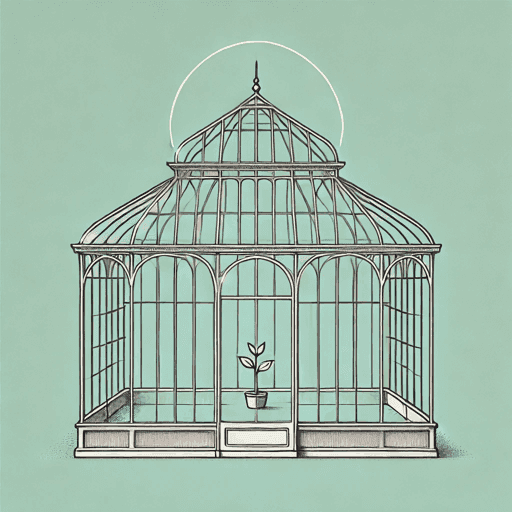
The Enchanted Greenhouse
50 pages • 1-hour read
Sarah Beth DurstThe Enchanted Greenhouse
A modern alternative to SparkNotes and CliffsNotes, SuperSummary offers high-quality Study Guides with detailed chapter summaries and analysis of major themes, characters, and more.
Chapters 1-7Chapter Summaries & Analyses
Content Warning: This section of the guide includes discussion of illness, death, and child abuse.
Chapter 1 Summary
Terlu Perna is a woman in her twenties who works at the Great Library of Alyssium. In the Crescent Islands Empire, only elite sorcerers are allowed to cast spells. However, loneliness drives Terlu to break the law and use magic to grant her spider plant, Caz, sentience. After Terlu’s arrest, the head librarian, Rijes Velk, pleads with the judge to show mercy because Terlu’s magic harmed no one. Unrest in the empire is growing, and the judge is determined to make an example of Terlu, so he sentences her to “be transformed into a statue and placed in the Great Library, to serve as a warning” (4).
Terlu’s sentence is carried out immediately by a sorcerer who assures her that she will live. Frozen in place, she alternates between a vague awareness of her surroundings and a dreamlike state in which she imagines herself surrounded by sunlight and laughter.
Chapter 2 Summary
Terlu awakens and sees that she has been moved from the library to a snowy forest. Suddenly, the spell on her breaks, leaving her aching but alive once more. There’s no sign of the person who brought her to the forest, so she staggers through the snow until she reaches an enormous greenhouse. No one responds to her calls for help. Afraid that she has escaped petrification only to freeze to death, Terlu attempts to break a glass wall with a branch, but the structure is magically reinforced. Summoning up her courage, Terlu forces herself onward until she finds the greenhouse’s door.
Inside, she finds shelter from the elements and an abundance of beautiful flowers that remind her of her home on “a sun-drenched island called Eano” (13). However, the overgrown state of the plants and the dust on the furniture lead her to fear that the greenhouse has long been abandoned and that she’s doomed to be alone again. A gray cat with emerald wings comforts Terlu by sitting on her lap and allowing her to pet him.
Chapter 3 Summary
Terlu originally applied to work at the library because she hoped to meet people who shared her love of languages and learning, but the empire’s tightening restrictions on magic severely limited the number of patrons, and she was “lucky if she saw another soul once a week” (19). She dreads the thought of being by herself again, and the winged cat’s presence is a comfort as she explores her surroundings. Terlu discovers that the greenhouse complex consists of many attached greenhouses, each with its own specialization.
The fifth greenhouse contains many varieties of roses and a gardener. Overcome with joy, Terlu hugs the man and shouts, “I’m alive, and you’re real!” (25). The handsome man recognizes Terlu as the former statue, explains that she was sent to him along with the directions to awaken her, and expresses his hope that she is a sorcerer. When she explains that she’s just a librarian, the man scowls in confusion. He invites Terlu to rest in his cottage until she’s strong enough to leave and then hurries away.
Chapter 4 Summary
Terlu follows the gardener because she has many questions about how she came to be in the forest, but she’s unable to find him. Instead, she discovers more of the greenhouse’s marvels, including butterflies with wings that change color. The cat guides her to the gardener’s cottage, which is only a short distance from the greenhouse. Terlu is immediately enamored with the cozy, tidy little house. She enjoys a few bowls of a delectable vegetable soup that the gardener left simmering over the fire, washes her dishes, and settles in with a book to await his return. However, the bed is as soft as “fresh-fallen snow looked like it should feel” (37), and the exhausted librarian soon falls asleep.
Chapter 5 Summary
Terlu awakens alone in the cottage the next morning. Although the gardener is absent, there are several signs that he was there recently, including a slice of honey cake on the table and a set of fresh clothes in Terlu’s size in the washroom. Feeling both grateful towards the gardener and embarrassed of her reliance on his hospitality, she resolves to find a way to thank him.
After eating breakfast and bathing, Terlu returns to the greenhouse. She stumbles upon an octagonal room filled with singing flowers. Their music brings her to tears because it reminds her of Caz, “the friend she’d made and lost” (41). She wonders if the spider plant is safe and happy and if he or any of her family members know what has become of her. She considers sending a message to her relatives but then decides that it would be better for them not to learn that she’s a criminal.
Terlu continues her exploration of the greenhouse, finding a small gryphon in a room of cacti, an orchard of fruit trees, and an ominous room filled with the “brown skeletons of shriveled vines” (43). To Terlu’s horror, she sees that there are at least five greenhouses full of dead plants. With the help of the winged cat, the gardener finds her and leads her to safety. He explains that the “lost” greenhouses are structurally unstable. Terlu tells him her name, and he introduces himself as Yarrow Verdane and the cat as Emeral. Yarrow says that the sorcerer who created the structure is dead and that the magic that sustains the complex is failing for unknown reasons. Of the 365 greenhouses, 191 have been lost. When he petitioned the capital for help, they sent Terlu. Terlu is distressed to discover that she was a statue for six years, but she tries to contain her emotions. She wants to help Yarrow, but he tells her that there’s nothing she can do if she’s not a sorcerer and offers to help her find transportation off the island of Belde. Feeling lost, she replies that she has nowhere to go.
Chapter 6 Summary
Yarrow suggests that Terlu borrow his tools and fix up one of the many abandoned cottages on the island. He then resumes his work in the greenhouse without another word. As Terlu examines the various repairs each structure needs, she thinks longingly of her sister, Cerri, who is a capable handywoman, and wishes that she had reached out to her family when she began to feel lonely at the library.
Terlu chooses a cottage painted a shade of blue that reminds her of “the sky on a summer day on Eano” (55). She left home because she wanted to find her purpose in life, but being a librarian was never her passion. She doesn’t want to endanger her family by returning to Eano in case she hasn’t been pardoned. Although she hates the idea of living alone again like she did in the library, she resolves to embrace her solitude as a chance to reflect upon what she wants to do with her life.
Near the island’s shore, she discovers a tower containing an abandoned workroom filled with dusty notes and a wilted plant. Terlu suspects that the tower belonged to the sorcerer who created the greenhouse. After she gives the plant some water, it opens its leaves to reveal a purple flower and asks her, “Just what do you think you’re doing?” (60).
Chapter 7 Summary
The plant introduces herself as Lotti and explains that she was able to survive without water and sunlight because she’s a resurrection rose. Lotti asks to see Laiken, the sorcerer who created the greenhouse. Terlu worries that she’ll be accused of bringing another plant to life and severely punished, so she panics when Yarrow enters the tower. She quickly hides Lotti and pulls Yarrow outside. She considers kissing him to distract him but then shows him the cottage she’s chosen instead. He looks saddened when he sees the blue cottage, which belonged to his sister before she left Belde. Yarrow invites Terlu to stay the night in his home until she’s able to make her cottage livable, and she’s deeply touched when she sees that he’s brought in a bed for her.
Although Yarrow is usually a man of few words, Terlu discovers that he is happy to talk about the greenhouse’s plants. He reveals that Laiken gradually dismissed the island’s gardeners. By the time the sorcerer died, only Yarrow and his father remained. Two years ago, Yarrow’s ailing father departed the island to receive medical treatment, leaving his son alone on the island. Terlu feels terrible for him and wishes that she had waited to ask such personal questions. Suddenly, Lotti pounds on the door and demands to be let in.
Chapters 1-7 Analysis
In the novel’s first section, Durst uses imagery and mood to establish the protagonist’s painful backstory and depict the healing she begins to find in her new home. Chapter 1 presents the novel’s inciting incident, Terlu’s trial, and uses the visual imagery of the “bluish tinge” of the light in the courtroom to emphasize that the people gathered to watch the proceedings are “cold and unfriendly” toward the main character (2). The enchanted sleep that Terlu enters during her time as a statue facilitates the six-year time jump and the transition from the capital city to a remote island. In addition, her dreamlike state allows her to escape the confines of her punishment and imagine new possibilities of joy and companionship, as shown in this excerpt’s use of gustatory and auditory imagery: “In her favorite dream, she was standing in sunlight, listening to music. Ahh, music! And she was tasting a pastry. Or tasting a kiss” (8). Durst’s use of vivid sensory details also expresses the story’s positive tone shift after Terlu awakens on Belde. Yarrow’s kindness in the forms of the “toasty warm” cottage and the nourishing soup that is “sometimes sweet and sometimes tart and always perfect” revives Terlu’s spirits as well as her physical well-being (36), signaling the shift to the tranquility that characterizes “cozy fantasy” and laying the foundation for the novel’s exploration of The Healing Power of Love.
Yarrow’s personality and skillsets align with the conventions of “cottagecore” and “romantasy” fiction, supporting the novel’s genre and positioning Yarrow as Terlu’s love interest. Plants and baked goods are quintessential components of the tranquil, nature-filled ideal promoted by the cottagecore aesthetic, and Yarrow is both an expert gardener and an avid baker. However, even as Durst incorporates these generic conventions, she challenges other classic cottagecore traits like self-sufficiency and isolation. For all his industriousness, Yarrow cannot save the greenhouse on his own, which reinforces Durst’s message about Escaping Isolation Through Empathy. Pairings in romance fiction often exhibit contrasting personality traits with “grumpy and sunshine” being a popular form of this trope. Initially, the affable, “huggable” Terlu and the “gruff” and “bearlike” Yarrow seem to follow this familiar pattern (36, 50, 28). However, Durst subverts the trope at the end of this section when Yarrow allows Terlu to stay in his cottage and she begins to realize that the gardener is simply shy and laconic rather than grouchy: “She’d thought Yarrow only wanted her off this island and out of his (gloriously streaked-with-gold) hair, or at least as far from him as possible, but this…This was kindness” (68). Food is another key way that Yarrow demonstrates his kindness throughout the novel, and his honey cake serves as a symbol of his care.
Terlu’s inner conflict emerges as the novel’s primary conflict as the protagonist’s fear of punishment clashes with her desire to make the most of her second chance. In this section, this internal tension leads to Terlu’s insistence that she can’t restore the greenhouse’s failing magic because she’s not a sorcerer. In addition, her terror of being accused of casting spells leads her to abandon the newly awakened Lotti, placing the sentient rose in a position that mirrors her own loneliness and bewilderment after waking up in the forest. As the story continues, Terlu realizes that helping plants like Lotti is vital to her experience of Second Chances and the Search for Redemption regardless of the potential legal danger working magic places her in.

Unlock all 50 pages of this Study Guide
Get in-depth, chapter-by-chapter summaries and analysis from our literary experts.
- Grasp challenging concepts with clear, comprehensive explanations
- Revisit key plot points and ideas without rereading the book
- Share impressive insights in classes and book clubs