The Everlasting
61 pages • 2-hour read
Alix E. HarrowThe Everlasting
A modern alternative to SparkNotes and CliffsNotes, SuperSummary offers high-quality Study Guides with detailed chapter summaries and analysis of major themes, characters, and more.
Part 1Chapter Summaries & Analyses
Content Warning: This section of the guide includes discussion of suicidal ideation, death, graphic violence, and sexual content.
Part 1: “The First Death of Una Everlasting”
Part 1, Prologue Summary: “Una and the Yew”
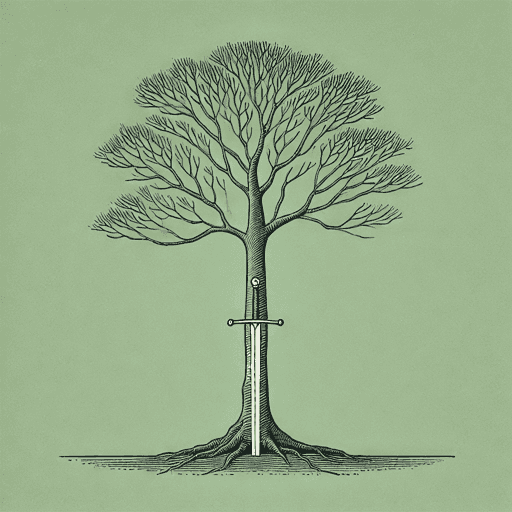
A first-person narrator introduces the story of Una Everlasting, beginning and ending beneath an ancient yew tree. The tree contains a sword driven into its heartwood—a blade whose name everyone knows. Beneath this tree, a woodcutter once found an infant girl. He raised her, and she grew wild and skilled, learning to hunt and fight. She became arrogant in her strength, though she was nameless and would have been forgotten.
In her 12th winter, the Brigand Prince raided her home while she was away, killing her father. Grief-stricken, Una went to the yew and pulled the sword from the tree. She tracked the Prince’s men through the snow and slaughtered them all, rescuing a captive woman—the future Queen Yvanne. The queen asked Una to serve her, and Una swore an oath. Yvanne knighted her as Sir Una, giving her a name at last. As Una swore her oath, the queen touched the sword to each of her shoulders and to the back of her head. Over the years, Una became the Queen’s Champion, the Red Knight, the Drawn Blade of Dominion—a legend.
The narrator, who rode at Una’s side and was her shadow, promises to tell how the legend ends. The text is identified as an excerpt from The Death of Una Everlasting, translated by Owen Mallory. A series of telegrams between Professor Gilda Sawbridge and Owen Mallory follows, showing Sawbridge’s skepticism about the text’s authenticity and her concern when Mallory suddenly disappears.
Part 1, Chapter 1 Summary
Several years after the war, Owen Mallory is a junior lecturer in Middle Dominion Studies at Cantford College. He receives a mysterious book in the post. He recognizes it immediately as The Death of Una Everlasting, a legendary text that scholars believe never existed. The book would be the greatest historical discovery of the millennium. When his rival colleague Jeremy Harrison arrives, Owen panics and hides the book inside his shirt, unwilling to share the find that could secure him the only endowed faculty position in their field.
On the train home, Owen examines the book. A young boy with welding scars, evidence of child labor in the munitions factories, sits beside him and asks about it. Owen shows him the dragon symbol burned into the wooden cover and reveals the title. Before leaving, Owen gives the boy a coin.
Part 1, Chapter 2 Summary
Owen reflects on his childhood in Queenswald, a mining village in what was once the Queen’s Wood. He claims that Una has saved his life three times.
The narrative flashes back to recount the first such instance. Owen is nine, living with his father, who has alcohol use disorder and is regarded as a coward and deserter from the last war against the Hinterlands. After the barkeep’s daughter calls his father a coward, Owen flees to a grove at the edge of the remaining Queen’s Wood. Contemplating leaving home, Owen finds a children’s book about Una Everlasting left for him by the barkeep. Inspired by Una’s courage, he decides to return home and face his father and his family’s struggles.
Years later, at 23, Owen comes face to face with a recruitment poster of Una as a war wages with the Hinterlands. He decides to enlist despite his terrible eyesight and fearful nature. At the front against the Hinterlanders, he discovers that he is an exceptional marksman, though he remains terrified and frequently ill. After a catastrophic battle at the southern beach, his commanding officer, Colonel Drayton, slits Owen’s throat for desertion. Owen survives by chance when Drayton is shot. Fevered and near death, Owen dreams of Una telling him to return, and he promises he always will.
After the war, Owen returns to find the grove cleared and the yew gone. Devastated but determined, he reenrolls at Cantford to study Una’s legend, hoping to serve his country through scholarship rather than combat. Under Professor Sawbridge’s skeptical guidance, he specializes in the Everlasting Cycle, though his work remains derivative. By the time he receives the mysterious book, he is desperate for a real discovery to save his failing career.
Part 1, Chapter 3 Summary
Owen examines the book as “an archaeological object” (29), performing tests to verify its age. He translates the opening pages and sends copies to Professor Sawbridge, who seems skeptical. One day, Owen leaves his flat for cigarettes and returns to find the book stolen, replaced by a white card bearing only an address.
Owen goes to the address—the capitol building—where his father is leading a protest against Minister of War Vivian Rolfe. Inside, Owen is escorted to Rolfe’s office. She explains that she discovered the book in a vault beneath Cavallon Keep and chose Owen to translate it based on his scholarship. She presents the book to him, but when Owen opens it, he finds that the pages are now blank. Confused, he asks why. Vivian tells him he has “not written them yet” (37), then drives a letter opener through his left hand and into the book. As his blood spreads across the empty pages, Owen’s vision fractures. Vivian whispers that Una needs him, and he is transported through time.
Part 1, Chapter 4 Summary
Owen wakes beneath the ancient yew tree in winter, a thousand years in the past. Una finds him with Valiance at his throat, assuming he’s a scribe following her to record her deeds. She’s wearing armor but appears to have been living as a hermit. Owen knows that an ill Queen Yvanne tasked her with finding the grail as her last quest, as it would revive her; however, he sees the look of a “coward” in Una’s eyes and knows that she abandoned the quest. He realizes that he was sent here by Vivien to ensure she finds the grail and solidifies Dominion’s future. He tries to convince her he’s from the future, showing her his cigarettes, spectacles, and revolver as proof. He even uses his own experience in battle, showing Una his scar and insisting that she inspires future generations to fight for Dominion. Una refuses to believe him but allows him to stay in her camp
Over several days, they establish an uneasy coexistence. Una reveals she came to the woods to rest and escape, but she’s tormented by nightmares about the violence she’s committed. In one last attempt to convince her he knows her future, Owen tells her she’ll receive a divine dream revealing where to find the last dragon and the grail.
Part 1, Chapter 5 Summary
Owen stays with Una for several more days, beginning to write her story. He reflects on poems he read about her history which recount her bravery, skill in battle, and devotion to Queen Yvanne. Under the Queen, the lands are united into the nation of Dominion for the first time.
One night, Owen realizes that Una has not been sleeping for fear of dreaming about the grail. He convinces her to sleep by offering to tend the fire. The next morning, she wakes him, shocked that his knowledge of the future was correct. He explains that she will go to Cloven Hill, where she will slay the last dragon, find the grail, and return it to Queen Yvanne. He confirms that it will be her last quest, as promised by the Queen, but avoids telling her about her death for fear that she will abandon the quest.
Una instructs Owen to prepare to leave by noon. When he questions why she is letting him join her, as she despises scribes, she reveals that it was Owen’s voice she heard revealing the grail’s location in her dream—not God’s.
Part 1, Chapter 6 Summary
Owen and Una travel north toward Cloven Hill. The journey is long and difficult for Owen on horseback. In villages, people recognize Una but fear rather than revere her. In a bathhouse, Owen is embarrassed when Una takes off her clothes in front of him, choosing to avert his eyes and stay clothed. Una explains that she is used to bathing with men, as people want to see her as something other than a woman, causing Owen to begin to understand the loneliness of her position.
Owen collects stories about Una from villagers and coaxes more from her directly. She tells him about her early adventures, including a love affair with the sorceress Morvain, a figure from one of her legendary quests, but refuses to speak of the Black Bastion, the final battle where she defeated the Hyllmen to win the First Crusade.
In one impoverished village, a man grabs Una, and she pulls her sword. At the last moment, Owen calls her name to stop her, so Una cuts off his hand rather than kill him. When Owen questions why she is rejected by the villagers, she points out that many of them were forced to join the nation of Dominion, and the Queen has done little to improve their lives.
Owen frequently experiences panic attacks tied to his experiences in the war. Una comforts him and eases his shame. However, when she has nightmares, crying out in her sleep, she refuses to allow Owen to help her. Owen begins to fall in love with her but forces himself to keep his distance. He writes The Death of Una Everlasting, describing their journey but rewriting much of it and smoothing over the brutal realities. He grapples with the knowledge of her impending death.
Part 1, Chapter 7 Summary
At Cloven Hill, Owen helps Una armor herself. She reveals her horse’s name is Hen before going to face the last dragon alone. Hours later, Owen hears the dragon’s death song. Una returns with the grail, physically unharmed but emotionally devastated. She reveals the dragon was beautiful, and that killing such ancient creatures has haunted her. However, Owen tells himself that even the death of something beautiful is worth saving Dominion. They ride south toward Cavallon Keep.
Part 1, Chapter 8 Summary
At Cavallon Keep, Una is hopeful, believing this is her last quest and she can finally rest. She reveals to Owen that, the day he found her, she was contemplating suicide. She is adamant that she would have done it if Owen had not appeared—despite the stories about her bravery.
Owen reflects on the stories of Una’s death, knowing that she will be shot by arrows from Hinterlanders that overtook the Keep in Una’s absence. He resists the urge to intervene, adamant that he will let her die for the future of his country. He helps Una don her armor.
At the last moment, as Una rides through the gates, Owen shouts a warning about archers, saving her from an ambush. Owen shoots the archers with his revolver, changing history, and Una slaughters the remaining Hinterlander soldiers. Inside the great hall, she presents the grail to Queen Yvanne, who appears to recover instantly. But then Sir Ancel, the Knight of Hearts, stabs Una from her blind side; he was working with the Hinterlanders. Una kills Ancel in a final duel but collapses. Dying in Owen’s arms, she begs him to come back for her, and he promises he will.
Part 1, Chapter 9 Summary
Owen awakes in the present. After Una’s death, Queen Yvanne visits him and reveals that she is actually Vivian Rolfe, the Minister of War from his own time. She discovered the book and traveled back in time, arriving at the real Yvanne’s deathbed. The dying queen convinced Vivian to take her place, believing Dominion needed the idea of her more than her actual presence. Vivian reveals she attempted this before, simply ruling competently as Yvanne. That version of Dominion fell within three years, making Vivian realize that she needed to create a myth surrounding Yvanne to ensure her success. She tells Owen that the book sent him to Una and her to Yvanne so they could create the founding myth Dominion required. The grail cannot actually resurrect anyone; Vivian was never truly dying.
Vivian takes Owen to Una’s corpse, laid out on a bier in the vaults. Owen, shattered, realizes Una died for nothing—unless he makes her death matter by writing her story. Through the night, Owen writes Una and the Betrayer, casting Ancel as the villain and framing Una’s death as the ultimate sacrifice for Dominion. He changes her final words from her plea to him to the patriotic “Erxa Dominus” (109) (For Dominion). By dawn, the book is complete.
Vivian reads Owen’s finished work and praises it, particularly his thorough vilification of Ancel. She promises they will remember Una and thanks Owen for his service. When they shake hands, she suddenly crushes his injured hand, drawing fresh blood onto the book’s pages. She tells him he never remembers that this has happened before, then time unravels again.
Part 1 Analysis
The opening of the novel establishes a central theme, The Power and Peril of Narrative Construction, by presenting a layered and self-referential narrative structure. The Prologue offers a mythic account of Una’s origins, describing her as a fated champion destined to become “a legend” (5), while the narrator claims to be Una’s true companion. This archetypal story is then immediately destabilized by the subsequent inclusion of telegrams between Owen Mallory and Professor Sawbridge, whose skepticism questions the text’s authenticity before the story begins. This framing device positions the primary narrative as a contested text, rather than a factual accounting of history. The novel thus becomes a story about storytelling itself, examining how personal identities and national histories are built upon curated narratives. Owen’s life has been shaped not by Una herself, but by her story in the form of a children’s book, a recruitment poster, and even a fever dream. These retellings of her legend are simplified, patriotic, and powerful enough to shape a life. This personal relationship with narrative is magnified to a national scale by Vivian Rolfe, who articulates the need for a founding myth to forge a strong nation, demonstrating that narratives can be weaponized as instruments of political power and social control.
At the same time, Owen and Una’s story serves as a deconstruction of traditional heroism. The legendary Una of the Prologue, who is a formidable warrior who slaughters the Brigand Prince’s men, is starkly contrasted with the real Una that Owen encounters: a traumatized, weary woman haunted by her past actions. Her refusal to speak of her victory at the Black Bastion, along with the villagers’ fear of her, dismantles the heroic archetype by revealing the brutal reality of conquest that sanitized histories omit. Owen’s own story serves as a critical counterpoint. He is considered a war hero for actions during a battle where, in reality, he attempted to desert and was nearly executed by his commanding officer. This irony exposes the disconnect between the state-sanctioned narrative of heroism and the inglorious truth of war. The novel uses both protagonists to argue that heroism is a construct, often built upon a foundation of trauma, violence, and narrative manipulation that erases the human cost of conflict.
Owen changes from a passive consumer of myth to an active, and ultimately trapped, creator of it. Initially, he is a man defined by others’ narratives: his father’s reputation as a coward, the heroic ideal of Una, and his unearned status as a war hero. His ambition is to solidify his place within the academic establishment by interpreting a foundational text. However, his journey into the past forces him to confront the flesh-and-blood reality behind the legend he reveres. His decision to save Una from the ambush by shooting the archers marks a pivotal shift. In this moment, he ceases to be a historian merely observing the past and becomes an agent actively altering it, motivated by a personal connection rather than an abstract devotion to his country. His duty to history becomes entangled with his love for its subject, forcing him to decide whether to tell Una’s true story or the one that will benefit Dominion. Ultimately, he makes the decision to write Una and the Betrayer, a coerced act of mythmaking which solidifies his role as the author of the very lie he once sought to uncover.
The symbol of the book and its activation by blood underscore the violent and sacrificial nature of writing history. The book is a magical artifact and a portal between eras, symbolizing the act of narrative creation. Crucially, its power is activated by blood, as Vivian initiates Owen’s journey by stabbing his hand and pinning it to the book’s blank pages. This act physically and metaphorically establishes that history is written in blood. The pages are empty because Owen, the historian from the future, has not yet created the past, making him both chronicler and creator. Vivian’s final act of crushing Owen’s hand to spill fresh blood onto the completed manuscript emphasizes the cyclical, editorializing nature of writing history: those in power write and rewrite events to tell the version of the truth they want to be remembered. The blood represents the real, human cost like Una’s death and Owen’s trauma that is transmuted into the sanitized, immortal narrative. The workings of the magical book suggest that national myths are not born from ink alone, but are forged through violence and pain, which the final story then works to conceal.
The narrative structure, culminating in the revelation of a time loop, serves as the novel’s commentary on the cyclical nature of foundational myths. The first nine chapters present a seemingly linear story of adventure and tragedy, but this illusion is shattered by Vivian’s final revelation that Owen never remembers what has happened before. This reveal recasts the entire preceding narrative as a single iteration in an ongoing process of historical fabrication. Vivian and Owen are not just telling a story; they are refining it, caught in a loop where Una must repeatedly die to perfect the myth that ensures Dominion’s future. This metafictional turn implicates the reader in the process of questioning narrative, forcing a re-evaluation of everything that has come before. The structure suggests that the writing of history is a dynamic, endlessly repeating performance, one that traps its actors in predetermined roles. In turn, this story becomes a literal prison for its characters, demonstrating the peril of a narrative so powerful that it overwrites human agency and condemns its subjects to an imposed destiny.

Unlock all 61 pages of this Study Guide
Get in-depth, chapter-by-chapter summaries and analysis from our literary experts.
- Grasp challenging concepts with clear, comprehensive explanations
- Revisit key plot points and ideas without rereading the book
- Share impressive insights in classes and book clubs