The Everlasting
61 pages • 2-hour read
Alix E. HarrowThe Everlasting
A modern alternative to SparkNotes and CliffsNotes, SuperSummary offers high-quality Study Guides with detailed chapter summaries and analysis of major themes, characters, and more.
Part 2Chapter Summaries & Analyses
Content Warning: This section of the guide includes discussion of child death, suicidal ideation, death, graphic violence, and sexual content.
Part 2: “The Second Death of Una Everlasting”
Part 2, Chapter 10 Summary
Several years after the war, Owen Mallory receives a wooden book in the post at his university office. Recognizing Una Everlasting’s device on the cover, he initially believes it to be a hallucination, a symptom of his deteriorating mental health following his wartime service. His colleague Harrison interrupts, but Owen hides the book and leaves. On the train home, a redheaded boy confirms the book is real by describing its cover. Troubled by the thought that translating it might inspire the boy to enlist and be broken by war as he was, Owen gives him money and goes home.
Over the following week, Owen translates the book, disliking what he perceives as the author’s cowardice but loving Una’s story. On the seventh day, he ventures out for supplies and finds the streets tense with unrest. Returning home, he discovers the book gone, replaced by a card bearing only an address.
At the capitol building, Owen encounters a massive protest. His father appears in the crowd, urgently warning him to flee as soldiers arrive. Violence erupts. Owen watches helplessly as his father falls on the steps, where a soldier stands over him with a raised rifle. Before Owen can act, someone pulls him through a door into the building. He is led upstairs to Vivian Rolfe, now Chancellor following Gladwell’s assassination, who encourages him to translate Una’s book. She notes that the country is on the verge of riot, often citing Ancel as their idol. When Owen questions why she needs the book, Vivian opens it to blank pages, presses his hand to one, and then stabs a letter opener through his palm, sending him back through time.
In the past, Owen laments the fact that he needs to write the story yet again. Instead, he insists that it is Una’s “turn to tell it” (124).
Part 2, Chapter 11 Summary
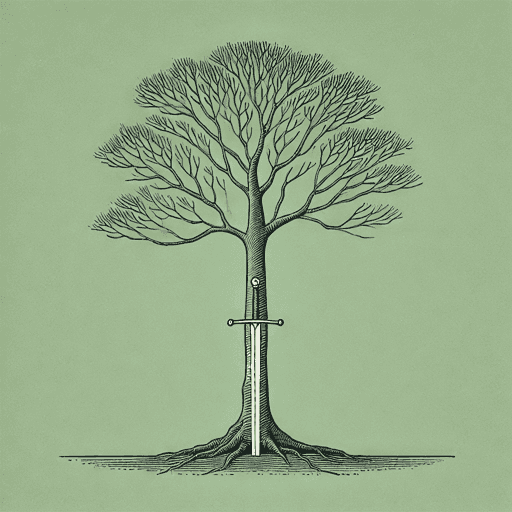
Una Everlasting is alone in the wild woods of her childhood, 20 years after her fathers died. She has come to the ancient yew tree to die, wearing her armor out of vanity so she will be remembered by name.
Suddenly, she is not alone. A man with his back turned stands on the far side of the yew, holding a bloodied knife. Una draws Valiance and presses it to his neck. When he turns, she sees Owen for the first time: thin, sad, poorly mended, and wearing strange glass panes over his eyes. He does not show fear but looks at her with adoration. She commands him to drop the knife, and he faints.
Una carries him to her fathers’ ruined cottage and tends to his wounded hand, noting his soft scribe’s hands and the book he carries bearing her symbol. When he wakes, he claims he was sent from the future to save Dominion. She dismisses him as a “madman” (128).
After Owen tells her she will dream of God, she avoids sleeping for days to postpone facing the truth that her peaceful exile is ending. Finally, she lets him tend the fire and falls asleep with her head on his shoulder. In her dream, his voice reveals the location of the last dragon. Believing this will lead to her release from service, she agrees to go for him.
Part 2, Chapter 12 Summary
On their first night traveling, Una has a nightmare and wakes with her hand around Owen’s throat. He calmly explains he has been waking her from bad dreams. She warns she could kill him, but he insists she will not. On subsequent nights, whenever she cries out, he is always near, whispering comfort.
They take smooth roads because Owen rides poorly. In the town of Farnvall, he charms a baker’s daughter into giving them food and directions to a bathhouse. When Owen enters the bathhouse after Una, he is flustered by her nudity. She stretches purposefully to hear his breath catch. He washes quickly and flees. Una lingers and masturbates, thinking of him.
In each town, Owen gathers local stories about Una, insisting that she tell her own versions. She tells him everything except the story of the Black Bastion. She watches jealously as he writes in his book, feeling he is inventing an idealized hero rather than seeing her. She holds him during his shaking spells but does not act on her desire.
In the Northern Fallows, they pass through a village Una once devastated. A scarred villager grabs her hair. Una intends to kill him, but Owen grabs her sword wrist, reopening his own wound to stop her. That night, when she tends to his injury, he catches her hand and kisses her palm. Una is overcome with desire, but when he looks up and sees the hunger in her eyes, he flinches. She pulls away, hurt.
Six days later, they climb Cloven Hill. Owen nervously helps her into her armor. Una finds the last dragon sleeping in a shallow cave. Though she swore never to kill in Yvanne’s name again, she lifts her blade for Owen’s sake and drives it into the dragon’s golden eye. The dragon screams and dies. In the back of the den, she finds a casket containing the grail. She feels the urge to throw it away.
Owen crashes through the trees, worried for her. He ignores the grail and tends to a cut on her forehead. As they ride away, Una realizes with certainty that she will die at Cavallon and never see her home again. Owen knows it too.
Over the following days, Una daydreams of escape but continues obediently toward her death. One cold night, she invites Owen to share her cloak. He refuses at first, then comes to her side when the fire dies. She pulls him against her, and when his body warms in her arms, she is overcome with desire to be with him before she dies. She brushes her lips against his neck, feeling his pulse rise, but he remains perfectly still. She believes he wants her death more than he wants her and concludes he is only using her for warmth. She holds herself motionless until dawn.
Part 2, Chapter 13 Summary
Owen insists Una wear her armor into Cavallon to match the paintings of her arrival. As he dresses her, she reveals she was planning to die by suicide on the day they met. In return, he confesses he is a deserter and again shows her his scars. He promises her death will redeem her and wipe their sins clean.
Una decides to shatter his faith by telling him the truth of the Black Bastion. She recounts how Queen Yvanne ordered them to burn a castle full of civilians with fire arrows, killing countless innocents. She confesses to killing a young soldier to maintain silence and explains her eye scar came from a girl in the ruins who Una let attack her; Ancel saved her by killing the child. The true horror was that Yvanne was only impatient for victory so they could have a spring parade with fresh flowers. This realization made Una shatter her original sword and lose faith.
Owen, shaken, still begs her to die as a hero for the sake of the story. Una recognizes his face and feels overwhelming love and familiarity. Unable to deny him, she agrees. As she rides toward the gates, Owen suddenly has a change of heart, warning her of 12 Hinterlander traitors waiting in ambush.
Realizing he is sacrificing the heroic story of her to save her life, Una leans down and kisses him. Knowing he needs the hero more than the woman, she rides into the trap despite his protests. As they fight, she hears Owen’s gun, killing several archers. The two defeat the ambush.
They enter the throne room. Yvanne, veiled and ill, sits on the throne with Ancel’s usual spot empty. Una kneels and presents the grail. Yvanne drinks and pulls back her veil, revealing a healed, youthful face. Outside, Hen screams and falls silent, signaling an attack to Una.
Ancel attacks from Una’s blind side. Owen throws himself between them, taking the blow across his middle. Una kills Ancel without hesitation. As she rushes to Owen’s side, she is stabbed twice in the back by other traitors. The queen yells that the crown and grail have been stolen.
Dying in Owen’s lap, Una pleads for him to come back for her. He promises he will always return, triggering her memory of their many lives and deaths together. Understanding she will see him again, she touches his face and tells him to wait for her “beneath the yew tree” (155). She then dies, smiling.
Part 2, Chapter 14 Summary
This time, when Una dies, Owen remembers the loop. He lets them take her body and is led placidly to a high room. Queen Yvanne, who is actually Vivian, arrives and takes him to the catacombs to see Una’s bier.
Owen asks how many times this has happened. Vivian admits she has lost track. He punches her in the face, chipping a tooth. She explains she has been altering the story with each iteration, making Ancel a traitor because Una had become too skilled at surviving the original Hinterlander ambush. In this iteration, however, Ancel was too much of a villain, inspiring the rebels in the current timeline. She reveals she forged Una into a legendary warrior by sending her back to die repeatedly, because the body remembers even when the mind forgets. Her goal is to create a story that inspires soldiers, not one that is merely a fairy tale.
Owen realizes his own life has been manipulated to bring him to this point, including the story at the age of nine and the poster that made him join the war. Vivian reveals her newest plan: a prophecy about the stolen crown and grail, which will justify reinstating the monarchy in the present timeline with her on the throne. When Owen refuses to write it, she has him imprisoned and tortured with extreme cold for three days.
Owen finally agrees. He rewrites the ending, recording the new events of Ancel’s betrayal and the theft of the crown and grail, and adding the false prophecy. He secretly embeds a coded message using 26 deliberately placed punctuation errors. After finishing, he dreams of a childhood memory of a girl beneath the yew, whom the text says never existed.
Yvanne returns, pleased, and gives him a knife to send himself back. He asks why he forgets; she explains he returns to his “native lifespan” (165) and cannot remember what has not yet happened to him. He theorizes he is beginning to remember through sheer repetition. He vows that next time he will remember more and save Una. She replies that there will not be a next time, as he stabs his hand on the book and returns.
Part 2, Chapter 15 Summary
The timeline resets. Owen receives the book again, this time feeling an ache in his chest and pain in his left hand. He immediately leaves his office, bumping into Harrison, and takes it home. For three days he struggles to translate even the first page, plagued by headaches and cold.
On the seventh day, he goes out for supplies. When a man spits on his boots, Owen smashes a milk bottle across his face. He returns to find the book gone, replaced by the card. At the capitol, the streets are quiet but littered with protest debris.
He meets with Vivian Rolfe, now Chancellor following Gladwell’s assassination. She gives her familiar crossroads speech, which sounds stale to Owen. He notices her chipped canine. She offers him a state-commissioned translation to be published by Satford and Gills. Owen opens the book and is shocked to find the pages are not blank.
In a daze, he signs contracts with the publishers. He is given an office in the capitol and two graduate students to assist. He learns Professor Sawbridge spoke highly of him before disappearing. The translation is completed quickly.
The book is published to conspicuously uniform praise. Owen is knighted so the cover can read Sir Owen Mallory. He goes on an extensive lecture tour and is celebrated, but encounters with patrons reveal they see him as a token representative of “his type,” noting his foreign, Hinterlander attributes. He understands he will never truly belong in Dominion. The only place that feels like home is the memory of the woods and the echo of the word yew, which also sounds like “you.”
Part 2, Chapter 16 Summary
The following summer, Owen returns to campus to find his office upgraded to a palatial room. Harrison confronts him, claiming the discovery should have been his and that he can remember things. News breaks that the cup and crown have been found.
Owen visits Professor Sawbridge’s office and finds her there for the first time in months. She reveals she and archivist Sylvie Shaw found the artifacts in Una’s tomb and tried to destroy them but were caught. She gives Owen a Lucky Star cigarette butt that she found inside Una’s sealed tomb, insisting that something is off about Dominion’s history, centered on Vivian. She then flees the country with Sylvie.
Owen spends the summer analyzing the entire Everlasting Cycle, discovering a pattern: the legend has been altered throughout history to justify political actions. Vivian is to be crowned Queen Yvanne II. While copying his notes into a childhood punctuation cipher, Owen realizes he has used it before. He examines his own translation and finds the 26 errors he planted, spelling out, “Wait for me, beneath the yew tree” (184). He remembers everything.
Owen hires a solicitor and visits his imprisoned father. His father reveals Owen is not his biological son. During the last war, his unit massacred a group of Roving Folk, including Owen’s mother. His father found infant Owen, deserted by shooting himself in the hip, and raised him out of love and guilt. His father gives him the name of a contact to help him break into the capitol.
A laundry woman helps Owen hide in the building until midnight. He breaks into Vivian’s bedroom and confronts her with his service revolver, demanding the book. He confirms that Tilda, Lysabet, and all the other queens were her. She admits Harrison was a previous candidate who failed, and that even Hen was impacted by repeated time travel. She built her power by creating her own heroic precedents, as history had no great women for her to emulate. She admits she must rule ruthlessly because any weakness would cause powerful men to destroy her.
Owen tells her he will unwrite her history. She threatens to hunt them through all of time. He bleeds on the book’s page. Vivian pulls out Valiance. As he is pulled back, Owen fires. She shifts the blade to block the bullet. The last thing he sees is Vivian smiling, as if she knew exactly how it would happen.
The perspective shifts to Una in the past, approaching the yew without armor, feeling joy. She finds Owen waiting. They touch hands, and she remembers everything. Owen tells her the truth. Una realizes her fathers’ deaths were likely engineered to make her a weapon. Owen also shows her that Valiance and his gun bear the same modern maker’s mark, proving everything is a manufactured fake. He convinces her their only duty is to each other, and that running will ruin Vivian’s perfect story. Una lets go of her anger and agrees to flee. He cuts her thumb on Valiance. They press their joined, bleeding hands to the book and disappear through time together.
Part 2 Analysis
The foundational legend of Una Everlasting explores The Power and Peril of Narrative Construction through Vivian Rolfe, who reveals herself to be the author of history. Her goal is to forge a national myth capable of uniting a populace and justifying state violence. Vivian confesses to Owen that she has engineered the time loop to refine this story, stating that a tragedy is “absolutely critical… There are only two kinds of stories worth telling: the ones that send children to sleep, and the ones that send men to war. I needed the second kind” (161). Her admission exposes the entirety of the Everlasting Cycle as a tool of propaganda designed to inspire patriotic fervor. This manipulation has contemporary consequences, linking modern dissent to a fabricated act of ancient treachery to discredit protestors. The book, as a physical object, symbolizes this process; its initially blank pages represent the historical void that Vivian fills with her self-serving fiction, a story powerful enough to crown queens and condemn generations to war. This conveys the idea that national identity is often built on curated narratives that serve the powerful, rather than on objective truth.
Parallel to the exposure of Vivian’s machinations, the narrative deconstructs the archetypal hero, revealing the suffering and moral compromise obscured by the legend. This engagement with The Personal Cost of Heroic Myths is exemplified in Una’s confession regarding the Black Bastion. She recounts how her supposed greatest victory was a massacre of civilians, ordered by Yvanne (Vivian) not for strategic necessity, but so the army could return for a victory parade with “fresh flower petals” (147). This revelation recasts Una’s legendary status as a product of sanitized history, erasing the human cost and amoral motivations behind her deeds. The glorified hero is revealed to be a traumatized woman haunted by her actions, always encountered by Owen while experiencing thoughts of suicidal ideation. Her reluctant killing of the last dragon further separates the woman from the myth, framing the act as a sorrowful execution. By juxtaposing the legend with Una’s reality, the text suggests that heroic narratives are often built on a foundation of lies designed to obscure war crimes and manipulate future generations into perpetuating cycles of violence.
The deconstruction of external myths prompts an internal journey toward self-determination for both Owen and Una, developing the theme of Personal Liberation Versus Imposed Destiny. Both characters begin as prisoners of Vivian’s narrative: Owen is her chosen chronicler, manipulated by his reverence for the legend, while Una is the tragic hero, riding “obediently onward, like a hog to slaughter” (142) toward a scripted death. Their liberation is a process of remembering—reclaiming a truth that exists outside the official story. Owen’s agency grows as he recalls past loops, culminating in the deciphering of his own coded message, an act of rebellion against his imposed role. For Una, freedom comes with the knowledge that her identity, including the sword Valiance, is a “manufactured fake” (201). This realization frees her from the weight of destiny. Their final decision to escape through time together, bleeding on the book to create their own path, represents a definitive rejection of their assigned roles. They choose a shared, uncertain future over a glorious, predetermined past, becoming “sworn to nothing and no one, now—save each other” (201). Their alliance transforms them from a hero and her historian into two individuals forging a personal narrative based on mutual self-preservation rather than national myth.
The recurring symbolism of scars serves as a physical manifestation of memory, trauma, and historical truth, emphasizing Owen and Una’s personal liberation. Scars are the indelible marks of past violence that the official narrative seeks to erase or romanticize. Owen’s throat scar is the literal trace of his desertion, a truth that contradicts his official status as a war hero. Likewise, Una’s eye scar is not from a glorious battle but from a child in the ruins of the Black Bastion, a physical reminder of her complicity in an atrocity. The narrative suggests that even when the mind forgets, “the body remembers” (160), implying that trauma is stored in the flesh. Blood functions as the ink with which this traumatic history is written and rewritten, causing an emotional scar that Owen feels even in the last timeline where he never actually cuts himself. The final act of Owen and Una pressing their joined, bleeding hands to the book, creating a new scar together, conveys the final creation of a new, shared history rooted in their personal connection. This visceral symbolism grounds the abstract concepts of history and memory in the physical body, suggesting that stories are not just told but are lived, suffered, and borne upon the flesh.
The narrative’s structure, defined by its time loop and shifting perspectives, functions as a literary device that implicates the reader in the text’s central thematic questions. Initially, the story is presented through Owen’s perspective as he translates the manuscript, positioning the reader as a passive consumer of a heroic legend. The revelation of the loop in Chapter 14 shatters this frame, prompting a critical re-evaluation of all preceding events. By replaying scenes from different viewpoints or with Owen’s accumulating memories, the structure encourages the reader to question the authenticity of the narrative and recognize Vivian’s authorial control. This technique makes the process of deconstruction an experiential one, as the reader must piece together the fragmented truth from conflicting accounts. The looping structure mirrors the contested nature of history itself, challenging the idea of a single, authoritative account. Through the disruption of a linear narrative, the text employs a postmodern strategy that moves beyond telling a story to questioning the act of storytelling, prompting awareness of how grand narratives are constructed and sustained.

Unlock all 61 pages of this Study Guide
Get in-depth, chapter-by-chapter summaries and analysis from our literary experts.
- Grasp challenging concepts with clear, comprehensive explanations
- Revisit key plot points and ideas without rereading the book
- Share impressive insights in classes and book clubs