The Everlasting
61 pages • 2-hour read
Alix E. HarrowThe Everlasting
A modern alternative to SparkNotes and CliffsNotes, SuperSummary offers high-quality Study Guides with detailed chapter summaries and analysis of major themes, characters, and more.
Part 3Chapter Summaries & Analyses
Content Warning: This section of the guide includes discussion of graphic violence, illness or death, child death, pregnancy termination, animal death, and sexual content.
Part 3: “The Third Death of Una Everlasting”
Part 3, Chapter 17 Summary
Una tells Owen about the nine years they spent fleeing through time after stealing the queen’s enchanted book—years she calls both “cowardly” and “perfect” (205). She asks him to write their story as a fairy tale about others, sparing her the pain of remembering too clearly.
Owen begins in third person, referring to himself as “the scholar” and Una as “the knight” (205) They activate the book with their blood and arrive beneath the yew tree in spring, roughly 130 years after Una’s death and 800 years before Owen’s birth. Owen chose a time without a queen on the throne for safety.
They run, abandoning everything: names, Una’s hair and armor, Owen’s red coat, even their genders, sometimes passing as two men or two women. At first, Owen keeps his distance despite clear desire. Una wonders if he loved only her legend.
One morning he wakes against her and apologizes. He insists that Una must be free to choose, as she has served others all her life. She invites him into her bed and the two have sex. When a boardinghouse owner expels them for being unmarried, Owen suggests marriage; Una refuses, not needing to have their relationship sanctioned by the crown, their enemy. However, she is adamant that she only wants to be with Owen.
Their intimacy becomes an anchor. Owen sets three rules: no permanent home; no travel before Una’s death or after his birth; no interference with history. Without Una and the grail, the queen’s empire crumbles, and she grows desperate to find them. Una often wants to break the rules to settle, rescue her horse, or stop injustice. After they abandon a beggar being beaten by soldiers, Una accuses Owen of killing Una Everlasting. He replies that the hero must die for her to live; she was never a hero but a weapon, and at least she no longer belongs to the queen. They make love again, Una directing, Owen calling her name.
Part 3, Chapter 18 Summary
Over years of running, Una and Owen learn to read the pulse that tells them when to move. They travel by every means across changing centuries, sleep anywhere, and learn which parts of the world shift quickly and which endure. Most importantly, they learn to understand each other completely. Owen knows every mark on Una’s body except a small silver circle between her breasts from childhood.
There are close calls when anachronisms or prolonged stays nearly expose them to the queen’s agents. They discover a fourth rule: No matter where they begin, using the book always returns them to the yew tree. Owen theorizes why; Una simply trusts it, since the queen has never found them there.
Gradually they linger in the woods longer, burying caches of supplies and repairing the woodcutter’s cottage. They begin to think of it as home, breaking the first rule.
The first time Una misses her period, she visits a brothel and obtains an herbal tea to end the pregnancy. Owen is shaken but cares for her through the illness. The second time, he briefly time travels to retrieve modern supplies, including pills. Una hesitates before swallowing one, though she cannot say why.
The third time, Una sees Owen’s trembling hands and realizes he wants the child. He admits it but says they cannot raise a baby while running. Una surprises them both by saying they could. Realizing the queen never intended her to have a future, Una crushes the pill and suggests traveling to before the queen ever existed. Owen protests, arguing that they might forget again or the book may not work that way, but relents seeing Una’s desire. They break the second rule.
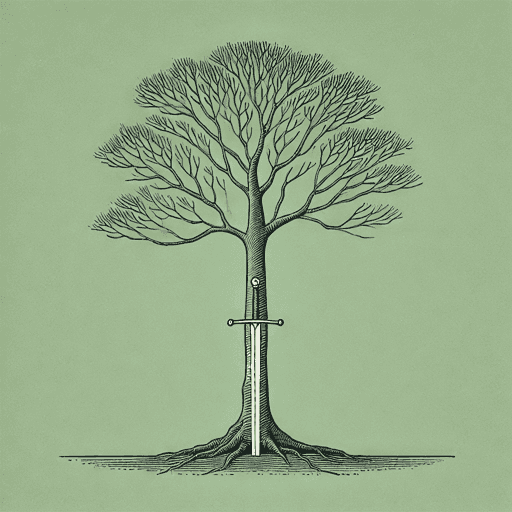
They arrive when the yew is young and Dominion does not exist. A sword hilt embedded in the tree panics Owen until Una sees it bears no maker’s mark. He speculates it may be the original Valiance of older legends, predating the queen’s copies. They are safe.
They build a cottage, taking small time jumps and using tools from the early modern era. When Una catches her pregnant reflection in a mirror Owen brought back, remarking on her womanhood but upset that her child will never see her wear armor. When Owen sees her upset, he removes the mirror without comment.
They travel forward to spring, and their son is born beneath the yew. He has pale, curling hair and a red birthmark on his left foot. Owen feels his son is something for which he would die, while Una feels he is something for which she would kill. The narrator refuses to write his name.
Part 3, Chapter 19 Summary
Feeling clumsy with infants, Una leaves most care to Owen. When the baby fusses at night, Owen tends him, thinking of his own father’s struggles and wishing he could ask for advice. Una watches them and thinks of the sword waiting in the yew to defend her family.
Several months after their son’s birth, a local crofter’s son arrives at their door in a panic. Raiders have attacked his family, and his brother is in danger. Owen demands to know why he came to them, but it is clear he recognized Una as a warrior. Una and Owen argue silently: She wants to help; he fears for their family. Sick with guilt, Owen signals his willingness to break the third rule.
Una walks to the yew and grips Valiance’s hilt. She imagines slaughtering the raiders and saving the farm, and also the queen discovering them as a result. She releases the sword and returns empty-handed. Kneeling before the crofter’s son, she tells him they cannot help. That night, she tends her baby with hands she knows will never hold a sword again, confirming for the scholar that Una Everlasting has died another death at his hands.
The narrative turns to their idyllic years and the book gathers dust. Their son learns to talk and declares he will be a knight, but Owen forbids it and stops telling stories—becoming, he thinks, his own opposite, destroying stories rather than preserving them as the price of peace. Their daughter is born with black hair and brown eyes. Owen wishes guiltily he could share small stories about his children with someone like Professor Sawbridge or even his father, then remembers their necessary isolation. Their children have no extended family, no lineage, only the present.
Years pass. On a summer day, their children play in the woods while Una and Owen share berries among white flowers. Owen says they are called dragonscales or ulla flowers. Hearing a name so close to her own, Una laughs, as if finding a lost part of herself. Owen wipes berry juice from her throat and tastes it, feeling he has reached heaven and accepting the moral cost.
At that instant of perfect happiness, footsteps approach. A voice he has not heard in nine years speaks, in a language from a millennium hence, addressing him as a corporal. The narrator concludes that “heaven is only a fairy tale,” but “the devil is real” (227).
Part 3 Analysis
The narrative structure of these chapters frames Una and Owen’s nine years of freedom as a self-conscious act of storytelling, directly engaging with the theme of The Power and Peril of Narrative Construction. The section opens with Una’s plea to Owen, the writer: “If you must write it… a tale overheard, about other people. Write it without you or I, but only they” (205). This metafictional device establishes the subsequent account as a constructed narrative, a “fairy tale” designed to create emotional distance from traumatic memory. By shifting to a third-person omniscient voice that refers to the protagonists as “the knight” and “the scholar,” the text enacts this request, transforming personal history into legend. This choice protects the characters from the pain of recollection while highlighting the artificiality of their idyllic existence. The language used—describing their escape as finding “heaven” (227) before the “devil” (227) arrives—reinforces this fairy tale structure, which ultimately proves fragile. The abrupt arrival of Vivian shatters the constructed narrative, demonstrating that while stories offer refuge, they cannot permanently alter the machinations of power.
This section develops the theme of The Personal Cost of Heroic Myths through Una’s abdication of her heroic identity. Having spent her life as a weapon for the queen, Una’s freedom is contingent on rejecting the actions that defined her legend. The three rules Owen establishes for their survival, particularly the mandate not to interfere with history, force her to confront this. The conflict culminates when a crofter’s son begs for help against raiders. Una is drawn to the yew tree and grips the hilt of Valiance, the source of her power and legend. She visualizes the familiar path of heroic violence but also its consequence: discovery by the queen. By choosing to protect her family, she must sacrifice the village. Her decision to remove “her hand from the hilt” (225) signifies the final death of “Una Everlasting.” This act refutes the glorified violence of her past, emphasizing her decision not to wield a sword for others, instead choosing a private existence even at a moral cost.
The development of Una and Owen’s relationship explores the theme of Personal Liberation Versus Imposed Destiny. Their bond becomes a space for redefining identity outside of prescribed roles as they shed their names, armor, and even conventional gender presentations. Their intimacy is founded on mutual choice rather than obligation. Wary of repeating the queen’s possessiveness, Owen insists Una must choose him freely. Una, in turn, reframes her allegiance not as submission but as a conscious act of claiming. Her refusal of marriage in favor of a personal declaration—“I fear I am a jealous woman, and do not share what is mine” (211)—is an assertion of autonomy. This personal vow replaces the public oaths of knighthood and fealty that once defined her. Their decision to have children represents the ultimate rebellion against the queen’s narrative, an act of creating a future and a lineage born of choice rather than political expediency.
Complementing Una’s transformation is Owen’s character inversion, which underscores the costs of their chosen peace. Initially defined as a scholar and historian—a preserver of stories—Owen is forced to become the opposite to protect his family. The life they build requires the suppression of narrative, as stories of heroes could inspire his son to a dangerous path or draw unwanted attention. When his son declares he will be a knight, Owen’s refusal and decision to tell “no more tales” (225) marks his transformation into a destroyer of the very thing he once cherished. The narrator notes that he “has slowly become his own opposite” (225), stamping out stories. This development shows him internalizing the lessons of his past. As he has seen what becoming a legend did to Una and what serving their country did to both himself and his father, he chooses to reject tales of heroism to become a guardian of his children’s fragile, ahistorical existence. His sacrifice of the history he once cherished demonstrates that the peril of narrative lies not only in its manipulation by tyrants but also in its perpetuation.

Unlock all 61 pages of this Study Guide
Get in-depth, chapter-by-chapter summaries and analysis from our literary experts.
- Grasp challenging concepts with clear, comprehensive explanations
- Revisit key plot points and ideas without rereading the book
- Share impressive insights in classes and book clubs