The Everlasting
61 pages • 2-hour read
Alix E. HarrowThe Everlasting
A modern alternative to SparkNotes and CliffsNotes, SuperSummary offers high-quality Study Guides with detailed chapter summaries and analysis of major themes, characters, and more.
Part 4Chapter Summaries & Analyses
Content Warning: This section of the guide includes discussion of graphic violence, death by suicide, illness or death, child death, pregnancy termination, and animal death.
Part 4: “The Fourth Death of Una Everlasting”
Part 4, Chapter 20 Summary
Nine years after escaping into the past, Owen and Una’s peaceful life in the woods is shattered when Vivian Rolfe arrives with armed men. Owen speaks in modern Mothertongue, a prearranged signal for their children to hide, then leads the group to their cottage. Inside, he retrieves the still-blank book from a shelf and throws it into the fire pit, but Vivian dismisses the act as a mere annoyance. Una confronts Vivian, declaring she will never fight or die for her again. Vivian reveals her leverage by pointing toward the woods, where their son and daughter are calling for their parents.
At Owen’s signal, Una attacks. She kills all of Vivian’s men with brutal efficiency, sustaining severe hand injuries when she catches a blade bare-handed to save Owen. Una approaches Vivian and places her ruined hands around the queen’s neck, but falters when Vivian whispers something in her ear. Vivian shoots Una in the chest with a revolver. As Una dies in Owen’s arms, she speaks their children’s names and asks him to wait for her, and Owen whispers the rest of their ritual promise.
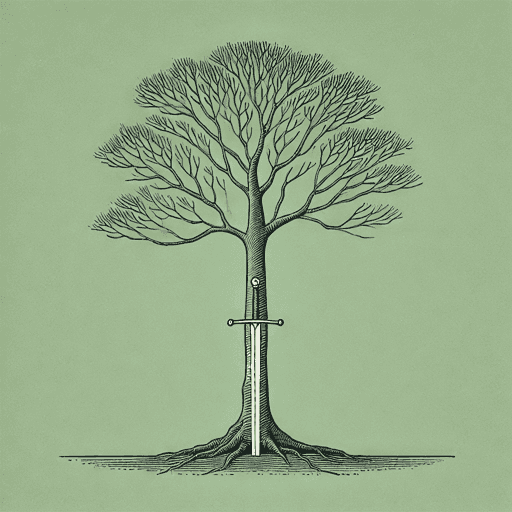
Vivian turns her gun on Owen, who prepares to die fighting her. The thought of orphaning their children stops him. After Owen’s call for the children goes unanswered, he tells Vivian they must have run off, so she shoots him in the knee to force them out of hiding. The children emerge to protect their father. Vivian forces them all to walk to the yew tree, where Owen realizes the book was made from the tree’s wood. Vivian confirms she had the ancient yew milled into paper.
At the tree, Owen understands that the yew itself—not just the book—enables time travel. As he prepares to use it, Vivian aims her gun at the children, stopping him. She reveals she allowed them nine years of freedom deliberately, using their children as bait for future compliance. She offers a deal: play his part in the story, and she will grant them a happy ending. Owen says goodbye to his children, laying them among the tree’s roots. When Vivian places her hand over his on the yew, Owen asks what she whispered to Una. Vivian reveals she is Una’s mother, then shoots through her own hand into his, triggering the time-travel effect.
Part 4, Chapter 21 Summary
Owen arrives in an altered modern timeline where Dominion is a diminished power rather than an empire. His throat scars now come from a burglary rather than war injuries. Vivian sits in his office and explains that she rebuilt her control. Harrison enters and acts subserviently toward Vivian. She reveals she manufactured his entire career to create a rival for Owen, funding his education despite his poverty.
Owen requests time to say goodbye. He visits Professor Sawbridge, who has been transformed into a fervent supporter of the authoritarian new Chancellor. She reveals Vivian holds her lover, Sylvie, hostage to ensure cooperation. When Owen urges her to flee the coming danger, Sawbridge refuses to abandon Sylvie, choosing instead to stand and fight.
Owen next visits his father at a tavern. His father attempts to pick a fight about Owen’s scholarship, which Owen recognizes as his clumsy way of connecting. They discuss Owen’s mother, and Owen realizes his father sacrificed his own dreams of traveling the world to raise him. When asked if he would flee, his father refuses, citing debts to his partners and his veterans’ group. Owen realizes he cannot run either.
Owen travels to the ruins of Cavallon Keep, where Vivian waits by the ancient throne’s plinth. She gives him a notebook for transcription, a revolver with three bullets, and her knife, keeping the main book herself. Owen cuts his finger, touches the book, and travels back to the distant past, resolved that this will be the last time.
Part 4, Chapter 22 Summary
Owen arrives at the yew tree in midwinter. Una is waiting and remembers everything. She embraces him and weeps. Unable to enter the cottage where she died, they make camp outside. Una despairs that they can never be free, as Vivian will always find them. Owen retrieves Valiance and performs a new knighting ceremony, asking Una to swear service only to a cause she chooses. She swears to fight for him and their children. He knights her using her secret, true name.
They ride for Cavallon. Owen writes new stories in his notebook about a nameless knight protecting a green sanctuary, telling these tales to villagers. He trades one story to boys from the conquered Hinterlands for phrases in their language, Shvalic. Una scrapes the royal device from her shield, and Owen has an artist paint a white tree on a green field. In a northern village, Una encounters a man whose sons she killed during the siege of the Black Bastion. She apologizes sincerely, expressing her own grief at losing her children. Owen tells the villagers to seek sanctuary in the Queen’s Wood if danger comes.
At Cloven Hill, Owen insists on accompanying Una to face the dragon. She enters the lair alone and emerges having taken the grail without killing it. She reveals her complex relationship with Ancel, whom she considered as close as a brother, and resolves to spare him if possible. They arrive at Cavallon. Owen checks his revolver and braids Una’s hair as they prepare for the final confrontation.
Part 4, Chapter 23 Summary
Owen enters Cavallon’s gate first, calling out a deceptive warning in Shvalic to trick the hidden Hinterlander archers into revealing themselves. When they emerge, he shoots all three with his revolver before their arrows can strike Una. The remaining Hinterlander soldiers refuse Una’s offer to surrender, their leader explaining that Vivian showed them visions of a conquered future. Una defeats them swiftly using her memory of previous loops.
Una rides Hen into the throne room, refusing to leave him outside to be killed again. The book lies open on Queen Yvanne’s lap as a threat. They proceed with the scripted scene. When Una kneels, Ancel attacks as expected. Una blocks the blow and engages him in an extended duel, trying to force him to yield. When he refuses, she incapacitates him but leaves him alive.
The Queen’s Guard attacks, leaving the throne undefended as Owen planned. He seizes Vivian, pressing a knife to her throat and knocking the book away. Ancel drags himself across the floor and grabs Owen’s ankle, stopping his attack on Vivian. Owen breaks free, but Vivian reveals her trap: modern crossbow archers hidden among the courtiers. She declares the story ruined and threatens to use one of their children as leverage next time.
As Owen is captured, Hen attacks his captors, freeing him. The book lands near Ancel. After meeting Vivian’s eyes with evident affection, Ancel urges Owen to get Una out and offers any affectionate farewell before tossing the book to him. As arrows fly toward them, Owen and Una hold the book between them and travel back to the very beginning of time.
Part 4, Chapter 24 Summary
Owen and Una arrive in the ancient past on a grassy knoll where the yew tree does not yet exist. Between their clasped hands they find the seed that will become the yew. A young girl appears and watches them. Owen burns the book and throws the seed into the flames, but the girl says it will not burn. She plucks it from the fire unharmed, revealing it is a dragon’s heart. Owen recognizes her scent of ulla flowers and realizes she is a young Vivian.
Una aims her sword at Vivian, who addresses her as daughter. Vivian tells her origin story: She was an orphan sold to an old king obsessed with conquering time. He discovered the dragon’s heart seed and its time-travel properties. To complete his ritual, he caused a pregnant Vivian to lose her child, as he needed a heart that had never been born. The stillborn child was Una. Vivian killed the king, took the child, and buried her with the seed in her chest on this hill. From this grave, the yew grew, and Una was eventually reborn from it, alive.
Owen says they will not let Vivian repeat the act. Vivian reveals she has already buried her daughter, Una, this time and only needs a soul displaced in time for the ritual. Una refuses to sacrifice herself, driving Valiance into the ground and stepping away. Vivian seizes Owen, holding her knife to his throat, telling Una she will die for him even if not for her. Owen realizes this is the inescapable trap: Una will always sacrifice herself for him, perpetuating the endless cycle. To break the loop and free Una, Owen keeps his eyes on hers and deliberately turns his head into Vivian’s blade, choosing death.
Part 4 Analysis
These final chapters conclude the central conflict between Personal Liberation Versus Imposed Destiny, as Owen’s self-sacrifice attempts to shatter Vivian’s cyclical control. The nine years of domestic life Owen and Una share in the form of temporal liberation is their only chance at freedom. However, its disruption by Vivian underscores the precariousness of their autonomy and the relentless nature of their imposed destiny. Vivian’s assertion that she allowed them that freedom highlights their destiny as a calculated system of emotional manipulation, reinforced by Una’s realization that “[i]t’s not freedom, if it can be taken away” (257). Vivian’s power relies on leveraging their love for their children and each other, twisting the source of their personal joy into the mechanism of their bondage. Owen’s final realization that Una will always choose to “die for him” (290) reveals the inescapable logic of Vivian’s trap. His death by suicide is therefore an act of agency. By choosing a death that lies outside the established script, he reclaims his own destiny by ending it, an act of self-negation that becomes an assertion of will and the only possible path to Una’s liberation. This choice critiques deterministic views of history, demonstrating that freedom can be found in the decision to defy imposed narratives, even at the cost of one’s own existence.
This section further dismantles traditional heroic archetypes by examining the psychological cost of violence and redefining heroism as an act of protection, forgiveness, and sacrifice. Una’s fury against Vivian’s men is depicted not as a glorious battle but as a visceral expression of trauma. Her question to Owen, “Have you learned to fear me yet, boy?” (235), reveals her alienation from her own capacity for violence. This deconstruction continues as she consciously adopts a new form of heroism marked by empathy and restraint: She apologizes to the man whose sons she killed, spares the dragon in its lair, and attempts to save her former comrade, Ancel. This redefinition of heroism relies on difficult choices made out of love and a desire to break cycles of violence rather than perpetuating them to create a legendary figure.
The final confrontation between Owen and Vivian metaphorically represents the fight to control the narrative of history. Initially a pawn, Owen has grown throughout the novel to actively subvert the story he is meant to record, ultimately becoming an agent of history. He creates counter-narratives about a nameless knight, masterminds the confrontation at Cavallon, and reclaims language by using Shvalic to deceive Vivian’s forces. With an understanding of how narratives shape reality, he confronts Vivian for authoritarian control, recognizing that her trap relies on the predictability of human emotion and his own love for Una. Owen’s death by suicide is the variable she cannot account for, a choice that disrupts her system by removing its narrator. In this way, the novel’s lopping timeline and cyclical structure convey the writing and rewriting of history to suit the needs of the victor, as those in power struggle to control the narrative. The fate of both Vivian and Owen in this moment underscores The Power and Peril of Narrative Construction. Manipulating history comes at great personal cost, while stopping it requires an act of will that negates the storyteller, creating the possibility of an unwritten future.
Throughout these chapters, foreshadowing and prophecy serve as ironic tools that are ultimately subverted, highlighting the characters’ struggle against a preordained fate. The central promise, “Wait for me […] beneath the yew tree” (237), transforms from a romantic ritual into a coded message of rebellion and a promise of reunion. What once served as prophetic emphasis on the doomed cycle of Una and Owen’s life, vaguely remembered and repeated without meaning, is now reclaimed and repurposed, even within the controlling narrative. Similarly, Ancel unexpectedly changes in his final moments, ironically subverting his prior role as the one who repeatedly destroys Una’s attempts to control her future. His last words, “Save me a kiss in hell, then” (279), and his decision to toss the book to Owen, gives him a form of redemption by betraying his queen’s plan out of a complex, personal loyalty. This act defies his scripted role as a simple traitor and suggests that even the most loyal pawn retains a measure of agency. This technique challenges the traditional function of prophecy in fantasy, suggesting that meaning is not inherent in the script but is created through the actions of those who live it, reinforcing the idea that even rigid narratives can be resisted from within.

Unlock all 61 pages of this Study Guide
Get in-depth, chapter-by-chapter summaries and analysis from our literary experts.
- Grasp challenging concepts with clear, comprehensive explanations
- Revisit key plot points and ideas without rereading the book
- Share impressive insights in classes and book clubs