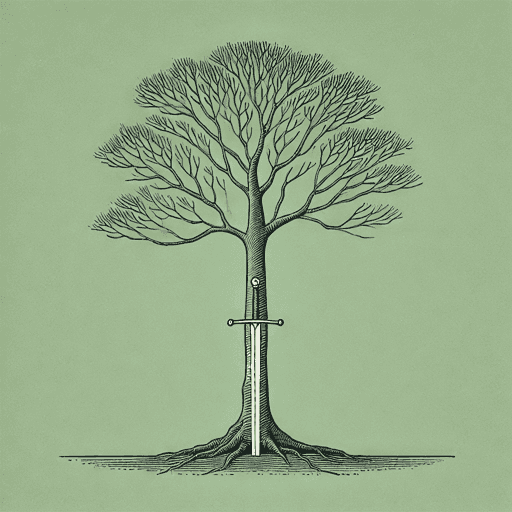
The Everlasting
61 pages • 2-hour read
Alix E. HarrowThe Everlasting
A modern alternative to SparkNotes and CliffsNotes, SuperSummary offers high-quality Study Guides with detailed chapter summaries and analysis of major themes, characters, and more.
Part 5Chapter Summaries & Analyses
Content Warning: This section of the guide includes discussion of death by suicide and illness or death.
Part 5: “The Last Death of Una Everlasting”
Part 5, Chapter 25 Summary
Una watches Owen die and realizes that, this time, she is the one left to grieve. She closes her eyes, unable to watch, then opens them to find Yvanne standing over his body.
Looking young and frightened, Yvanne offers to return Owen and their children to Una. Una levels Valiance at Yvanne’s chest. Yvanne tries to manipulate her by invoking Una’s oath of service, threatening that she will be forgotten, and calling her a monster for wanting to kill her own mother. Una replies that she serves no master now and that the name “Una Everlasting” is not her true one.
Una asks if Yvanne would stop scheming if spared and demands the truth. Yvanne admits she would never stop. Una considers this the only gift her mother ever gave her and kills her quickly, cutting her heart in two.
Una removes her armor and lies beside Owen’s body, taking the warm dragon seed from his palm. She whispers that she will “wait for [him] beneath the yew” (298). She spends the entire day digging Owen’s grave, While digging, she pushes Yvanne’s body down the hill. She takes Yvanne’s knife, stabs it into Owen’s heart, and plants the seed inside the wound. She buries him and lies down beside the grave to wait.
Part 5, Chapter 26 Summary
Una waits by Owen’s grave, letting days pass uncounted. She marks seasons by the yew sapling’s growth, which occurs unnaturally fast.
When her cloak disintegrates, Una descends to a nearby settlement of cob huts, the future Queenswald. She meets a smith and trades her armor for supplies, including two woolen blankets, one for her and one for Owen’s return. She keeps Valiance, knowing she must be ready to defend the wood against future threats.
The villagers whisper about the strange, sword-carrying woman and begin leaving offerings at the foot of the hills. Una tries to repay them by returning lost lambs, driving away thieves, and making pursuers vanish. The villagers stop using the land near the yew, allowing it to grow wild.
Time moves strangely beneath the yew. Una suspects she sometimes sleeps for years. The tree grows massive, and she notices a face-like pattern in its trunk. One day she falls asleep in autumn and wakes in summer to the sound of breathing.
She finds Owen sitting against the other side of the tree, alive and whole. His hair is now bone-white like hers, and he bears a silver scar on his chest from where Una planted the seed. His eyes are tawny amber. He opens them and speaks her true name, which remains withheld. They kiss “fiercely and furiously, for a long time” (303). Owen says he remembers some things, especially her. Una tells him that is enough.
Part 5, Epilogue Summary: “Una and the Yew”
Owen narrates that their story ends where it began, beneath the yew tree in an unnamed wood near the former Queenswald. The wood has never been successfully claimed or named; soldiers and surveyors who enter find no luck there. A woman guards it, called the Keeper of the Yew or the Green Knight.
Owen recounts legends of the Green Knight. In one, a prince who came to hunt a dragon was driven away with his men; in another, two deserter brothers sought courage and were put to sleep beneath the yew for a hundred years until their war ended. Other tales tell of lost children found with gold, hungry families finding game, and highwaymen hidden from sheriffs.
Owen and Una live in a cottage near the yew with their children, a son and a daughter as they had before. Their son bears the same yew-berry birthmark. They also have their horse, Hen, who lives unnaturally long. Their wood becomes a refuge for outcasts. A woodcutter and his husband, whom Una greets with unexplained affection, also settle nearby. A beautiful knight with orange hair, searching for someone to serve, visits briefly; after a walk with Una, both return weeping.
Owen explains he cannot write Una’s true name to prevent it from becoming a battle cry but encodes it in a cipher his father taught him. He plans to send the manuscript through time, perhaps to a professor from his past at Cantford who encouraged him to take good notes, and asks Gilda, a contact from his original time, to pass it to his father. Legends say Owen and Una eventually lay down together beneath the yew and did not rise again.
A message from Gilda confirms she and Owen’s father will visit a very long time ago. A postscript notes Owen renewed his library books, indicating he has returned to his original time.
Part 5 Analysis
The novel’s final chapters replace the glorified violence of Una’s legend with a heroism rooted in preservation and community. Una’s first act after the time loop breaks is killing Queen Yvanne, which serves as an execution to secure her freedom. Her subsequent actions underscore The Personal Cost of Heroic Myths as she rejects her martial identity for one that more closely aligns with her own values. She trades her armor, the primary signifier of her knightly identity, for simple blankets, metaphorically exchanging a life of combat for one of care. The epilogue solidifies this transformation through the folklore surrounding her new identity as the Green Knight. The new tales are not of epic battles but of quiet protection: runaway brothers are given refuge, a dragon hunt is thwarted without bloodshed, and the hungry are fed. Owen’s narration makes this deconstruction of heroism explicit, noting that in these new stories, “[n]o duels are fought, no crowns are won. There are not even any heroes, really” (305). This subverts the Everlasting Cycle’s premise, suggesting that heroism lies not in glorified heroic acts for the state but in the work of fostering life.
Una’s arc underscores the theme of Personal Liberation Versus Imposed Destiny by rejecting the narrative identity her mother constructed. Yvanne’s power over Una was always narrative; by naming her “Una Everlasting,” she trapped her in a role. When Yvanne invokes this title, Una’s response, “That is not my name” (296), is the definitive act of self-reclamation, verbally severing ties to her imposed destiny. While killing her mother finalizes this break, it is Owen’s self-sacrifice that shatters the narrative cage, as it is an act of agency Yvanne’s cyclical plot could not predict. Free from the loop, Una’s choice to live as a protector of an unnamed wood rather than as a champion of a dominion represents the realization of her liberated identity. The final step is Owen’s redaction of her true name from his manuscript, ensuring it cannot be co-opted as a “legend” or a “battle cry” (307), thus preserving her identity as her own.
The symbols of the yew tree and scars are transformed in the concluding chapters, reflecting the narrative’s turn from cyclical trauma to regenerative healing. The yew tree, once the engine of Yvanne’s time loop and a site of repeated death, is reclaimed as a source of life and sanctuary. Una uses its magic to resurrect Owen, planting the dragon’s heart seed within his fatal wound and transforming the site from the place where history resets into the source of his rebirth. The tree becomes the heart of a wood that “[has] never been named, nor claimed by any king or country” (305), a space outside the dominion of political narratives. Similarly, the scars they bear once served as markers of past wounds and their experiences in battle. Now, they both bear the mark of the tree’s growth, replacing their battle wounds and serving as physical testaments to their shared ordeal and survival. In this way, tools of their trauma have been repurposed for healing, marking their personal renewal rather than political exploitation.
The novel’s conclusion uses a metanarrative structure to resolve the theme of The Power and Peril of Narrative Construction. The epilogue is a collection of folklore framed by Owen’s reflections as an author, cementing the victory of personal, evolving truth over a singular, state-sanctioned myth. Instead of one authoritative text like the Everlasting Cycle, Una’s new legend is presented as a series of fluid, communal stories and fairy tales. This shift demonstrates that her story now belongs to the people she protects, evolving organically rather than being dictated from above. Owen’s final act is to write their true story and send it through time to his former professor and a contact named Gilda. This act serves to correct the historical record, supplanting Yvanne’s fabricated tragedy with their lived reality. The final message from Gilda confirms that the true manuscript has been received, effectively closing the narrative loop by ensuring that the authentic story endures. This structural choice champions personal testimony and collective memory over the monolithic histories written by the powerful.

Unlock all 61 pages of this Study Guide
Get in-depth, chapter-by-chapter summaries and analysis from our literary experts.
- Grasp challenging concepts with clear, comprehensive explanations
- Revisit key plot points and ideas without rereading the book
- Share impressive insights in classes and book clubs