The Everlasting
61 pages • 2-hour read
Alix E. HarrowThe Everlasting
A modern alternative to SparkNotes and CliffsNotes, SuperSummary offers high-quality Study Guides with detailed chapter summaries and analysis of major themes, characters, and more.
Symbols & Motifs
Content Warning: This section of the guide includes discussion of graphic violence, illness or death, and sexual content.
The Yew Tree
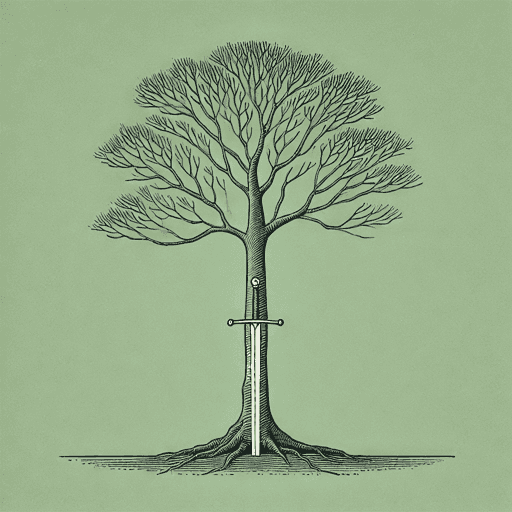
The Yew Tree symbolizes death and rebirth, serving as a natural power that exists outside of Vivian Rolfe’s constructed narratives. It represents both literal rebirth, as it grows from both Owen and Una after their deaths, and a metaphorical rebirth of the timeline, as Owen and Una return there each time they travel through history. For Una, it is the source of her legendary sword, Valiance, locking her into a heroic destiny, and the place where she is allegedly found by Yvanna in her legend. Owen, too, feels its pull, first as a childhood refuge and later as the portal for his travels through time. The tree is a place of deep, cyclical magic where “time runs strangely” (3), suggesting a power that defies the linear, controlled history Vivian seeks to impose. In this way, the tree’s symbolism develops the theme of Personal Liberation Versus Imposed Destiny, offering an alternative to the rigid fate written in the book. Ultimately, the yew provides the final escape from Vivian’s control. By traveling back to its very beginning and planting a new, untainted seed, Una and Owen choose to create their own history, one that grows organically from a place of wild magic rather than from the blood-soaked pages of a tyrannical narrative.
The Book
The magical book, The Death of Una Everlasting, symbolizes the writing of history, developing the theme of The Power and Peril of Narrative Construction. It is the instrument through which Vivian Rolfe creates and controls reality, shaping individual destinies to serve her nationalistic ambitions. The book’s magic, powered by blood, blurs the line between recording history objectively and writing it to serve one’s own ambitions, embodying the idea theme that stories are potent tools for forging identity and justifying violence. Initially, Owen believes he is translating a “true accounting” (27) of Una’s life, seeking to honor a fixed past. However, Vivian reveals the book’s true, terrifying nature when she presents him with the empty volume and states, “Because you haven’t written them yet” (37). This revelation exposes the core of Vivian’s power: the ability to manufacture a heroic past to legitimize her rule in the present and future. By forcing Owen to write a pre-determined tragedy, she turns history into propaganda and destiny into a prison. At the same time, the book is also the key to liberation. While it traps the characters in a repeating cycle of suffering, it is Owen’s authorship that ultimately allows for escape. By embedding a secret message within the text and later choosing to burn the book, the characters reject their imposed narrative. Their final act of destroying their own legend is Owen and Una’s assertion of personal agency over historical destiny, affirming that true freedom is found in rejecting the pre-written story to live an authentic life.
Scars
Scars in the novel symbolize the indelible physical and psychological trauma of violence, subverting the glorified legends of heroism imposed on the characters. These marks are histories written on the body that refuse to be erased by patriotic tales, developing the theme of The Personal Cost of Heroic Myths. Owen’s prominent throat scar is an ironic manifestation of this symbolism; it is the source of his status as a war hero, yet it was inflicted not by an enemy but by his own commanding officer when he deserted. This scar emphasizes the lie at the heart of many state-sanctioned stories of valor, serving as a physical manifestation of the trauma Owen experienced in war. In contrast, the novel presents authentic scars as testaments to suffering that official narratives ignore or exploit. The young boy on the train has “wrists spattered with hot pink scars” (11) from munitions factory work, revealing the hidden civilian cost of Dominion’s wars. Later, the Hyllman villagers’ hatred for Una is embodied by a man whose head is covered in “slick pink scars, as from fire” (71), a direct result of her brutal tactics at the Black Bastion. These physical wounds contradict the ballads that praise her as a “Virgin Saint” (5). The novel contrasts Una’s real, scarred body with the flawless image of her in propaganda posters. Scars undermine the idea of clean, noble violence, arguing that the true cost of empire is written in wounds that can never be fully sanitized or forgotten.

Unlock the meaning behind every key symbol & motif
See how recurring imagery, objects, and ideas shape the narrative.
- Explore how the author builds meaning through symbolism
- Understand what symbols & motifs represent in the text
- Connect recurring ideas to themes, characters, and events