The Feast of the Goat
71 pages • 2-hour read
Mario Vargas LlosaThe Feast of the Goat
A modern alternative to SparkNotes and CliffsNotes, SuperSummary offers high-quality Study Guides with detailed chapter summaries and analysis of major themes, characters, and more.
Chapters 13-15Chapter Summaries & Analyses
Chapter 13 Summary
At supper, Urania notices how different her Aunt Adelina appears: “bent, almost bald […] her face puckered into a thousand wrinkles, dentures that shift when she eats or speaks” (192). Urania sees her niece Marianita, whom she has never met, watching her carefully, and she wonders what her niece has heard. Urania’s aunt and cousins reinforce the belief that Urania’s father recognizes her and feels happy to see her, even if Urania cannot tell. Lucinda complains that the family’s fortunes began to change when Trujillo died, but Adelina says that their troubles started earlier, with the letter in “The Public Forum” denouncing Agustín.
The narrative begins shifting between the present and the time of the letter’s publication. Agustín’s brother-in-law originally informed him of the letter via telephone and assured him it was probably just a mistake. Agustín suspected the letter was a trap of some kind, though he, too, was not unnerved by its appearance, as “it was the first time he had appeared in the infernal column” (193). The letter—signed by a Telésforo Hidalgo Saíno, but certainly written by a high-ranking government official, if not Trujillo himself—accused Agustín of corruption during his time as the Minister of Public Works. As he read and reread the letter, he tried to remember anything he might have done to offend Trujillo.
Back in the present, Aunt Adelina claims that Agustín never discovered with certainty why he fell into disgrace. Another cousin, Manolita, says Trujillo blamed Agustín for the troubles with the bishops. Adelina says that in the swirl of rumors, the doubt itself was the worst part.
The morning Agustín entered the Senate following the letter’s publication, his secretaries expressed concern, but Agustín promised all would be cleared up soon. He spoke with the newspaper’s editor on the phone, who told him that the paper had corroborated the letter but offered to print a rectification as soon as Agustín provided it. As soon as Agustín hung up the phone, he doubted that he’d made the right move. He then discovered that the Senate meeting had been canceled without his involvement, throwing his position as President of the Senate into doubt.
In the present, Urania says she doesn’t remember much of the incident, as Agustín tried to hide it from her. Her aunt and cousins suggest that some good came of it for Urania, even though it proved disastrous for the rest of the family.
Following the canceled meeting, Agustín rebuked the Vice President of the Senate, Dr. Jeremías Quintanilla. Quintanilla took him to the balcony, out of earshot, where he confirmed that Trujillo ordered an attack on Agustín through Henry Chirinos: “The nightmare is happening, the one that came periodically to drag down his triumphs […] he has been estranged from the Chief” (200).
Agustín arranged a meeting with Chirinos. En route to Chirinos’s house, his driver informed him that SIM agents followed behind, causing Agustín to wonder if arrest were imminent. At their meeting, Chirinos denied orchestrating the attacks, telling Agustín that he did what he was ordered to do; this message doesn’t reassure Agustín, who knew Chirinos as “a first-rate actor” (203). Chirinos denied having written the letter in “The Public Forum,” but he wouldn’t say who wrote it. Chirinos advised Agustín to talk to Trujillo to figure out what happened and rectify it. Agustín knew that even if Chirinos “hadn’t actually devised this, in his heart of hearts he was celebrating it as a great victory over someone who, despite all appearances, had always been his rival” (204). In the days that followed, Agustín’s confusion only increased. SIM agents continued to follow him, and he was investigated for financial crimes. Neither Trujillo nor any other high-ranking officials would meet with him, and Agustín told young Urania to prepare for the worst.
In the present, Adelina decries it all as ridiculous, as Agustín never kept anything for himself. She claims he was “the most honorable politician and the best father in the world,” and criticizes Urania for not treating him properly (207). Urania considers her aunt’s rebuke, then explains that “he wasn’t as good a father” as she thinks (208).
The narrative shifts again into the past: Agustín met with Abbes, the only government official willing to speak to him. Abbes told him to write to Trujillo directly, and if Agustín sounded sincere, Trujillo would respond. Abbes told Agustín that whether or not Abbes arrested him depended on what orders he received. He left Agustín with an escort to ensure that Agustín didn’t seek asylum. Abbes then hinted that Agustín’s troubled stemmed from having recently attended a party at Henry Dearborn’s house; Agustín had been ordered to attend that party in order to report on it. Abbes then made a snide remark about Agustín going against him in his suggestions regarding the United States, which made Agustín wonder if Abbes were behind the attack.
Flashing forward to the present, Adelina continues to defend Agustín and wonders how Urania could claim that he was a bad father after everything he sacrificed for her. Urania tells Adelina that “he didn’t make those sacrifices out of love […] He wanted to buy me. Salve his guilty conscience” (212).
Following his meeting with Abbes, Agustín stopped at a bar to clear his mind. In the paper, he saw that Trujillo’s confidante, Manuel Alfonso, had returned to the Dominican Republic. Agustín ran out of the bar, inspired.
Chapter 14 Summary
At five o’clock, Trujillo meets with President Joaquín Balaguer, as he has done every weekday for the past nine months. Trujillo has just discovered that Balaguer authorized Urania Cabral to leave the country two weeks prior. Balaguer feels confused, as he had sent a memorandum explaining the proposition, and when Trujillo did not object, as the trip was urgent, Balaguer proceeded. Trujillo doesn’t believe that the letter was lost and instead assumes it was misdirected, to enable her escape.
Balaguer states that he will conduct an investigation to get to the bottom of the incident and apologizes for not speaking with Trujillo personally, but notes that he considered it a trivial matter, since Agustín’s situation was not meant to extend to his family. Trujillo suspects that the Catholic nuns provided the scholarship as a bribe to bring Agustín to their side; however, Balaguer notes that the nuns don’t have a high opinion of Agustín and wanted to help Urania, not him. Trujillo still wonders whether Cabral betrayed him or will betray him still. “Had it been frivolous to put an efficient servant like Cabral to the test at this difficult time for the regime?” (218).
Trujillo pivots to discussing the Church. Balaguer believes he has convinced Monsignor Reilly to leave Ciudad Trujillo; Trujillo wonders if he should exile them, as Abbes has suggested. Balaguer suggests that Trujillo knows better than to listen to Abbes on this: “But the Generalissimo was too wise and too much of a realist to follow the rash, impolitic advice of the head of the SIM, which, if carried out, would have the most unfortunate consequences for the nation” (219). Balaguer thinks Abbes is strong on security but has no feel for politics.
To Trujillo, Balaguer remains a mystery, a man with no ambition who will do whatever Trujillo asks of him. Trujillo wonders whether his puppet president is sincere or has a larger scheme afoot. Neither he nor Abbes have found vice or weakness in Balaguer’s background, either: “There’s something inhuman in you […] You don’t have a man’s natural appetites” (221). Trujillo admits that the one work of intellectualism he’s read was a published speech Balaguer gave some years prior, called “God and Trujillo: A Realistic Interpretation.” Trujillo considers his curiosity about the speech weak, but he knows Balaguer won’t reveal that weakness to anyone.
Chapter 15 Summary
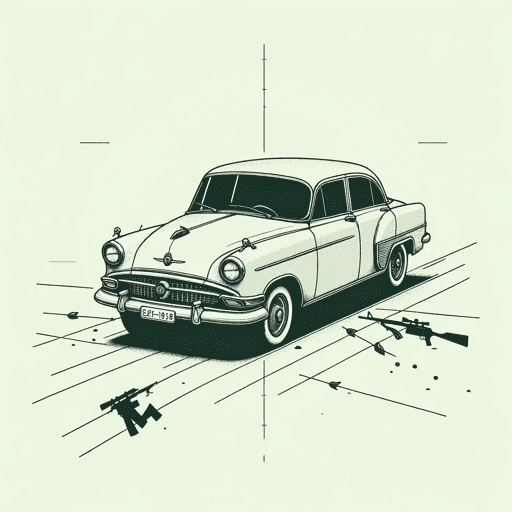
Further up the highway, Huáscar Tejeda and Pedro Livio Cedeño wait in their Oldsmobile for the signal; like the four in the Chevrolet two kilometers back, they’ve begun to believe that Trujillo won’t come because the hour grows late. They await Tony’s signal—three headlight flashes—at which point they will cut off Trujillo’s car so that all can surround it. When the two cars race by, the Chevrolet does not signal; faced with a decision, Pedro and Tejeda race after them.
Pedro was once married to a close friend of Trujillo; after their divorce, she used her influence to prevent him from seeing their daughter. His current wife knows he detests the regime for this, but she believes the vendetta to be personal rather than political. Pedro believes his wife wouldn’t understand his true reason for opposing the regime: the murder of the Mirabal sisters.
As they race to catch up, they realize that they also forgot to signal another co-conspirator: Fifí Pastoriza, who waits in the last car along the highway. As they catch up to Trujillo’s now-stopped car, Tejeda slams on the brakes as Pedro opens the door, throwing him from the car. Pedro rolls hard on the pavement, then gets up and moves toward the car before Turk unintentionally shoots him.
As Pedro and others try to assess his injuries, Pedro can only make “guttural noises.” Despite his condition, he feels relieved when he sees Trujillo being put into the Biscayne. The others are in a rush: They need to show the body to General Román so that he will put the rest of the plan into motion. They had agreed to give any injured conspirator a coup de grâce so no one would fall into the hands of Abbes or any other Trujillistas. Pedro wonders if they will follow through on this promise, but they appear not to consider it; instead, they maneuver him into the car and try to figure out how to help him.
More cracks begin to show in the execution of the plan. Turk’s Mercury was left on the highway, which enrages Turk, who realizes that this oversight will implicate him. Amadito assures him that it won’t matter since Román will assume power that night, but they soon discover that Román isn’t at home. When they attempt to deliver the body, his wife tells them Román has left with General Espaillat because something had happened to Trujillo.
Pedro believes they’ve forgotten about him, but he’s soon surrounded by faces, including a dentist, Bienvenido García, and a physician, Linito, who examine him. Linito tells them that Pedro is bleeding to death and must be taken to a hospital immediately, as he needs surgery right away. Pedro no longer cares about dying now that the assassination has succeeded, but he cannot say the words, and they take him to the International Clinic.
At the clinic, doctors stabilize Pedro, and he is able to speak again. He realizes that the doctor will have to inform the SIM that a man with a bullet wound has entered the hospital; however, he believes that the others “must have shown Pupo the body by now, and Román would have alerted the barracks and announced the civilian-military junta” (247). His wife arrives; he tells her it was just an accident, but then excitedly tells her “He’s dead, Olga! He’s dead, dead!” (247).
Abbes enters the room before Pedro goes into surgery; he orders everyone but the doctor to leave. Abbes begins questioning Pedro, who tries to lie to Abbes, even though he knows his lies will be discovered. Pedro then tells Abbes the truth. Abbes’s demeanor doesn’t change; instead, he begins asking about the conspiracy and his co-conspirators, torturing Pedro with cigarettes as he interrogates him. “[Pedro] closed his eyes. The heat was intense; there was a smell of singed flesh. When he opened them, Abbes García was still there. It had begun” (249).
Pedro gives up Tony Imbert, then Antonio de la Maza, and he tells Abbes that there were no leaders. He then tells them that the two Antonios are looking for Pupo Román, which stuns Abbes and the others with him. Pedro realizes that something is wrong: The revolution has not begun if Abbes and the two military men who accompany him are still there. The doctor tries to get Pedro into surgery, but Abbes threatens to kill the doctor if he doesn’t revive Pedro for further questioning. Pedro continues confessing about the conspiracy and asks if they’ve shown the body to Pupo and Balaguer, to which Abbes’s jaw again drops—“in some obscure way, [Pedro] was winning the game” (253).
The doctor finally convinces Abbes that Pedro requires immediate surgery, as he’s slipped into a coma. Abbes tells the doctor that if the patient doesn’t survive surgery, the doctor will be executed.
Chapters 13-15 Analysis
Chapters 13 through 15 reveal that even the most carefully laid plans, even those slowly built over a lifetime, can be thrown into chaos. The assassination plot, though it succeeds in eliminating Trujillo, ends in disaster. The plan seemed foolproof: Men on the inside let the assassins know precisely when Trujillo would travel to Mahogany House. Thanks to Trujillo’s predictable routine and exaggerated machismo, the route had no security along it. The smallest crack dooms the plan when Trujillo’s mild lateness, an unheard-of deviation from routine, throws the conspirators on edge and leads Imbert and later Pedro to forget to signal the other cars. An act of mercy—failure to execute Pedro according to their pact—leads to their downfall. General Román, tasked with arguably the most important part of the plan, fails miserably (his story appears in a later chapter), and this failure enables high-ranking Trujillistas to retain power and issue a brutal reprisal.
Agustín’s story also highlights how easily one simple act can upend a lifetime of fealty. After years of diligent and loyal service—early in Chapter 13, we learn that Agustín has adopted many of Trujillo’s habits, such as his rigid punctuality, in deference to El Chivo—Trujillo chooses to test him. Chapter 14 reveals that Cabral must endure what anyone close to Trujillo eventually experiences: a test of loyalty. Instead of handling it gracefully, Agustín fumbles, further angering Trujillo and extending Cabral’s time in purgatory. In desperation, Agustín will soon betray his own daughter, an act performed at the suggestion of Manuel Alfonso, first seen at the end of Chapter 13. Cabral never discovers what his offense was, or that he could have eventually been cleared of it.
Throughout his life, Trujillo tries to stave off unpredictability by maintaining rigid control of himself and others. Enemies know they face the risk of jail or execution, and they know the women in their lives are unsafe. Prone to offense and anger, however, Trujillo fails to control his temper; any deviation from his expectations tends to set him off. Incontinence— real and imagined—and erectile dysfunction serve as physical manifestations of this loss of control.
The contrast between Balaguer and Trujillo highlights the book’s overall theme on the tension of brute strength versus intellect; both serve as sources of power, and throughout the novel, Vargas Llosa explores which is superior. Unlike Trujillo, Balaguer has no vices and leads a quiet, reserved life filled with books and his religion. He avoids the scandal and infighting that consume nearly everyone else surrounding Trujillo, always able to determine not only what to say but also when (or whether) to say it. Trujillo perceives Balaguer’s reserve as a lack of ambition, but Balaguer has made it his life’s mission to remain patient and in control until the right moment. He displays this control for the first time in Chapter 14; it becomes even more relevant later.

Unlock all 71 pages of this Study Guide
Get in-depth, chapter-by-chapter summaries and analysis from our literary experts.
- Grasp challenging concepts with clear, comprehensive explanations
- Revisit key plot points and ideas without rereading the book
- Share impressive insights in classes and book clubs