The Field Guide
The Field Guide
A modern alternative to SparkNotes and CliffsNotes, SuperSummary offers high-quality Study Guides with detailed chapter summaries and analysis of major themes, characters, and more.
Summaries & Analyses
Quizzes
NEWReading Tools
Important Quotes
Content Warning: This section quotes text that refers derogatorily to psychiatric hospitals.
“There is an invisible world around us and we hope that you, dear reader, will open your eyes to it.”
(
In an opening note, Holly Black sets forth the basic premise of the book, that the strange creatures in it are real. This is an example of literary “verisimilitude,” where something is claimed to be real but is still fictional—that suggests the story is somehow an astonishing part of real life.
“If someone had asked Jared Grace what jobs his brother and sister would have when they grew up, he would have had no trouble replying. He would have said that his brother, Simon, would be either a veterinarian or a lion tamer. He would have said that his sister, Mallory, would either be an Olympic fencer or in jail for stabbing someone with a sword. But he couldn’t say what job he would grow up to have. Not that anyone asked him. Not that anyone asked his opinion on anything at all.”
(Chapter 1, Page 1)
Jared Grace is an angry boy. He resents having no purpose when his siblings already have theirs. He also feels left out of the major decisions being made about his life, especially having to live in an old house instead of back in New York with all of his family, including his dad. Lacking a goal to keep him busy, and forced to live in what appears to him as a gigantic shack, Jared has more reasons than ever for his rage to come to a boil. Through him, the novel will explore The Importance of Purpose. As he focuses on solving the house’s mystery, Jared will come into his own.
“Jared figured it would take a lot of rabbits and hedgehogs and whatever else was out here to satisfy Simon.”
(Chapter 1, Page 3)
In this first of the Spiderwick Chronicles books, Jared is the featured character; his twin brother, Simon, is an amateur biologist who collects small critters as pets. Simon’s interest in animals foreshadows his ability to reckon with the strange beings who live in or near their house. Though the brothers don’t always get along, they understand each other very well and tend to be allies most of the time.
“The doors were a faded gray, worn with age. The only traces of paint were an indeterminate cream, stuck deep in crevices and around the hinges. A rusted ram’s-head door knocker hung from a single, heavy nail at its center. Their mother fit a jagged key into the lock, turned it, and shoved hard with her shoulder. The door opened into a dim hallway. The only window was halfway up the stairs, and its stained glass panes gave the walls an eerie, reddish glow. ‘It’s just like I remember,’ she said, smiling. ‘Only crappier,’ said Mallory.”
(Chapter 1, Pages 4-5)
The aging Victorian mansion has seen better days. Its rundown condition suggests that it’s uncomfortable, possibly unsafe, and gives the impression of being haunted. Such old, rambling buildings often serve as settings for scary stories and fantastical creatures. This house mirrors the Grace family, who are in a precarious state after the breakup of Helen Grace’s marriage.
“‘If your great-aunt Lucinda hadn’t let us stay, I don’t know where we would have gone. We should be grateful.’ None of them said anything. Try as he might, Jared didn’t feel anything close to grateful. Ever since their dad moved out, everything had gone bad. He’d messed up at school, and the fading bruise over his left eye wouldn’t let him forget it. But this place—this place was the worst yet.”
(Chapter 1, Pages 5-6)
Helen Grace’s attempt to put a good face on a bad situation fails with her children. Jared is already resentful about his parents’ breakup and how it’s impacted his family. Yet anger makes him brave, and his yearning to escape his predicament focuses him. He is courageous and curious, which will help him when he encounters the strange creature lurking inside the house.
“I heard Mom on the phone. She was telling Uncle Terrence that Aunt Lucy thinks little men bring her food.’ ‘What do you expect? She’s in a nuthouse,’ Jared said.”
(Chapter 1, Page 7)
The Grace children’s great-aunt offers her house as temporary shelter for the Grace family. Jared’s remark presumes her statements prove she has a mental health condition. His offhand comment will come back to haunt him.
“‘[Y]ou brought all your fencing junk!’ ‘It’s not junk,’ Mallory growled. ‘And it’s not alive.’ ‘Shut up!’ Jared took a step toward his sister. ‘Just because you’ve got one black eye doesn’t mean I can’t give you another one.’”
(Chapter 1, Pages 8-9)
Mallory’s threat to punch her brother signals the depths to which the Grace family has fallen. They’re upset about their dad leaving, and Jared’s recent angry misbehavior, combined with Mallory’s bossy attitude, sets them even more on edge. Here, Tony DiTerlizzi and Holly Black establish tension, which will only escalate when the boggart vandalizes the house.
“He took a tentative step and then another, until the creak of a board under his feet stopped him. Just as he paused, something inside the wall rustled. He could hear it scrabbling upward, until the sound disappeared past the ceiling. His heart beat hard against his chest. It’s probably just a squirrel, he told himself.”
(Chapter 1, Page 11)
The house immediately hints at elusive goings-on. The house is a character in the story in its own right, animated by secrets and mysteries. Despite the eerie sounds, Jared ventures inside, thus passing a first test of courage. Already, the new house distracts him from his recent miseries.
“He didn’t mind sharing a room with Simon, but sharing a room with cages of animals that rustled, squeaked, and scratched was eerier than sleeping alone would have been. It made him think of the thing in the walls. He’d shared a room with Simon and the critters in the city, but the animal noises had dimmed against the background of cars and sirens and people. Here, everything was unfamiliar.”
(Chapter 2, Pages 16-17)
Simon’s animals interrupt Jared’s thoughts; they remind him that he’s no longer living in the city with both of his parents. The stresses of moving during the family’s breakup put Jared on edge, and the strangeness of Spiderwick mansion enhances this. He is nervously sensitive to anything strange that he hears or sees. This heightens his senses for the unusual adventure to come.
“‘Mom went out to the store for milk and cereal,’ Mallory said, pulling the covers off him. ‘She said I was supposed to keep an eye on you. We don’t have much time before she gets back.’”
(Chapter 2, Page 18)
Mallory, trained in the martial sport of fencing, is brave and inquisitive like Jared, and has a sense of frisky playfulness. Despite her duties as babysitter to her kid brothers, she’s instantly willing to risk her mother’s wrath by bringing them along on an adventure and whatever trouble that may bring. In the novel, bravery and curiosity are rewarded; without these qualities, the Grace children wouldn’t have discovered and made amends with the boggart.
“‘I think it’s there. Listen,’ Mallory whispered. The sound stopped completely. Mallory picked up a broom and held the wooden end like a baseball bat. ‘I’m going to knock open the wall,’ she said.”
(Chapter 2, Page 19)
Mallory attacks problems like they’re fencing opponents. She doesn’t like things that annoy her, and she acts quickly and decisively to fight them. However, her opponent seems to be smart: Whatever it is, it hears her words, understands them, and changes tactics instantly. The kids thus face something more formidable than a simple squirrel. This enhances the stakes and conflict.
“Straight pins poked into the wooden beams on either side, making a strange upward-snaking line. A doll’s head lolled in one corner. Dead cockroaches were strung up like garlands. Tiny lead soldiers with melted hands and feet were scattered across the planks like a fallen army. Jagged pieces of mirror glittered from where they had been glued with ancient gum.”
(Chapter 2, Page 20)
The strange creature that lives in the walls collects odds and ends—sometimes stealing them from humans—and assembles them into decorations that mean something only to it. The doll’s head, dead insects, and deformed toy soldiers generate a sense of dread about a being whose mind might be dangerously alien to humans. Here, DiTerlizzi and Black use similes, where something is compared to something else using “like” or “as:” “Dead cockroaches were strung up like garlands. Tiny lead soldiers with melted hands and feet were scattered across the planks like a fallen army” (emphasis added).
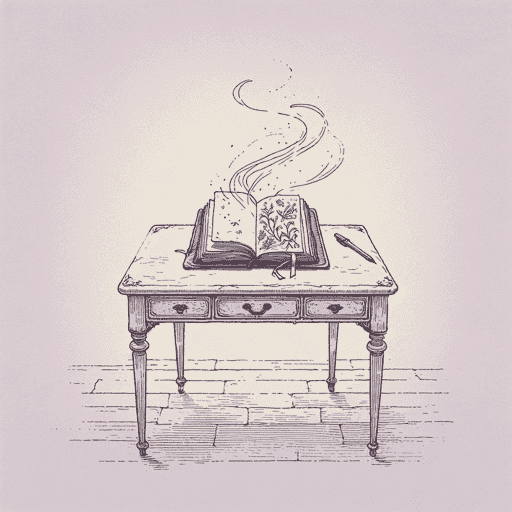
“It was a smallish library, with one huge desk in the center. On that was an open book and a pair of old-fashioned, round glasses that caught the candlelight.”
(Chapter 3, Page 33)
The items in the hidden library suggest that an owner stepped away briefly and never came back. Jared’s encounter with the secret room opens his mind to the possibility that the mansion contains more mysteries than the strange creature living in the walls. The library’s book collection, with its many titles relating to unusual creatures, implies a connection between the hidden room and the house’s strange noises. Jared’s visit to the library, with its books that symbolize knowledge and wonder, sets him on a path—one that, despite its strangeness, gives him a sense of purpose.
“[H]e scanned the shelves. They were all strange: A Historie of Scottish Dwarves, A Compendium of Brownie Visitations from Around the World, and Anatomy of Insects and Other Flying Creatures.”
(Chapter 3, Page 33)
Jared discovers more than just a library: Its books give a window into the mind and interests of the librarian. Volumes about bizarre creatures, shelved in a hidden room, suggest someone obsessed with the unexplained. This mystery captures Jared’s imagination; as a bright, bored child, he’s looking for something, anything, that will take his mind off his problems.
“‘I believe you…about the note and all,’ Simon whispered, but Jared didn’t reply. He was just glad to be in bed. He thought he could probably stay there for a whole week.”
(Chapter 3, Page 41)
Mallory is skeptical about Jared’s fantastic claims, but Simon knows his identical-twin brother well and believes him. Together, the bright Grace children somehow manage, despite arguing, to work together well enough and take the halting first steps toward solving the many puzzles built into their new residence. Through their efforts, the novel suggests The Value of Kindness and the importance of teamwork and community.
“‘Who did this?’ Their mother looked at Jared angrily. ‘I don’t know!’ Jared glanced at Simon standing in the doorway, looking puzzled. It must have been the thing in the walls. Their mother’s eyes got huge. It was scary. ‘Jared Grace, I saw you arguing with your sister last night!’ ‘Mom, I didn’t do it. Honest.’ He was shocked that she thought he would do something like this. He and Mallory were always fighting, but it didn’t mean anything.”
(Chapter 4, Pages 44-45)
Jared’s recent misbehavior comes back to bite him when his sister gets pranked by the wall creature and he receives the blame. Jared’s relationship to his mother begins to deteriorate even as he tries to protect the house from the strange being that inhabits it. Through him, the novel explores the impact of Alienation from Family. His frustration may be part of the creature’s plan to punish the children for vandalizing its home in the wall.
“With each crumbling page, Jared was learning strange facts. Could there really be brownies in his house? Pixies in his yard? Nixies in the stream out back? The book made them so real. He didn’t want to talk to anyone right then, not even Simon. He just wanted to keep reading. ‘I don’t know,’ Simon said. ‘I thought maybe you’d be bored by now. You don’t usually like to read.’ Jared looked up and blinked. It was true. Simon was the reader. Jared mostly just got into trouble.”
(Chapter 5, Page 65)
Unlike his siblings, Jared has no compelling interest with which to fill his days. The faerie field guide changes that: It symbolically turns a page in Jared’s life by presenting him with a world of wonders about which he can care deeply. It’s not his brain that has limits, but a lack of compelling subject matter. Now he has his own pursuit, and his mind is up to the task.
“Jared flipped to the page that read, Boggarts delight in tormenting those they once protected and will cause milk to sour, doors to slam, dogs to go lame, and other malicious mischief.”
(Chapter 5, Page 71)
Jared’s research produces a solution to the riddle of the wall noises, to say nothing of the damage to the kitchen and to Simon’s animal collection. Helen Grace and Mallory won’t believe him—they’ll assume that he is making excuses for bad behavior; Jared’s only choice is to take matters into his own hands. It’s a reckless decision, but points to Jared’s courage and determination, qualities that will be rewarded in the novel.
“[H]e couldn’t help feeling a little bit bad and a little bit weird at the same time. In the first place, it was weird that he was down here, setting a trap for something that he didn’t even know if he would have believed in two weeks ago. But the reason he felt bad was… well, he knew what it was like to be mad, and he knew how easy it was to get into a fight, especially when you were really angry about something else. And he thought that just maybe that was how the boggart felt.”
(Chapter 5, Page 74)
Jared’s struggles with anger, loss, and inadequacy have given him insights into himself that he might not otherwise have known. Jared can imagine how the mysterious creature in his house might react to his attempts to learn more about it. He identifies with the boggart and feels kinship and compassion for it.
“Gathering up all the pieces of the nest, Jared put them carefully aside from the rest of the trash. Could he make a new house for the boggart? Would it matter? Could that stop it? He thought about Simon crying and about the poor, stupid tadpoles frozen in ice cubes. He didn’t want to help the boggart. He wanted to catch it and kick it and make it sorry it ever came out of the wall.”
(Chapter 6, Pages 83-84)
The text shows Jared’s ambivalence. He is beginning to understand why the boggart is mad at him and his siblings. As someone who’s been falsely accused, Jared can sympathize with a creature whose home has been damaged. His mind shifts between wanting revenge and wishing to atone for his complicity in harming the creature. It’s a big shift in attitude: He is developing a more nuanced and kind view, as well as becoming more involved in a project, one that tests his mettle and challenges him to climb out of his self-pity.
“‘If anything else happens around here, I’m going to have to take you to see someone. Do you understand?’ Jared nodded, but he felt weird. He remembered what he had said about Aunt Lucy and the nuthouse and suddenly felt very, very sorry.”
(Chapter 6, Page 86)
This quote calls back to Jared’s earlier comments about his aunt. He now feels contrition and believes that Aunt Lucy really had seen little men in the house. Jared realizes that he, too, may face the same fate as Aunt Lucy. He’s in an impossible situation: Anything he says in his defense will be taken as an excuse or a sign of a mental health condition, but, if he says nothing, his mother will see it as a tacit confession. He feels his only choice is to stop the boggart.
“‘Dear Boggart,’ Simon said again. ‘We are writing you to say that we are sorry we messed up your first house. We hope you like what we made and that even if you don’t, that you’ll stop pinching us—and other things—and that if you have Jeffrey and Lemondrop to please take care of them because they are good mice.’”
(Chapter 7, Pages 100-101)
Dictated by Simon, the children’s letter to the boggart is an olive branch, and the birdhouse a peace offering. The children have learned The Value of Kindness, and that casual cruelty toward the creatures in their house can backfire badly. They’re learning how to be more diplomatic and cooperative with outsiders; at the same time, they’re also learning how to get along better with each other and to work together to solve their collective problems.
“Best of all, there were no more night attacks, no more scuttling in the walls—nothing other than Mallory’s shorter hair to make it seem like the whole thing had really happened.”
(Chapter 7, Page 102)
The sudden end of the boggart’s mischief is a good sign: Perhaps the creature accepts the birdhouse peace offering. Due to the nature of faerie interactions with humans, there’s no proof they happened. Jared thus remains the chief suspect in the mayhem. His siblings may know what really took place, but convincing anyone else, especially their mother, is another matter. In this way, the novel does not achieve complete resolution.
“Arthur Spiderwick’s book is not for your kind. Too much about Faerie for a mortal to find. All who have kept it have come to harm. Be it through violence or through charm. Throw the book away, toss it in a fire. If you do not heed, you will draw their ire.”
(Chapter 7, Page 104)
Thimbletack introduces himself to the Grace children and expresses his satisfaction with their gift of a birdhouse furnished with his possessions. He then warns them that the Spiderwick field guide isn’t for humans and must be disposed of. This portent, near the end of the novel, bodes ill for the kids as the book series continues. Telling someone not to read something is an excellent way of getting them to do just that; thus, the boggart’s warning may have the reverse effect.
“‘I mean—this is a big book.’ It wasn’t a small book. ‘Yeah, I guess.’ ‘And all these entries…all these things are real? Jared, that’s a lot of real.’ And then, suddenly, Jared understood what she was saying. If you looked at it that way, it was a big book, an absolutely huge book, too large to even comprehend.”
(Chapter 7, Page 107)
The Grace siblings realize that the field guide introduces them to an enormous world of creatures unseen by most but affecting all. Rather than dealing with just a few types of faeries, the children must master lore about all of them, including the dangers and opportunities that they represent. This last scene in the book serves as a cliffhanger, a “what now?” moment encouraging readers to follow the saga in the novels that follow.

Unlock every key quote and its meaning
Get 25 quotes with page numbers and clear analysis to help you reference, write, and discuss with confidence.
- Cite quotes accurately with exact page numbers
- Understand what each quote really means
- Strengthen your analysis in essays or discussions