65 pages • 2-hour read
A modern alternative to SparkNotes and CliffsNotes, SuperSummary offers high-quality Study Guides with detailed chapter summaries and analysis of major themes, characters, and more.
Content Warning: This section of the guide includes discussion of death.
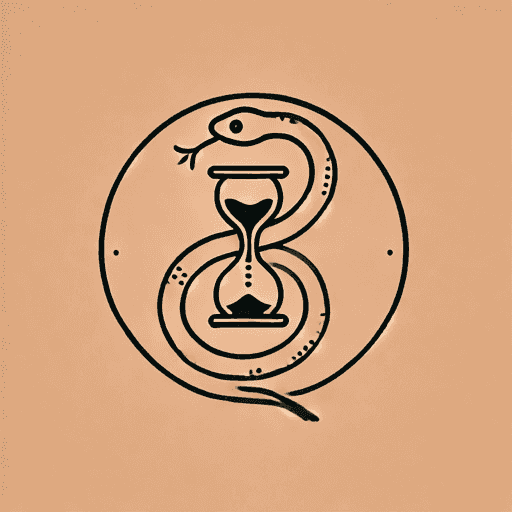
Kalachakra are also known as ouroborans, an allusion to the Ouroboros, the ancient image of a snake consuming its own tail that represents the inescapable loop of birth, life, and death. It thus serves as the novel’s central symbol for the kalachakra’s cyclical existence. Each life begins where the last one started, creating a closed, repeating timeline. The novel repeatedly links this image to the kalachakra condition, as when describing a historical Club member who states that “like the snake he would swallow his own tail and be born again” (44).
The symbol is linked to the theme of The Relationship Between Memory and Personal Identity. For a kalachakra, memory is the only element that provides continuity and meaning across lives. Without it, the Ouroboros represents a meaningless cycle of self-destruction and rebirth, where the individual is erased and no progress is made. The symbol thus underscores the novel’s core argument that identity is forged by the conscious recollection of a life lived, making the threat of the Forgetting a form of true death for beings who cannot otherwise die. At the same time, the implicit violence of the snake’s consumption of itself hints at the traumatic weight of memory for a kalachakra, suggesting that each new birth involves pain.

The Cronus Club is a key symbol in the novel, representing an institutional philosophy of passive observation and strategic non-interference in the face of near-omniscient foreknowledge. Formed by kalachakra across centuries, the Club is more than a social organization; It provides stability and community for its members but also demands adherence to its foundational principle of preserving the known historical timeline at all costs. This philosophy is perfectly encapsulated in its core mantra: “Complexity should be your excuse for inaction” (65). This statement reveals the Club’s deep-seated belief that the timeline is too intricate and interconnected to manipulate without risking total collapse.
The Club’s rigid stance on non-interference is central to the theme of The Moral Calculus of Historical Intervention. While its members possess the knowledge to prevent atrocities and alter history for the better, they choose inaction, arguing that the potential for unforeseen, catastrophic consequences outweighs any possible good. However, this philosophy is thrown into crisis by the central plot device: a message sent back through the generations of the Club, warning that “the end of the world is getting faster” (2). This apocalyptic news, delivered through the very network the Club created, forces the institution to confront the paradox of its own creed, which the Hoeness debacle previously exposed: that a policy of nonintervention requires at least limited intervention to sustain. More than inaction per se, it is the Club’s refusal to recognize its agency that contributes to its destruction.
The quantum mirror is the novel’s ultimate symbol of The Corruption of Unchecked Ambition and the perilous pursuit of god-like omniscience. As a theoretical device capable of extrapolating the state of the entire universe from a single particle, it represents the ultimate temptation of forbidden knowledge. For the antagonist, Vincent Rankis, the mirror is the endgame of all his efforts, a tool that promises to answer the fundamental questions of existence, including the nature of the kalachakra themselves. His quest to build it is driven by an ambition so absolute that it justifies any cruelty, from destroying the Cronus Club to murdering his own colleagues. This pursuit directly embodies the novel’s theme of corruption, demonstrating how a desire for knowledge, when untethered from ethical constraints, can become monstrous. Harry correctly identifies the blasphemous nature of Vincent’s goal, realizing his rival’s ultimate desire is “to see with the eyes of God” (219), a hubristic ambition that seeks to transcend human limitations at any cost.
The mirror’s symbolic weight is matched by its narrative function as the direct cause of the apocalypse. In his relentless drive to create the device, Vincent accelerates human technological development far beyond its typical course, inadvertently destabilizing the world and causing it to end “faster.” The very instrument designed to provide perfect, god-like understanding of the world becomes the agent of its destruction. This irony transforms the quantum mirror into a cautionary symbol, representing the catastrophic consequences of an ambition that values knowledge over wisdom and progress over humanity.


Unlock the meaning behind every key symbol & motif
See how recurring imagery, objects, and ideas shape the narrative.