22 pages • 44-minute read
The Flesh and the Spirit
A modern alternative to SparkNotes and CliffsNotes, SuperSummary offers high-quality Study Guides with detailed chapter summaries and analysis of major themes, characters, and more.
Symbols & Motifs
Riches
Riches are a recurring motif, since both Flesh and Spirit desire them, and they both conceive of riches in terms of precious stones. Flesh mentions “silver, pearls, and gold” (Line 31) as examples of the “riches” (Line 29) that people long for—all of which are available in abundance on earth. Spirit scorns such earthly things and tries to establish a contrast: She will be “enrichéd” (Line 75) by “Eternal substance” (Line 76), yet the heavenly city she describes as the ultimate manifestation of spiritual truth is also full of precious stones. Although Spirit does state that the crown she will wear in heaven will be made not of “diamonds, pearls, and gold, / But such as angels’ heads enfold” (whatever such a crown might be), the holy city is a different matter. Its walls are made of “precious jasper stone” (Line 88), the gates are “of pearl” (Line 89), and the streets are “transparent gold” (Line 91). Although Spirit is following her source in the Book of Revelation (especially Revelation 21), it is almost as if she has sublimated her longing to experience the earthly riches that Flesh mentions into a form that is more acceptable to her spiritual worldview. This underscores Spirit’s acknowledgement in lines 60-61 of the allure that worldly things have, and the temptations they present, even for her.
The City
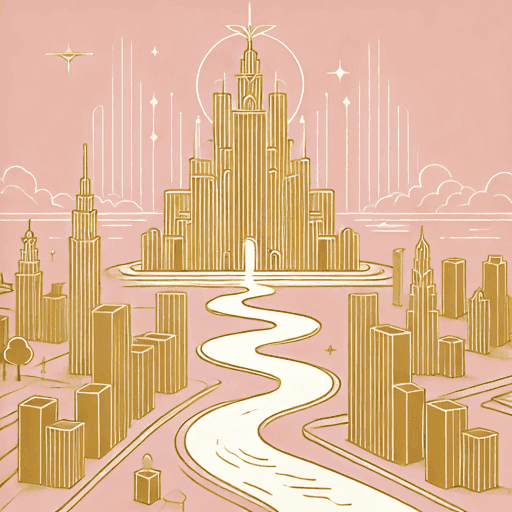
Spirit paints an extended image of “The city where I hope to dwell” (Line 85), in which there is no sorrow. The heavenly city that Spirit describes in details, drawn entirely from the Book of Revelation, might be interpreted literally, since it appears that Spirit fully expects to become an inhabitant of that city when Flesh dies. Thus, this city is a future-oriented concept. However, the city can also be understood symbolically. It represents the ideal of living a life devoted to God and in the presence of God; for the Christian believer, the building of the heavenly city is going on right now, in the present. Indeed, the Puritan New Englanders, for whom the Bible was the literal truth, nevertheless also believed, as they struggled to tame their environment and build a pious religious community, that they were building the New Jerusalem on earth. In that sense, the extravagant imagery describing the city in Revelation symbolizes the glorious nature of their enterprise.
Illusions
Both Flesh and Spirit regard the things that are precious to the other as an illusion. Flesh thinks that Spirit’s contemplation and meditation is a waste of time because it does not relate to anything real. Flesh regards Spirit’s belief that she is communing with or directly experiencing a higher, spiritual realm as invalid; it is a fiction possessing no value. As Flesh pours scorn on Spirit, she repeats the same idea in slightly different ways several times, speaking of Spirit’s “Notion without reality” (Line 14), of Spirit being “fancy sick” (Line 19) (that is, suffering from hallucinations), of Spirit catching at “shadows which are not” (Line 20), and of Spirit occupying herself with “things unknown, only in mind” (Line 36), that is, things that exist only in the mind, and therefore have no true substance.
For her part, Spirit has much the same view of the things Flesh lives for. Because everything related to earthly human life is transient and soon comes to an end, its value is illusory; only the permanent realities are true, and these are spiritual not material. This is why, for Spirit, earthly things are “trash” (Line 80), unworthy of serious attention. They will soon vanish, in contrast to the eternal reality of the holy city, which will never come to an end.

Unlock the meaning behind every key symbol & motif
See how recurring imagery, objects, and ideas shape the narrative.
- Explore how the author builds meaning through symbolism
- Understand what symbols & motifs represent in the text
- Connect recurring ideas to themes, characters, and events