The Forest of Hands and Teeth
52 pages • 1-hour read
Carrie RyanThe Forest of Hands and Teeth
A modern alternative to SparkNotes and CliffsNotes, SuperSummary offers high-quality Study Guides with detailed chapter summaries and analysis of major themes, characters, and more.
Chapters 28-36Chapter Summaries & Analyses
Content Warning: This section of the guide includes descriptions of graphic violence, illness, and death.
Chapter 28 Summary
Travis uses a storage barrel to ferry Argos and Mary to the tree house. He fires an arrow with the other handmade rope attached. Harry pulls the rope as Mary clutches it tight, and the barrel slides along the braided rope. When Travis attempts to climb out onto the rope that bridges the gap, it dips almost within reach of the milling Unconsecrated below, and at the same time, the undead inside the house suddenly break out and swarm to the edge. One woman falls and grips Travis’s leg, poised to bite, but a man falls and knocks her loose. Travis manages to hook his legs around the rope but is then paralyzed with fear. Mary urges him to focus on her voice as she coaches him on where to move, and he finally shimmies across to safety.
Chapter 29 Summary
Later, Mary awakens in the tree house with Travis nearby. He says that the undead woman scratched his leg but insists that he is fine. He tells Mary that the others have a tentative plan to return to the fenced paths by rigging a rope into the Forest. However, someone will have to cross through the undead in order to get past the gate and tie off the rope. Harry believes that they can wait until winter, when the cold weather might slow the movement of the undead. Mary is unhappy at the thought of waiting that long.
Mary can also sense a change in Travis’s attitude. Travis admits that Gabrielle told him that she had seen the ocean, but that it was ruined, just like the land, because the Unconsecrated there cannot be fenced in and pirates make the shore too dangerous. He says that he knew they could never try to find the ocean, but he did not tell Mary this because he wanted to let her have hope. He says he was planning to come for her, but then he realized that he would serve her better by letting Harry marry her. He reasoned that if he and Mary had tried to escape together, the Sisters might have punished Mary the way they punished Gabrielle. Now that Travis has seen her wade into a horde of undead and survive, however, he knows that she does not need him, and he understands that he will always come in second to her dream of escaping their constrained lives. Mary realizes Travis is right, and that not even her love for him can ease her need to get to the ocean.
Chapter 30 Summary
Mary finds a quiet place alone on the platforms and peruses the tiny book that she rescued from the attic trunk. It is a book of Shakespeare’s sonnets, with letters that seem to serve as numbers (Roman numerals). She quickly realizes that the metal tags on the fences and gates are numbers. Jacob approaches and mentions that Travis said Mary was very brave for fighting off the Unconsecrated. Mary laughs and credits Argos with saving her. Jacob says he loves Argos, so Mary gifts the dog to him.
Cass approaches and sends Jacob off to help with dinner. She then bluntly tells Mary that things have been hard for her for a long time because both Harry and Travis love Mary. Now, Cass’s primary concern is Jacob. She has missed Mary’s friendship but wants Mary to know that if a choice must be made to either keep Jacob safe or follow Mary to her ocean, she will choose Jacob. Mary understands, and the two companionably watch the clouds together.
Chapter 31 Summary
Jacob inadvertently starts a fire, and the group’s platform and tree house refuge quickly go up in flames. One of them must take the rope beyond the gate and tie it off so that they all can escape. While Harry and Jed argue over which of the two of them should take on this task, Travis suddenly tells Mary how much the days in the brick house meant to him, then jumps off the platform with the rope, intending to get through the gate and tie the rope off. Using arrows and crossbows, Jed and Harry fight off the Unconsecrated that are attacking Travis. Travis makes it through and ties off the rope. As soon as it is secured, Mary shimmies over to Travis without a safety harness or a weapon.
Chapter 32 Summary
Travis is still alive, but he is bloodied and injured, and Mary knows that he must have been bitten. Even so, she tries to give him hope by mentioning the possibility of a healer or another village. Travis confesses that he was actually bitten while escaping from the house. He urges Mary to find the ocean, and as she proclaims her love for him and weeps, he dies. The others have saved themselves by using the rope. Jed now stands ready to slay Travis when he turns, but Mary insists on taking the scythe and doing it herself.
Chapter 33 Summary
The growing fire pushes the survivors through the fenced paths at a punishing pace, and they have very little food. Three days after leaving the village, Mary sees Jacob lying awake at night, so she gives him the postcard of New York City to comfort him and give him hope. The next day, a fierce rain begins. Mary wonders if it will be enough to extinguish the fire. She enjoys lying in the mud and letting the rain wash away the ash and soot.
They arrive at what looks like another dead end, but Mary sees that it is actually a differently-shaped gate with the numeral I. Excitedly, she tries to explain the significance of the number, insisting that “they” built the first gate here for a reason and that she is meant to go into the Forest to find the ocean. Harry and Jed angrily insist that she cannot know if her beliefs are true, but Mary trusts her instincts and stands her ground. Harry leaves her and returns to Cass, but Jed continues to argue with his sister, telling her that her earlier choice to take them to the village led to no good. Mary points out that they had no other choice but to investigate that village, and she then bitterly asks why Jed even cares, given that he turned her out of the family home when their mother died. Defeated, Jed says that Mary is all he has left of family.
Chapter 34 Summary
Mary defies Jed and slips out the gate. She runs with the ax, enjoying true freedom, but the undead begin to converge upon her. When Jed follows and fights off the undead, Mary is shocked and touched that he has come to her rescue. They hear the sound of rushing water and flee toward it. While sliding over the crest of a steep embankment, the siblings become separated. When Mary stands, she sees an Unconsecrated man crashing into Jed. Mary finds Jed’s scythe underfoot and uses it to kill several undead; she then rouses Jed, and together they try to fight off the undead hordes coming over the crest and down the hill.
Chapter 35 Summary
Jed realizes that they have reached the edge of a canyon. A river lies below, and a gushing waterfall is nearby. He instructs Mary to climb down. As they climb, he says he had to come after her since he is her “big brother.” She thanks him. Suddenly, an undead man falls and collides with Jed, who falls into the roiling water below. A despairing Mary climbs down and then travels downstream along the riverbank. Many undead are in the river, having fallen from the canyon rim. When she attempts to cross a fallen log, Unconsecrated hands pull her into the water. Mary tries to stay afloat as the current sweeps her away, but she loses consciousness. In a dream, the undead surround her: far too many to fight.
Chapter 36 Summary
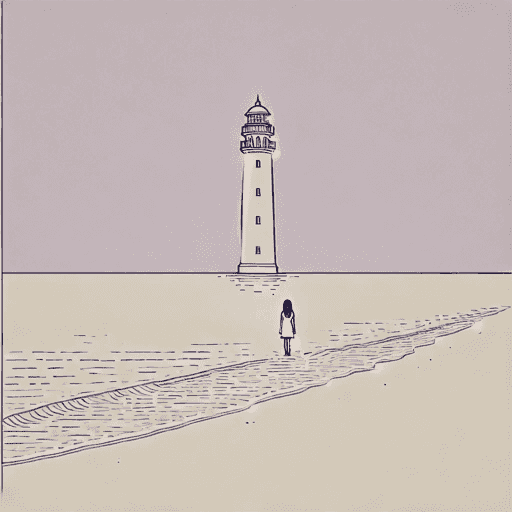
Mary wakes on a sandy beach to find that a man is using a shovel to annihilate the undead all around her. He almost uses the shovel on Mary, too, but she rolls away at the last second. She is shocked at the sight of the ocean but sobers when she remembers that she lost sight of Jed the night before. She and the man check all the bodies on the beach but do not find Jed. The man says he lives in the lighthouse nearby; it is his duty to kill any “Mudo” (“speechless”) that wash up, as he must prevent them from reaching the town. He says that the ocean always sweeps away any Mudo with the tide, leaving a clean beach. When Mary says that she came from the Forest, he explains that the fences connecting town and Gate 1 were removed when his grandfather was young; the goal was to prevent anyone from using the paths, since the paths led into the Forest, where they assumed that only the Mudo lived. Now, as Mary swims in the ocean, she mourns Jed and thinks of everyone she left behind. When she leaves the sea, she goes to the lighthouse with the man.
Chapters 28-36 Analysis
When Mary steps into the Forest, she faces a crucial decision that dictates the rhythm of the novel’s climax and denouement. Before this moment, Mary has allowed herself to be pushed and pulled on one direction or another by a mixture of external factors, such as Jed’s decision to shun her or Harry’s determination to speak for her. She has also allowed her course to be dictated by events such as the breach of the village and her imprisonment in the brick house. Now, however, Mary is faced with a choice that will change everything: She must decide whether to venture beyond the first gate or stay within the dubious safety of the fences. This time, no outside interference can influence Mary’s decision; this moment belongs to her, and her independent choice will direct the outcome of the narrative.
Notably, the intensity of the final events in the novel’s rising action—the fire, the escape, Travis’s death, and the finding of Gate I—all work to prepare Mary for this important choice. The fire propels forces the group’s exit from Gabrielle’s village, while Travis’s dying words reinvigorate Mary’s quest for the ocean. Finally, the metal tag on the gate marks the point of egress that Mary has long been searching for. Galvanized by the closeness of her long-held dream, Mary seizes a new level of Female Agency within Oppressive Social Structures when she argues against Harry’s and Jed’s points and defies their directives that she remain with them. The interpersonal struggle also reflects The Tension between Self-Interest and Self-Sacrifice, and at this point in her inner journey, Mary is no longer willing to compromise her own goals just to keep others comfortable. These events show that she has grown stronger, both physically and emotionally, and she now comes of age with a mature sense of confidence in the future.
Although Mary runs through Gate I and takes on the Forest alone, she is glad to rediscover an archetypal ally when her brother arrives and protects her from the approaching undead. Although Jed has primarily played an antagonistic role toward Mary by blaming her for their broken family and striking her for revealing Beth’s condition, he now demonstrates abject repentance when he acts to save her. Later, as Mary grieves his loss, she is forced to acknowledge the harsh consequences of pursuing her own personal dream. Although she is satisfied to have realized her goal, she feels responsible for Jed’s presumed death. However, she also recognizes his ultimate sacrifice as her loving older brother, and this juxtaposition completes the novel’s thematic focus on The Tension between Self-Interest and Self-Sacrifice.
It is significant that, for Mary, The Persistence of Hope amidst Death exists without direct mention of the religion that so powerfully influenced her upbringing. From the moment her mother turns and is expelled into the Forest, Mary no longer believes in a higher power, and she never turns to religion for help or faith as she struggles to survive her dangerous journey through the Forest. This nuance aligns with the novel’s portrayal of the village’s religion as oppressive and controlling, a trend that is further emphasized by the Sisters’ callous expectations that all young people meekly accept the lives that are planned for them. Thus, the passivity of Mary’s childhood and adolescence under the Sisters’ rule is juxtaposed against her unfounded but fierce belief in the possibility of a better life. In short, she chooses to have faith in herself and in what remains of humanity, rather than pinning her hopes on the abstract ideals of an oppressive religion.
Consequently, the lynchpin of knowledge that prompts her choice at Gate I comes not from a book of Scripture but from a book of Shakespeare, a poet and dramatist who has often been credited with capturing the intricacies of the human condition. After realizing the significance of the numbers in the book, Mary recalls the “XVIII” carved on the trunk of food and weapons, and it is significant that her revelation comes when she sees Sonnet 18 (“Shall I compare thee to a summer’s day?”). The line of the poem reading “Nor shall death brag thou wander’st in his shade” can be interpreted, in modern parlance, to mean that death will not threaten the young man who is the poem’s subject if he is immortalized in verse. This line catches her eye and strikes her as a bolstering sentiment that helps her to maintain The Persistence of Hope amidst Death. In an extension of the symbolic connection between the carved numbers and Shakespeare’s sonnets, Mary’s decision to enter the Forest at Gate I can be analyzed in light of Shakespeare’s Sonnet 1, which is essentially a message to young men about the brevity of life. Specifically, the concluding couplet (“Pity the world, or else this glutton be, To eat the world’s due, by the grave and thee”) is typically interpreted as a directive to the young man to focus on life and future generations despite the dire circumstances that humanity must suffer. In the context of the novel, this sentiment is relevant because with Mary’s quest for the sea now fulfilled, her final actions suggest that she has embraced a similar line of thought. In short, her decision to follow the man to the lighthouse reflects her willingness to embrace a new life path despite the dangers that surround her.

Unlock all 52 pages of this Study Guide
Get in-depth, chapter-by-chapter summaries and analysis from our literary experts.
- Grasp challenging concepts with clear, comprehensive explanations
- Revisit key plot points and ideas without rereading the book
- Share impressive insights in classes and book clubs