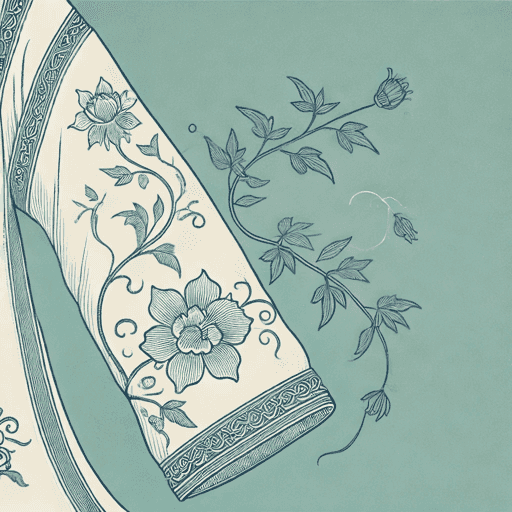
The Girl Who Wrote in Silk
50 pages • 1-hour read
Kelli EstesThe Girl Who Wrote in Silk
A modern alternative to SparkNotes and CliffsNotes, SuperSummary offers high-quality Study Guides with detailed chapter summaries and analysis of major themes, characters, and more.
Important Quotes
Content Warning: This section of the guide discusses racism and death by suicide.
“She rolled down the window and drew in the scent that her mind had forgotten but her soul had held on to—sun-warmed dirt, blooming blackberry bushes, briny salt water. As she breathed it in, she felt something inside of her shift, like a puzzle piece sliding into its niche.”
(Chapter 1, Page 7)
Inara’s first experience of returning to the island reveals the beauty and calming influence of the setting. The vivid descriptions of sights, smells, and sensations emphasize the ability of nature to soothe and clarify as an underlying message that recurs with the ocean and other natural scenes throughout the novel.
“She would not confront them. She would not lose her honor and beg for her family’s lives. These weren’t men, but demons. Demons didn’t listen to reason.”
(Chapter 4, Page 55)
Mei Lien sees the white men who destroy her family as demons, making a stark distinction between human beings who can empathize with those different from them, and “demons” who are only interested in furthering a specific agenda. This passage also highlights the power Mei Lien finds in remaining silent rather than reducing her dignity by attempting to exert physical power. The violent expulsion of her family also begins the novel’s exploration of The Generational Impact of Racism.
“The sun had set, but the island was still cloaked in that blue-black moment before dark that felt in equal parts like a quiet sigh and a pounding heart.”
(Chapter 5, Page 68)
The dual imagery in this passage reflects the metaphorical link between the Orcas Island setting and the larger plot of the novel. Though the island seems peaceful, “like a quiet sigh,” there is also “a pounding heart” which can represent anxiety, fear, or passion. This passage mirrors Inara’s discoveries, which satisfy her quest for knowledge while revealing the dramatic injustices of the past.
“The water had taken everyone from her. It should take her too. In the water she’d be with her family again. She’d be away from this lonely ache and living fear that gnawed at her every breath. The water waged a battle and tonight she’d let it win.”
(Chapter 6, Page 86)
The personification of the ocean here provides the initial portrait of the ocean as a threatening, violent force. However, even as the ocean is described as taking away Mei Lien’s family, it also offers a release from her grief. She believes that entering the ocean would be a way for her to rejoin her father and grandmother and relieve her emotional turmoil.
“Mei Lien squirmed as both men scrutinized her. She ached to raise her chin and meet the Baron’s gaze head-on, but she forced herself to play her role. She quickly dropped her chin to her chest and hunched her shoulders again, assuming the position of the unseen servant.”
(Chapter 7, Page 97)
An important element of Mei Lien’s characterization is her inner strength. Although she recognizes the power of the white men around her and certainly acknowledges their ability to overpower her physically and socially, her internal strength pushes her to exert her own power. In this passage, she uses that strength to overcome herself—to maintain a masquerade even as her independent spirit balks at the injustice. The special disadvantages she faces as a woman who must disguise herself as a man to have any autonomy also speak to The Historical Evolution of Womanhood.
“She would never again hear her breathing in bed beside her. Nor would she ever again hear her father’s voice calling to her, calling her my son, which he always made sound like an endearment.”
(Chapter 7, Page 101)
This passage highlights both the significance of Mei Lien’s loss and The Historical Evolution of Womanhood. Mei Lien’s realization that she has permanently lost her grandmother and father is emphasized by the use of “never again,” “nor […] ever,” and “always.” Further, this passage foreshadows Mei Lien’s relationship with Yan-Tao, whom she will lie next to in bed before she dies and whom she will call “my son” as her father called her.
“The water was like her sleeve mystery, she decided. It seemed so pure and uncomplicated on the surface, yet below were all kinds of secrets.”
(Chapter 8, Page 124)
Inara’s connection between the ocean and the sleeve actively reveals the connections between Inara and Mei Lien, the past and the present, and the varying symbols throughout the novel. The sleeve and the ocean both contain “secrets” that will reveal Campbell’s crimes, Mei Lien’s traumas, and Inara’s connection to both.
“Historically, and occasionally still today, a male heir has been preferred to carry on the family name because they can physically do more labor and because it is a son’s responsibility to care for his parents in old age. Once married, a daughter becomes part of her husband’s family and no longer part of her parents’.”
(Chapter 9, Page 130)
Having Daniel explain the gender disparities of the past and of Chinese culture avoids a possibly judgmental element to the novel. Daniel is an academic, a Chinese American, and is clearly loving and devoted to the women in his life. Further, offering this explanation of historical and cultural gender roles neutrally allows the facts to inform the reader rather than bias, while also reflecting The Historical Evolution of Womanhood.
“He had a distant look in his eyes, as though his soul could remember the pain even though he hadn’t personally lived through it.”
(Chapter 9, Page 133)
Daniel’s emotional experience in response to learning about Mei Lien and her family’s story demonstrates The Generational Impact of Racism. Although Daniel “hadn’t personally lived through” the racism and violence experienced directly by his ancestors, part of his psyche has inherited the traumas suffered by his forebears.
“But she knew the real reason she gave in was because of the fire he’d ignited in her body. She yearned to know where it led, and she knew only Joseph could show her. She’d never felt so alive and so full of power—a sensation quite foreign to her but entirely welcome.”
(Chapter 11, Page 154)
Most of Mei Lien’s narrative is imbued with tragedy and hardship, but there are bright moments. Her love for Joseph and his kindness and respect for her are a notable example of brightness within darkness. A subtle secondary theme throughout Mei Lien’s narrative is the power that comes from love and family. It is only love for Joseph and then for Yan-Tao that drives her to survive and create—Mei Lien’s sense of living is intimately and innately connected to her love for others.
“A low, burning anger settled into her stomach as she stared at the water-covered beach. Silently she promised her family she would never forget what had been done to them. Someday, somehow, she would make sure the truth was told. She would tell the story, or she would die trying.”
(Chapter 11, Page 158)
This passage, the outcome of Mei Lien’s grief after finding her grandmother’s body, provides the explanation and necessity for the sleeve. The sleeve’s importance is largely that it reveals the past, which otherwise would have been inaccessible. Mei Lien can’t tell her story to the world while she lives, and she can’t tell her young son the story while he’s a child. However, using the tools her grandmother gave her, she can create a narrative that will be understood nearly 100 years later.
“She pushed the palms of her hands to the sides of her head as horror and shame consumed her. Her thoughts whirled. If the ship had docked somewhere to unload the passengers, the log would have noted that. Plus, an influx of Chinese into any community at that time would have caused a stir. The fact that no logical explanation for their disappearance was noted on the log proved that the company wanted no record of it. Something illegal and inhumane had occurred.”
(Chapter 12, Pages 160-161)
Inara is largely able to control and navigate her emotions in the novel, with three notable exceptions: The memory of her mother’s accident, this realization about Campbell’s crime, and the discovery of the deed in Daniel’s family’s trunk. The intensity of the language in this passage reveals The Generational Impact of Racism—although Inara is entirely innocent of any racist action or thought, the racism of her ancestor throws her emotionally off-balance.
“She tilted her head to deepen the kiss, savoring the moment, the taste of him, the delicious sense that nothing mattered but the two of them. Not their families, not the sleeve, not her hotel.”
(Chapter 14, Page 193)
The moment Daniel and Inara kiss, the imagery insists that their connection overrides the source of that connection. As they discover each other, they transcend their individual histories or the overarching history that brings them together, both literally and figuratively.
“His eyes were open and staring up at her, dark and deeper than the ocean. In that moment she felt something pass between herself and her son. A kind of communication that didn’t need words. she’d never met him before, but at that moment she knew she’d always known him.”
(Chapter 15, Page 210)
A secondary theme throughout the novel is the power of parental connection. Here, Mei Lien’s first time meeting her son shows that the relationship she forges with him is stronger than her grief, her tragedy, and transcends the power of language.
“In Seattle she knew her neighbors, but they all pretty much kept to themselves. Orcas Island was different. Neighbors invited her for dinner; islanders chatted with her at the grocery store or post office and waved to her on the road. Her roots were sinking deeper into the island…Had Mei Lien felt like she belonged on the island? Did her neighbors invite her to dinner? Not likely.”
(Chapter 17, Page 229)
Inara’s experience of life on the island is initially idyllic but her recognition of her love for that slower, friendlier life pushes her to acknowledge the primary difference between her and Mei Lien. Inara asks herself to consider Mei Lien’s experience, demonstrating Inara’s ability and willingness to acknowledge her own privilege and what that means for those who lack that privilege.
“She had wanted to find out. She couldn’t live here and not know. She couldn’t dig in the garden and wonder if she’d pull up human bones.”
(Chapter 17, Page 235)
The possibility that Campbell murdered Mei Lien and Joseph to steal their land is devastating for Inara. It would be very simple for her to resist and ignore it, just as she attempts to do with the certain knowledge of Campbell’s real murders. However, her need to uncover the truth, regardless of the personal cost, indicates the in-process development of her character that will lead her to expose Campbell and tell the truth at the novel’s resolution.
“She’d embroidered nothing on this silk that did not have meaning or purpose.”
(Chapter 18, Page 241)
There are several discussions of the specific embroidery on the sleeve. This passage shows how vitally important each stitch and each element of the story are to Mei Lien, and by extension to the novel as a whole, speaking to The Cultural and Personal Value of History.
“She kept rocking her son, comforting him as best she could as she drew comfort from the warmth of his small body on her lap. Over and over again she reassured him they would be all right. But even as she spoke the words, she knew down to her soul that they would never be all right again.”
(Chapter 18, Pages 251-252)
Mei Lien comforting Yan-Tao, sharing her grief at Joseph’s death with him, is a series of repetitions that mimics the action of rocking, which shows the reciprocal nature of grief and comfort in that moment. This passage is significant because Mei Lien’s relationship with Yan-Tao represents the future of her family, and that future is imbued with shared experiences and emotions.
“She’d been dreaming about the murdered Chinese people ever since her meeting with her dad. The dreams woke her up at night, heart pounding, lungs gasping for breath. And sometimes images of her mother’s mangled car would weave into images of all the bodies in the water and she’d hear someone laughing cruelly, though she could never see who it was.”
(Chapter 19, Page 255)
As Inara moves closer to the novel’s climax, all of her guilt, both primary and secondary, weaves together and enters her dreams. The image of the cruel laughter is ambiguous—potentially referencing Mei Lien’s revenge on Campbell’s descendant, but more likely representing the cruelty of the past itself and The Generational Impact of Racism.
“The secrets, the evasions, remembering who knew what and what she could and couldn’t say, worrying about the future of her hotel, the emotional roller coaster from it all. It was enough to make her want to stop. Stop everything, stop sleeve research, stop work on the hotel, stop dating the man she was lying to. Everything. It was too much.”
(Chapter 20, Page 264)
The repetition of the word “stop” in this passage reveals Inara at an emotional breaking point. Her internal conflict is increasing in intensity, pushing toward the major development in her character as the novel reaches its climax.
“Her ancestor hadn’t just murdered hundreds of innocent people: he’d murdered people directly related to Daniel. And if she told him and his family the truth now, it would destroy their relationship. His family would sue her family, ruining all of them. He’d hate her. Hate her very existence and everything she came from because her family had launched their future on the blood that now flowed through his veins.”
(Chapter 21, Page 279)
Inara’s realization of the direct connection between Daniel and her family yields a detailed description of her internal conflict. Fundamentally, the conflict is between doing the morally right thing for Daniel’s family or her own. That conflict specifically underscores The Generational Impact of Racism because even though her living family have done nothing wrong, they have still benefitted from the wrongdoing of their ancestor.
“The water would soothe her. The solitude would help her figure out what to do next.”
(Chapter 23, Page 293)
The image that consistently connects Mei Lien and Inara throughout the novel is the ocean and the effect the ocean has on each woman. Nearing the end of the novel, when everything seems to have fallen apart, it is the beach that “soothes” Inara, just as that beach kept Mei Lien close to her family and her purpose.
“Exhausted and shaking from the effort, Mei Lien lay down on Yan-Tao’s bed and curled her body around his smaller one as he slept. Determinedly, she focused on imprinting him into every cell of her body. His every breath she breathed into her own lungs. His sweaty boy smell she took in so that it filled the darkest reaches of her soul. No mother should ever have to say good-bye to her baby.”
(Chapter 25, Page 315)
The last line of this passage reveals a secondary theme of the novel related to parental connection. Mei Lien must leave Yan-Tao just as her parents left her, and the loss is more intense than any other loss she has known. However, the loss is also more hopeful, because Yan-Tao will live on and she has the opportunity to “imprint” herself and her love into him, just as she breathes him into herself.
“Her whole life she’d been like a person walking around with a gaping wound, pretending to be normal, and wondering why no one could see how much she bled. She’d lacked the northern star that was a mother’s guidance, and she felt that lack right down to her smallest cell.”
(Chapter 26, Page 335)
Inara’s grief at her own failure connects finally and fully to the loss of her mother. Inara’s acknowledgement of the damage done by the loss of her mother recalls Mei Lien’s last night with Yan-Tao, before he loses his mother. The two women are therefore connected in their deepest loss and lowest moments.
“Gathering her strength, she stepped beside Nate with a hand on his back so he knew she was there and then she pasted on a smile for the crowd. Olivia stepped to his other side. Together they’d face what came and they’d do whatever it took to bring peace to those shattered by their news.”
(Chapter 31, Page 369)
The moment that Inara and her siblings tell the truth about their family history shows their combined strength of spirit. The symbolism of the three descendants of Duncan Campbell telling the truth, accepting the generational consequences, and working to provide comfort demonstrates The Cultural and Personal Value of History.

Unlock every key quote and its meaning
Get 25 quotes with page numbers and clear analysis to help you reference, write, and discuss with confidence.
- Cite quotes accurately with exact page numbers
- Understand what each quote really means
- Strengthen your analysis in essays or discussions