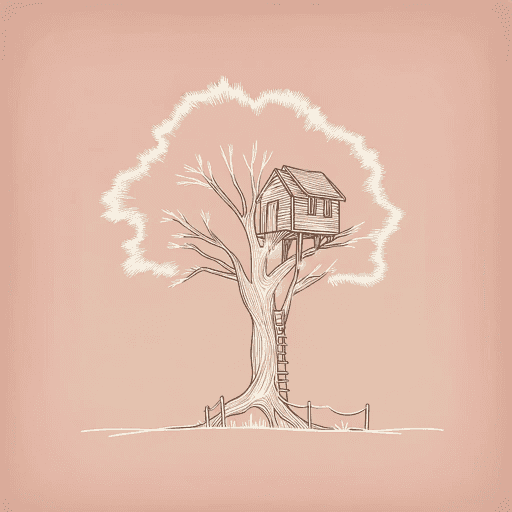
The Great Treehouse War
The Great Treehouse War
A modern alternative to SparkNotes and CliffsNotes, SuperSummary offers high-quality Study Guides with detailed chapter summaries and analysis of major themes, characters, and more.
Summaries & Analyses
Quizzes
NEWReading Tools
Symbols & Motifs
The Treehouse
As the central setting and symbol of the narrative’s primary conflict, Winnie’s treehouse is the most significant motif in the novel. It symbolizes Winnie’s self-expression and facilitates her arc toward Self-Advocacy and Standing Up for One’s Needs as she’s Navigating Parental Divorce and Complex Family Dynamics.
Physically, the treehouse is situated between both of Winnie’s parents’ houses. Like Winnie, it occupies an awkward, liminal space between the two parents, and as such, becomes representative of Winnie herself—a parallel reinforced by the descriptions of the treehouse inside, and what it means to Winnie: “When she’d first moved in, Uncle Huck had helped Winnie paint each wall different colors— turquoise blue with white polka dots, pink with wiggly green stripes—whatever she’d felt like. No matter what the weather was outside, the inside of the treehouse was always bright and cheerful” (28). Its characterization designates it as a space of self-expression for Winnie, and a kind of refuge for her, where everything is always “bright and cheerful” no matter the figurative storms she faces outside its walls.
Beyond self-expression, the treehouse also symbolizes Winnie’s autonomy. despite the fact that the treehouse exemplifies Winnie’s parents’ extreme thinking, it’s also the one space where Winnie can be herself and use her time any way she wants. Later, when Winnie chooses the treehouse as the setting of her stand-off, it becomes of symbol of both autonomy and defiance—a space in which Winnie has complete control, foreshadowing Winnie’s arc toward self-advocacy. At the end of the novel, the treehouse represents Winnie’s transformed outlook. She opens it as a museum where all kids can take part in acts of expression; it’s no longer a site of conflict, but a place for kids to express themselves, reinforcing the importance of self-advocacy, autonomy, and healthy communication of needs to successfully navigate complex family dynamics.
Artist Vision
The novel positions Artist Vision as Winnie’s unique, discerning perspective and the connection she has to a supportive adult in her life (Uncle Huck) despite the conflict with her parents. Winnie’s love of art is central to her character; Uncle Huck nurtures her creative side by introducing her to Artist Vision, the ability to “see things in ways that most other people couldn’t” (62). For Winnie, accessing her Artist Vision makes “the light [shift], just a little, and she [can] observe things at a new angle– better, deeper, truer” (62). Winnie often taps into this mode during moments of high tension, and her observations grant her valuable insights that influence her perspective and actions.
Each time Winnie uses her Artist Vision, it leads directly toward the resolution of the novel’s major conflicts. In Chapter 14, Winnie uses her Artist Vision to understand that her friends need something more than what they initially thought they wanted: “Her friends, Winnie [realizes] as she watche[s] and doodle[s], had come to the treehouse with very clear demands about what they wanted. But in the shifted light, Winnie [begins] to see that perhaps what they really [want is] something else entirely” (218). It is this revelation that leads Winnie to resolve the conflict in the treehouse, itself a prefiguration of her resolving her own conflict with her parents. After all her friends are gone, Winnie turns her Artist Vision on herself for some inward reflection:
Because now that she [is] all alone in the treehouse, there [is] no one left to turn her Artist Vision on but herself. And Winnie [isn’t] entirely happy with what she [is] observing. Her restless tossing and turning. The persistent churning of her stomach. Winnie [should be] happy to have another regular Wednesday in her treehouse. But she [isn’t] (245).
Winnie’s self-reflection here, aided by Artist Vision, contributes to the epiphany she has about standing up for her own needs. Winnie’s Artist Vision as a motif helps her unlock her ability to self-advocate, the primary focus of her character arc.
Winnie’s final use of her Artist Vision in the novel reveals the fundamental change in her relationship with her parents. After telling them her plan for the treehouse, Winnie sees the genuine humor and laughter in them:
Winnie [hasn’t] used her Artist Vision in a while, but she [turns] it on then just for practice. She [squints] her eyes, observing her parents in the shifted light. The twitch of her mom’s lip, just before her mouth [morphs] into a smile. The smirk in her dad’s eyes, as he [watches] his daughter (271).
Her Artist Vision allows her to recognize the change in her parents, reinforcing it as a motif that signifies Winnie’s unique perception, and its role as a tool of discernment and insight for her.
Wednesdays
Like the treehouse, Wednesdays symbolize refuge for Winnie. On Wednesdays, Winnie lives in her treehouse, providing her with time completely to herself, away from her parents’ challenging behavior: “On nothing-special Wednesdays, Winnie often [ends] up doing the sorts of things that most kids could do any old day of the week” (32). Wednesdays recur throughout the novel as a motif that supports Self-Advocacy and Standing Up for One’s Needs.
Wednesdays are first introduced as a motif and a point of interest in Mr. Benetto’s letter to Winnie’s parents at the very start of the novel. There, Graff establishes that something significant happens on Wednesdays that influences Winnie’s mood. The narrative begins with the question “What happens to Winnie on Wednesdays?” (7), establishing it as a significant motif with major implications for the protagonist and the plot. The reader quickly learns that Wednesdays are Winnie’s haven; they are the only time she has entirely to herself. The threat of losing these Wednesdays in Chapter 5 incites the main action of the plot. At the end of the novel, the treehouse museum opens on a Wednesday, underscoring their significance in the novel as a whole and demonstrating the transformed situation in Winnie’s life: Although Wednesdays are no longer her only haven, she wants to pass them on as a refuge for others. The passing on of the treehouse exemplifies Winnie’s growth into someone who can self-advocate for their needs.
Wants Versus Needs
The emphasis Graff places on the motif of wants versus needs in the final chapters of the novel, reinforce its importance to resolving major conflicts in the plot and developing the themes of Navigating Parental Divorce and Complex Family Dynamics and Self-Advocacy and Standing Up for One’s Needs. Winnie’s friends first arrive at the treehouse with a list of demands for their parents, ranging from a moratorium on grounding to permission to watch a prohibited TV show. In Chapter 14, however, Winnie realizes that her friends’ wants belie their true needs; this revelation allows her to resolve the conflict between the Treehouse Ten. Reflecting on her own needs prompts the key revelation that drives the climax:
Both of [Winnie’s] parents in the treehouse together—that was the only thing Winnie had demanded when she’d climbed up into her treehouse and refused to come down. But once [she turns] her Artist Vision on herself and really [examines] things in the shifted light, [she realizes] that what she needed was something more (260).
The motif recurs at the climactic confrontation between Winnie and her parents, wherein she repeats the words “I want” and “I need” until they finally listen to her. The wants versus needs motif supports Winnie’s ability to advocate for herself and suggests the importance of being able to communicate one’s needs to navigate complex family dynamics.

Unlock the meaning behind every key symbol & motif
See how recurring imagery, objects, and ideas shape the narrative.
- Explore how the author builds meaning through symbolism
- Understand what symbols & motifs represent in the text
- Connect recurring ideas to themes, characters, and events