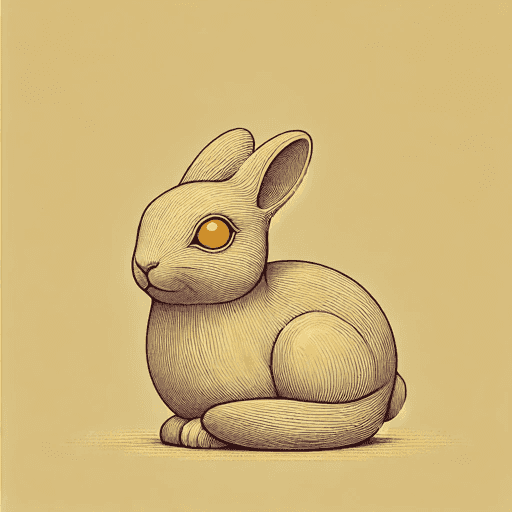
The Hare With Amber Eyes
51 pages • 1-hour read
Edmund de WaalThe Hare With Amber Eyes
A modern alternative to SparkNotes and CliffsNotes, SuperSummary offers high-quality Study Guides with detailed chapter summaries and analysis of major themes, characters, and more.
Key Figures
Content Warning: This section of the guide includes discussion of racism, religious discrimination, and death.
Edmund de Waal
The author and central figure of The Hare with Amber Eyes, Edmund de Waal, is an internationally acclaimed potter and ceramicist. His minimalist porcelain installations have been displayed in major museums and collections worldwide. Born in 1964 in Nottingham, England, de Waal trained in the Anglo-Oriental ceramic tradition. In The Hare with Amber Eyes (2010), his breakthrough literary work, de Waal turns this focus to his family’s history, using his inherited collection of Japanese netsuke as a central organizing concept. Since the publication of this memoir, his art has increasingly echoed his literary themes. His own ceramics explore the relationship between form, memory, and history, and are often displayed in vitrines, emphasizing the symbolism of vitrines. In acknowledgement of his services to the arts, de Waal was appointed Officer of the Order of the British Empire (OBE) in 2011 and Commander of the Order of the British Empire (CBE) in 2021.
The Hare with Amber Eyes unfolds through de Waal’s investigation into the fate of his ancestors, the Ephrussi family. The book is both a biographical history and a memoir, charting the author’s engagement with his partly Jewish identity and cultural inheritance. Consequently, the prose blends historical research with inner reflection. Throughout the narrative, the author’s sensibility as a potter shapes the memoir’s tone, structure, and themes. A sensitivity to texture, color, and surface manifests in descriptions of the netsuke, grounded in a maker’s understanding of how they are carved, polished, and attain their patina. De Waal applies a similarly artistic approach to recreating historical events, stating:
I want to know what the relationship has been between this wooden object that I am rolling between my fingers […] and where it has been. I want to be able to reach to the handle of the door and turn it and feel it open. I want to walk into each room where this object has lived, to feel the volume of the space, to know what pictures were on the walls, how the light fell from the windows. And I want to know whose hands it has been in (19).
This preoccupation with tactility and texture imbues his conjuring of past events with a vivid immediacy. Additionally, the memoir’s themes illustrate de Waal’s belief that artworks possess the ability to express identity and absorb history, highlighting the theme of Objects as Vessels of Memory and Continuity.
Charles Ephrussi
Born in Odessa in 1849 and raised in Vienna, Charles Ephrussi was the original purchaser of the netsuke. A patron of the arts in late 19th-century Paris, his charm, wealth, and refinement established him as an influential figure in the artistic circles of la belle époque (“the beautiful age”). He was an advocate of the Impressionists, the editor of La Gazette des Beaux-Arts, and a friend to artists such as Manet and Renoir.
Through Charles’s profoundly personal aesthetic taste, de Waal explores the theme of Art and Collecting as Identity-Making Practices. In many ways, Charles represented the pinnacle of Jewish assimilation into European high culture. However, as the memoir shows, his Jewish heritage meant that he was never entirely secure. He remained, in the eyes of many, an interloper within France’s cultural institutions. The Dreyfus Affair at the end of the 19th century, when virulent antisemitism erupted in France, reveals how quickly tolerance can turn to hostility. Charles, like other assimilated Jews of his class, became vulnerable to the very forces he believed his education and culture could transcend. His story foreshadows the greater ruptures to come for the Ephrussi family, whose wealth and cosmopolitanism the Nazis later obliterated.
Described as “good-looking, […] with a neatly trimmed dark beard, which [had] a haze of red in particular lights” (37), Charles is one of the memoir’s most vividly drawn ancestors. De Waal admits to admiring Charles as he learns more about him through his research. Identifying with Charles’s passion for crafted objects, the author reclaims a family lineage that found expression in art.
Viktor von Ephrussi
Born in Russia in 1860, Viktor von Ephrussi was de Waal’s great-grandfather. Scholarly rather than business-minded. Viktor unexpectedly inherited the Vienna branch of the family’s fortune when his elder brother was disinherited. His marriage to Emmy Schey von Koromla, a member of a Viennese aristocratic family, further reinforced the family’s social ambition and assimilationist aspirations. In the lavish Palais Ephrussi on Vienna’s Ringstrasse, Viktor was surrounded by cultural emblems of European cosmopolitanism. However, underpinning this lifestyle was an awareness of his Jewishness in a society that both admired and resented his success.
Unlike his cousin Charles, who gifted him the netsuke, Viktor had a distant relationship with the Japanese carvings. Instead of displaying them in his study or the public areas of the Palais, they were tucked away in his wife’s dressing room, where Emmy and the children handled them. De Waal notes that he can envision Viktor “opening a brown parcel of books from his dealer in Berlin with a silver paper knife at this library table” (193) but cannot see him “in Emmy’s dressing-room looking down into the vitrine, unlocking it and picking out a netsuke” (193). This observation reflects Viktor’s strained relationship with his much younger wife and his preference for historic scholarship over art.
Viktor’s faith in intellect and cultural refinement as tools of assimilation reflects the liberal optimism of the Habsburg era. However, his eagerness to display patriotism toward his chosen country led him to make disastrous financial investments. His belief in the permanence of Austrian civilization collapsed under the weight of antisemitism and war, and his later years were marked by loss, exile, and displacement. After fleeing to Czechoslovakia, he spent his final years in diminished circumstances in England with his daughter’s family. His burial, “far away from his father and grandfather in the Doric-pillared mausoleum in Vienna, built […] to house the dynastic Ephrussi clan forever” (315) underscores his tragic trajectory. De Waal depicts his great-grandfather with empathy, portraying him as a man whose faith in culture and decency was betrayed by the civilization he believed in most deeply.
Ignace “Iggie” von Ephrussi
De Waal’s great-uncle Iggie von Ephrussi was born in Vienna in 1906 and grew up in the opulent Palais Ephrussi, when his father, Viktor, was still the head of the Ephrussi banking dynasty. Although Iggie was expected to follow in his father’s footsteps, he inherited his mother’s love of fashion due to the hours he spent in her dressing-room playing with the netsuke. As a young man, he broke free of the life set out for him as an Ephrussi. Fleeing to the US, he underwent “a sort of baptismal crossing from one life to another, a voyage in some way into himself” (268), becoming a fashion designer and embarking on his first love affair with a man. Unlike his father, who clung to the old order of Viennese culture and banking respectability, he embraced change and displacement as a form of liberation from the identity that defined the Ephrussis.
Iggie’s decision to settle in Japan after World War II, along with the netsuke, marked a full-circle return to the Japanese carvings’ origins. Living in Tokyo with his partner, Jiro, Iggie constructed a life that harmoniously blended East and West, continuity and renewal. Iggie’s relationship with Jiro further deepened his significance as a figure of chosen identity. Unable to have a traditional family, Iggie formally adopted Jiro, an act that highlights how belonging can be created as well as inherited. His authentic cosmopolitanism contrasted with the fragile assimilation that his ancestors briefly attained, making him the embodiment of diasporic resilience. Iggie’s stewardship of the netsuke ensured that his family’s story, once nearly obliterated, survived. De Waal’s inheritance of the netsuke from his great-uncle provides a crucial bridge between the Ephrussi family’s former European grandeur and the author’s modern sense of identity.
Elisabeth von Ephrussi
Elisabeth Ephrussi, later Elisabeth de Waal, was Viktor and Emmy’s daughter and de Waal’s paternal grandmother. Born into extraordinary privilege in the early 20th century, Elisabeth grew up in the Palais Ephrussi surrounded by luxury and art. However, de Waal notes that she was immune to “the world of objects, netsuke and porcelain” (258). A “plain, fierce, focused intellectual” (249), she was dedicated to a life of the mind. Fluent in multiple languages, Elisabeth viewed education as her escape from life at the Palais Ephrussi and was one of the first women to study philosophy and law at the University of Vienna. Her modern sensibility contrasted with that of her parents, who were still bound to traditional forms of assimilation and decorum.
After receiving a doctorate in law from the University of Vienna, Elisabeth left Vienna at the first opportunity. Her voluntary departure contrasted with her parents later forced exile from Austria. Marrying a Dutchman, Hendrik de Waal, and bearing two sons (including Victor, the author’s father), she refused to be confined by national boundaries, moving to the US, Paris, Switzerland, and England. Elisabeth returned to Vienna only to secure her parents’ permits to leave Austria under the Nazi regime and to retrieve what few possessions remained at the Palais.
De Waal reveals that Elisabeth’s poetry and novels, published posthumously, examine themes of exile, belonging, and the fragility of European civilization—concerns that mirror the central preoccupations of his own memoir. Through the depiction of his grandmother, the author explores the enduring power of thought and creativity to preserve identity when wealth, homeland, and social position have been stripped away. Elisabeth’s significance in The Hare with Amber Eyes also lies in her role as a preserver of family history. She retrieves the netsuke collection from Anna and keeps them in England until her brother, Iggie, takes them to Japan. Her journals, which recall her childhood in the Palais Ephrussi, also provide vital details in de Waal’s own narrative. At the same time, Elisabeth’s decision to destroy correspondence relating to her mother, Emmy, highlights the prerogative to erase aspects of one’s family history.

Unlock analysis of every key figure
Get a detailed breakdown of each key figure’s role and motivations.
- Explore in-depth profiles for every key figure
- Trace key figures’ turning points and relationships
- Connect important figures to a book’s themes and key ideas