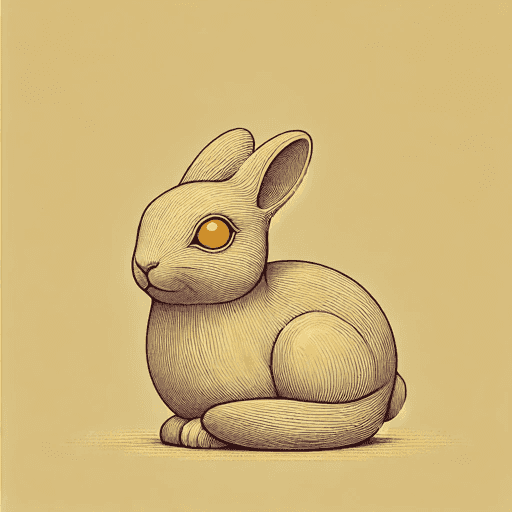
The Hare With Amber Eyes
51 pages • 1-hour read
Edmund de WaalThe Hare With Amber Eyes
A modern alternative to SparkNotes and CliffsNotes, SuperSummary offers high-quality Study Guides with detailed chapter summaries and analysis of major themes, characters, and more.
Part 4Chapter Summaries & Analyses
Part 4: “Tokyo 1947-2001”
Part 4, Chapter 30 Summary: “Takenoko”
When Iggie arrived in Tokyo in 1947, the city was devastated by bomb damage. The Japanese were experiencing poverty and a scarcity of resources as the occupying US forces began the process of reconstruction.
Part 4, Chapter 31 Summary: “Kodachrome”
At age 42, Iggie bought his first home in Japan. The netsuke were displayed in a vitrine, alongside a handful of paintings from the Palais Ephrussi. During Iggie’s regular parties, he encouraged guests to handle and admire the netsuke, and Japanese friends explained the meaning of some of the carvings. For example, the ivory hare is a lunar hare, central to Japanese folklore, and also a sign of the zodiac. When Iggie moved to his second Japanese home, he incorporated an apartment for his partner, Jiro Sugiyama. The couple met in 1952 and stayed together until Iggie’s death.
Part 4, Chapter 32 Summary: “Where Did You Get Them?”
Iggie became a collector of Japanese and Chinese art. An expert assessed the netsuke and confirmed that many were fine and valuable examples of the art, identifying many of their makers.
Part 4, Chapter 33 Summary: “The Real Japan”
By the 1960s, Iggie was fluent in Japanese and felt that he belonged in Tokyo. He became a wealthy businessman and the representative of the Swiss Bank in Tokyo. By this time, his younger brother Rudolf had settled in the US, and his sister, Gisela, was thriving in Mexico. Elisabeth’s son, Victor, was a Church of England priest and university chaplain and had four sons, including the author. Victor’s brother, Constant Henrik, was a London barrister.
In 1972, Iggie and Jiro moved to adjoining apartments and, a year later, finally revisited Vienna. Upon returning to Japan, Iggie adopted Jiro as his son and reverted to his Austrian citizenship.
Part 4, Chapter 34 Summary: “On Polish”
During the 1970s, Iggie numbered and itemized the netsuke. The tiger, crafted by the netsuke master Tomokazu, emerged as the most valuable. Tomokazu was an early 19th-century carver of animal netsuke who once disappeared in the mountains for days to study deer. He often spent up to two months creating a single netsuke.
Part 4 Analysis
In Part 4, the narrative turns from trauma to renewal as the author’s great-uncle creates a new home for the netsuke in Tokyo. Iggie’s restoration of the Japanese carvings to the country of their origin underscores the symbolic meaning of the netsuke as Objects of Memory and Continuity. Against the backdrop of a Tokyo devastated by US bombing, Iggie’s display of the netsuke in a new vitrine is represented as a symbolic act of healing, illustrating the restorative power of art and highlighting vitrines as a symbol in the memoir. Furthermore, the identification of the netsuke makers contrasts with the erasure of identity depicted in Part 3. The story of the netsuke carver Tomokazu, who immersed himself in studying deer before sculpting them, underscores the intertwined nature of artmaking and identity. De Waal’s observation that he instinctively knows Tomokazu studied turtles when he handles one of his netsuke suggests that these works communicate an essential aspect of the artist’s essence. In addition, this anecdote reinforces de Waal’s belief that creating art requires time, care, and patience.
The setting of Japan recontextualizes the netsuke as symbols of cross-cultural exchange. De Waal emphasizes how the Japanese carvings harmonized with Iggie’s “dramatic interior of golden screens and scrolls, paintings and Chinese pots” (354), again invoking the motif of gold. Once fetishized by Charles Ephrussi’s artistic circle as objects of Eastern exoticism, the netsuke “lose their strangeness” and gain realism, becoming “surprisingly accurate renditions” (355) of everyday Japanese items and creatures. In handling the netsuke, Iggie’s Japanese guests reanimate them through their understanding of the carvings’ cultural references. At the same time, the netsuke sat comfortably alongside European paintings that Iggie retrieved from the Palais Ephrussi. De Waal suggests that the comfortable dialogue between cultures in his great-uncle’s home sprang from Iggie’s cosmopolitan background. In contrast to the cultural mimicry that de Waal identifies in the Palais Ephrussi, the décor authentically expressed Iggie’s aesthetic taste.
In these chapters, the author shifts from a focus on cultural heritage and assimilation to the notion of belonging beyond national, racial, or familial boundaries. Iggie, a Jewish Austrian exile and former US soldier, had “the chance to reinvent himself” (371) in Japan and found his spiritual home there. Whereas earlier generations sought legitimacy through assimilation into Europe’s elite, Iggie achieved a more enduring sense of belonging. Discovering a lifelong partner in Jiro, Iggie’s unconventional decision to adopt his lover formalized their bond and ensured Jiro’s legal and familial security. Iggie’s creation of a chosen family mirrored the stability and legacy that the Ephrussi family once represented. Meanwhile, his decision to revert to his Austrian citizenship and become a banker, “a hundred years after his grandfather Ignace opened the bank in Vienna off the Schottengasse” (377), suggests a selective return to his heritage, on his own terms.

Unlock all 51 pages of this Study Guide
Get in-depth, chapter-by-chapter summaries and analysis from our literary experts.
- Grasp challenging concepts with clear, comprehensive explanations
- Revisit key plot points and ideas without rereading the book
- Share impressive insights in classes and book clubs