42 pages • 1-hour read
The Hidden Stairs and the Magic Carpet
A modern alternative to SparkNotes and CliffsNotes, SuperSummary offers high-quality Study Guides with detailed chapter summaries and analysis of major themes, characters, and more.
Important Quotes
“Neal made a face at Eric. ‘That doesn’t sound like much fun.’
‘According to my dad, it’s not supposed to be fun,’ Eric replied. ‘It’s supposed to be done.’”
(Chapter 1, Page 2)
This dialogue between Eric and his best friend characterizes them as typical 10-year-olds. Although they are obedient to the adults in their lives, they still grumble over their appointed chores because they are more interested in fun than in being productive. They are neither exceptionally good nor exceptionally bad, and neither boy is yet unusually mature, capable, or self-disciplined during their time in the “real” world. This characterization is typical for the main characters of a portal fantasy, as such individuals only embrace the potential for internal growth when their external circumstances drastically change.
“Eric smiled. Neal is a true friend, he thought. He’ll even help clean up junk.”
(Chapter 1, Page 3)
Eric’s thoughts about friendship lay the groundwork for the story’s focus on The Importance of Honoring Commitments. In Eric’s mind, a good friend should always commit to standing by one’s side, even in unpleasant situations like cleaning out a basement. Even though Neal soon proves to be less helpful than Eric would like, he does stay rather than going outside to play on his own while Eric is stuck inside finishing up his chores. This dynamic foreshadows the fact that the friends will stick together in the dangerous circumstances that they will soon encounter when they stumble upon the land of Droon.
“Julie stepped into the room and reached for the ball. ‘It’s an awesome secret hideout.”
(Chapter 1, Pages 8-9)
Julie’s optimistic comment characterizes her as a strong-willed, cheerful person who focuses on seeing the best in every situation. Although she has committed to helping Eric with the unenviable chore of cleaning out the basement, her outlook shows that she has an eye for pulling positive results from even the most distasteful of circumstances. This scene also foreshadows the friends’ Chapter 2 discovery of the hidden world of Droon, for Julie has no idea just how “awesome” and “secret” the closet really is, and she does not yet know that the world of Droon will become a monumentally important “secret hideout” for the three friends over the course of the series.
“‘Come on,’ said Eric. He wasn’t sure why, but he felt as if they had to go.”
(Chapter 2, Page 12)
In portal fantasies, the hero or heroes often feel “called” to the adventure that lies before them, even if they do not understand why. This mysterious feeling suggests that the adventure is a manifestation of the hero’s destiny. Eric does not yet realize it, but future installments of the series will eventually reveal that his life has long been intertwined with the history of Droon. For him, entering this mysterious realm genuinely is his destiny.
“Eric stopped. What he saw coming out of the pink mist was not from any theme park he’d ever been to. ‘Uh-oh,’ he gasped.”
(Chapter 2, Page 15)
The short sentence “Eric stopped” conveys the abruptness of his action and implies that intense emotion and urgency is attached to this detail, for something that he sees is clearly surprising enough to halt his progress entirely. The longer sentence that follows builds up the narrative suspense by deliberately employing vague language (“what he saw coming out of the pink mist”) instead of immediately revealing the thing that has caught his attention. By relating Eric’s current circumstances to the fantastical contrivances of a theme park, the narrative also implies that the rules of the mundane world no longer apply, and this impression is further strengthened by the mention of the “pink mist.”
“‘Follow me to the bottom!’ Eric yelled. ‘We can hide in the trees!’ He rushed down, jumping two steps with every jump.”
(Chapter 3, Page 17)
Once the children are fully immersed in Droon’s dangers, Eric finds himself channeling a more heroic side. Forced to adapt to an entirely new world, he takes over as the leader of the group and acts quickly to ensure everyone’s safety. With the use of exclamations and decisive diction like “yelled,” “rushed,” and “jumping,” the author underscores the excitement and danger of the scene and accentuates Eric’s dramatic response to the threats of this world. Eric is clearly concerned not just for himself but for the safety of Neal and Julie, and his instinctive urge to protect his friends in this situation demonstrates his understanding of The Importance of Honoring Commitments.
“Kaww! Kaww! They dived toward him.”
(Chapter 3, Page 18)
The danger that the lizard-riding Ninns represent is conveyed through the narrative’s copious use of onomatopoetic words and short, sharp sentences that emphasize the quick action of the scene. Notably, the sound “Kaww!” is more akin to a bird’s cry and is not a natural sound for a lizard to make. However, the author is drawing upon the common characterization of crows as evil omens, and the unnatural sound contributes to the tense atmosphere of this scene. The sound is also cacophonous—full of harsh consonants—adding to the sense of impending danger.
“‘Tower?’ said Eric. ‘I can’t find any tower. I have to find my friends and get home!’”
(Chapter 3, Page 22)
Eric’s incredulous refusal of Keeah’s initial request reflects the stress he is feeling as he struggles to navigate a dangerous and entirely unfamiliar situation. Additionally, his instinctive response makes it clear that his first obligation is to the two missing friends who accompanied him through the magic portal. In this moment, he is not thinking solely of his own safety; he only wants to return to the Upper World in the company of Julie and Neal. His refusal to help Keeah does not suggest that he is indifferent to her plight; instead, he knows that he must honor his current commitments before making new ones.
“Scour the forest! Burn it down if you must, but find the girl! Find her friends, too!”
(Chapter 4, Page 29)
These bombastic, overblown orders depict Lord Sparr’s status as the leader of the “evil” forces arrayed against Keeah and her allies. The story’s use of exclamation points and short, abrupt sentences convey his angry and determined tone, and his callous willingness to burn down an entire forest in order to locate a few children establish that he will go to any length to get what he wants, even if it means causing massive destruction to living things. The final sentence in this passage also shows that the three friends are now in just as much danger as Keeah. This moment heightens the narrative tension and supports the theme of Joining the Battle against Evil.
“He looked into the forest where he had last seen Keeah. He hoped she was safe. But something told him she wasn’t.”
(Chapter 4, Pages 30-31)
Eric’s concern for Keeah illustrates his compassionate nature. He has every reason to be angry at being drawn into a dangerous conflict that has nothing to do with him, but instead he remains focused on doing what he can to help Keeah. The ominous final sentence of the passage foreshadows the children’s later discovery that Keeah has been captured by Sparr and his forces, and the foreboding tone of the narrative implies that that there is still considerable danger ahead.
“‘We learned about petrified trees at camp.’
‘I don’t remember that,’ said Neal.
‘You were too busy eating snacks,’ Julie said.”
(Chapter 5, Page 33)
Neal and Julie’s quirky exchange stands as a prime example of indirect characterization, for rather than stating that Neal is inherently inattentive and irresponsible, the dialogue describes a situation that shows him demonstrating these very traits. The conversation also implies that the conscientious Julie feels superior to Neal because she is more attentive and responsible. Her good-natured teasing lightens the tone of the narrative and reinforces how different the two friends are.
“Old leather books were stacked up everywhere. Hundreds of tiny bottles were collecting dust on deep wooden shelves. A big, ancient mirror leaned against one wall.”
(Chapter 5, Page 36)
Although Neal jokes that Galen’s tower room is similar to Eric’s parents’ basement, the only real similarity is in the level of clutter that the two spaces show. Neal’s comment ironically draws attention to the key differences between the magical world and the children’s mundane origins, for unlike the basement in Eric’s house, Galen’s room is littered with the arcane detritus of wizardry, and the setting therefore enhances the story’s focus on Escaping the Mundane World and Embracing New Growth.
“I cast them to the winds to change their shapes. No one knows what they have become.”
(Chapter 6, Page 45)
Galen’s explanation of his enchantment of the Three Powers provides crucial exposition that helps the children understanding how Keeah can be in possession of the Red Eye of Dawn without knowing it. His words also add to the magical, mysterious atmosphere of the story, creating a sense of anticipation that will only be fulfilled by the future installments in the series, in which The Golden Wasp and The Coiled Viper—the two remaining objects—will take center stage.
“‘Wait,’ Eric turned to his friends. ‘Keeah helped me in the forest. And she was going to get us home. Now she’s in trouble. I mean, we have to help her.’”
(Chapter 6, Page 46)
As Eric urgently calls his friends to action, his determination shows his commitment to doing the right thing and helping those who have helped him. He feels obligated to come to Keeah’s aid because she healed his ankle and promised to see him safely home again at the conclusion of their bargain. Now, with this bargain fulfilled Eric ignores the fact that he could rightfully ask for Galen’s help in returning home, and he instead commits to further adventures and dangers in Droon. The italicization of the word “have” indicates Eric’s belief that his obligation to help Keeah is a fact as immutable as gravity.
“It was an animal the size of a horse. But with long white fur. And six legs. And a friendly face. It looked like a shaggy camel.”
(Chapter 6, Page 47)
The description of Leep combines familiar elements—“the size of a horse,” “long white fur,” “a friendly face,” “like a shaggy camel”—to create an entirely unfamiliar picture of the fantastical pilka. The unusual detail of the pilka’s six legs contributes to this unusual picture, and the Droon inhabitants’ casual acceptance of the pilka conveys the idea that everything about this world defies the norms that Eric and his friends are accustomed to in their own world.
“When you return home, tell no one about us. Also, you must not take anything from Droon with you, nor leave anything from the Upper World behind.”
(Chapter 7, Page 49)
Galen’s warnings to the three Upper World children contribute to the author’s broader efforts at world-building, for these stern “rules” will dictate the children’s conduct in Droon during all of their visits to this fantastical world. Galen’s warning about not leaving anything in Droon or taking anything back to the Upper World are also important plot points in this first novel, and for the first time, the children realize that they must leave the invisibility cloak behind and retrieve their missing soccer ball.
“The high black walls of a large city loomed before them. The sky was thick with clouds. The air smelled of smoke.
‘Let me guess,’ Neal said. ‘This is Plud.’”
(Chapter 7, Page 52)
The name Plud, which rhymes with dull words like “mud” and “thud,” carries implicitly unpleasant and ominous connotations. As the descriptions of clouds and the oily smell of “smoke” contribute to this effect, this new setting and Neal’s flat statement suggest that this area is aligned with the forces of evil, darkness, and destruction. Notably, the sky is no longer bright and pink, as it is in the rest of Droon, and because it is now “thick with clouds” that obscure the light, the atmosphere itself breathes out notes of pure darkness.
“Sparr laughed. ‘Neither your father nor your mother will ever see you again.’
‘My mother died,’ Keeah said. ‘And my—’
The sorcerer smirked. ‘Your mother is—’ Then he stopped. His eyes flashed.”
(Chapter 8, Page 59)
This exchange between Keeah and Sparr is the first hint that Queen Relna is not actually dead, as Keeah believes. However, Sparr breaks off just as he is about to reveal an important piece of information, and his physical reaction suggests that he knows all about Queen Relna’s fate. This moment of uncertainty creates a note of tension that will not be resolved in this particular installment. The exchange therefore sets the stage for future conflicts and adventures in Droon, foreshadowing the revelation in later books that Relna has been transformed into the white falcon that follows Keeah from place to place.
“At once the pouch began to shrink in Sparr’s palm. It shriveled to the size of a small egg.
Then it turned very smooth.
Then it turned red.
It began to glow.”
(Chapter 8, Page 60)
The transformation of the pouch into the Red Eye of Dawn is conveyed in a series of short sentences, each isolated on its own line. This stylistic placement ensures that each detail receives considerable emphasis, stressing the surprise of the characters and the significance of this moment to the broader arc of the series.
“Then the sorcerer spoke words that turned their blood to ice.
‘I…know…you…three.’”
(Chapter 8, Page 60)
The metaphor of the children’s blood turning to ice conveys the emotionally “chilling” effect of Sparr’s words. They are terrified to learn that he knows who they are and where they come from, because his pronouncement implies that he might be a threat to them even in their own world. The ellipses between each word show how slowly he utters this sentence, and the menacing tone that results is meant to support the idea that he presents a clear and present danger to the children.
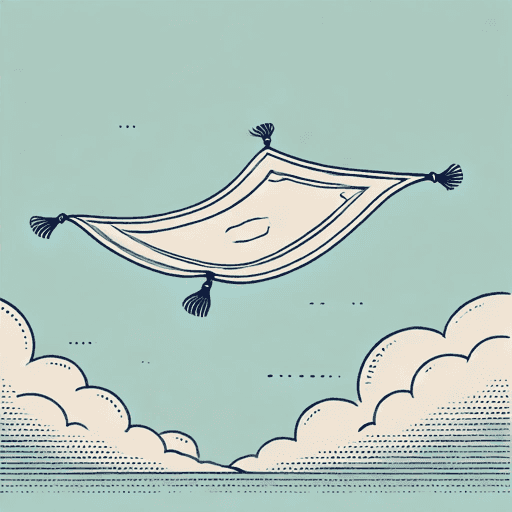
“Julie read the label. ‘It says, “Rugs by Pasha. Do not remove this tag.”’”
(Chapter 9, Page 67)
The magical rug that Keeah points out contains a warning against removing its tag, just as many home goods in the “real” world do. These tags are often considered pointless because they insist upon intrusive rules that cannot be enforced. This detail is aligned with the author’s commitment to creating a humorous tone and drawing whimsical parallels between Droon and the real world.
“Kkkrrkk! The door started to splinter.”
(Chapter 9, Page 67)
The use of onomatopoeia and cacophony in this passage vividly portrays the children’s terror in the moment when the door begins to give way. These details stress the action-focused nature of the scene, suggesting that their window for escape is rapidly closing.
“Keeah laughed. ‘The carpet must like your voice. Pasha’s rugs don’t fly for just anybody.’”
(Chapter 9, Page 68)
Keeah is surprised that the magic carpet responds to Julie because even in Droon, the carpets do not obey just any user. This moment hints that Julie has an innate connection to the land of Droon and is destined to do many important things in this fantastical setting. The text also hints that Julie may have some magical abilities of her own—an idea that is explored in more depth in future installments of the series.
“Eric turned to Keeah. ‘Galen was right. We did enter a world in trouble.’
Keeah nodded. ‘But a world with hope, too. Thanks to all of you, I can keep fighting Lord Sparr.’”
(Chapter 10, Page 75)
Earlier in the story, Galen’s description of Droon as “a world in trouble” was a reference to Lord Sparr’s evil attempts to take over the kingdom by attacking good people like Keeah and King Zello. Now, Keeah makes it clear that the efforts of the Upper World children have been instrumental, and she is grateful that they have committed to Joining the Battle against Evil in Droon.
“Neal studied the words. ‘It says, “Your dreams will tell you to return.”’”
(Chapter 10, Page 79)
The novel concludes with the three Upper World children reading Keeah’s magical message, which promises them a return to Droon. The appearance of this enchanted message on the surface of their soccer ball unites the two realms in one object, symbolically suggesting that Eric, Neal, and Julie will be able to enjoy the best of both worlds.

Unlock every key quote and its meaning
Get 25 quotes with page numbers and clear analysis to help you reference, write, and discuss with confidence.
- Cite quotes accurately with exact page numbers
- Understand what each quote really means
- Strengthen your analysis in essays or discussions